
How to Read a Roofing Slate Test Report: The Six Rows That Carry the Whole Verdict
The sixty-second version: a slate test report is a short story about one batch of stone, and it only has six plot points — the water absorption, the flexural strength, the freeze–thaw result, the chemistry, the thickness control, and the batch number that ties the paper to your container. Read those six rows and you know what the stone is. Read them crosswise — checking the numbers against each other — and you know whether the report is even true. This article walks you through each row, then shows you the four ways the numbers quietly don't add up.
Part of the Roofing Slate Guide's Quality, Testing & Standards section. It follows our EN 12326 explainer and the ASTM C406 explainer — those pages decode the standards; this one decodes the piece of paper you actually get in your inbox.
Picture the scene: a container arrives in Manchester, and the buyer walks around the opened door holding a three-page PDF printed on A4. The pallets are shrink-wrapped, the strapping is tight, the tiles look exactly like the sample he approved. He hands the report to his colleague, who squints at it and says the same sentence every importer has said at least once: "so… is this good?"
The honest answer is: the report is never good or bad by itself. It is good or bad compared to what you ordered, and compared to what the rest of the report says. A real lab report can condemn a container just as surely as a forged one — not because the test failed, but because the buyer didn't know which numbers to compare. This page fixes that.
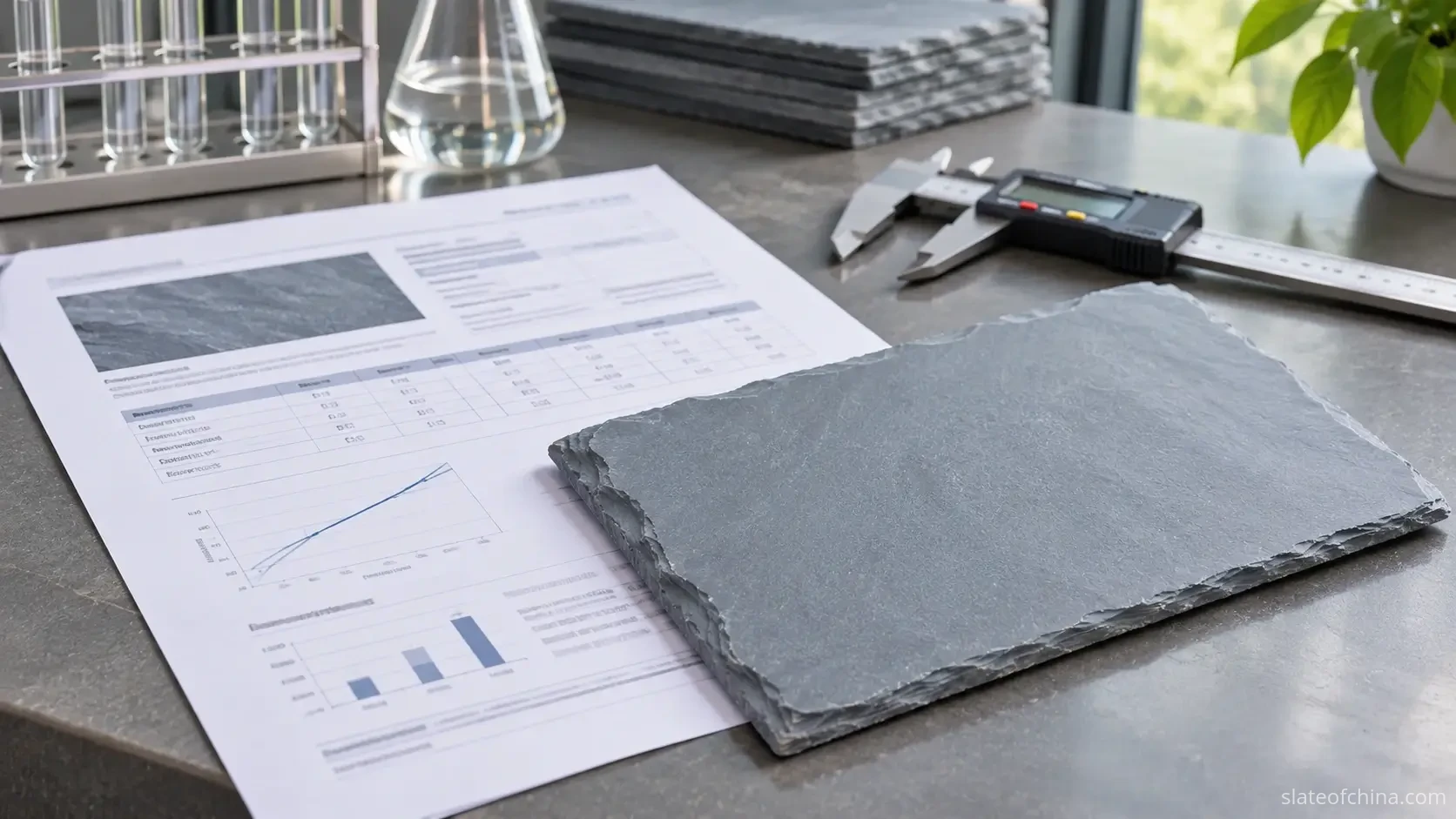
Row one: the header — read the batch before you read anything
Before any number, check the frame. A legitimate report names five things in its header block, and the absence of any of them is a reason to slow down: the testing laboratory (with its name and reference), the standard tested to (EN 12326-1, ASTM C406, or both), the sample description (slate type, size, thickness), the test date, and — the one most buyers skip — the batch or lot number.
That last line is the thread that ties the paper to the stone. A report without a batch number is a statement about a slate; a report with your batch number is a statement about your slate. A surprising share of purchase disputes start with a report that is genuine, honest and entirely irrelevant, because it describes a different season's production than the pallet you are checking.
Rows two and three: water absorption, and why it ranks first
The absorption row tells you how much water a dry slate drinks after a soak, as a percentage of its own weight. It is the closest thing the slate trade has to a single screening number, because absorption decides how much water a winter has to work with inside the stone. Our own explainer on water absorption goes into the full two-day lab routine; the row you want on the report is the apparent absorption value in %.
As a practical benchmark: below 0.6% falls in the top EN water-absorption class (W1 in the current EN 12326 classification); below 0.25% clears the American S1 gate; and the stone we quarry in Lushan sits around 0.2%, which is the same story in either standard. Water absorption is an important screening indicator, but it is not a standalone durability verdict on its own — a single percentage line should be read together with the frost, flexural-strength and chemistry rows, and with the climate the roof will actually sit in. A figure above 1% is a serious warning flag: it means the stone drinks enough that frost has water to work with, and it should push you to look hard at the freeze–thaw row and the batch before you judge the stone by this line alone.
Rows four, five and six: strength — and the thickness that changes its meaning
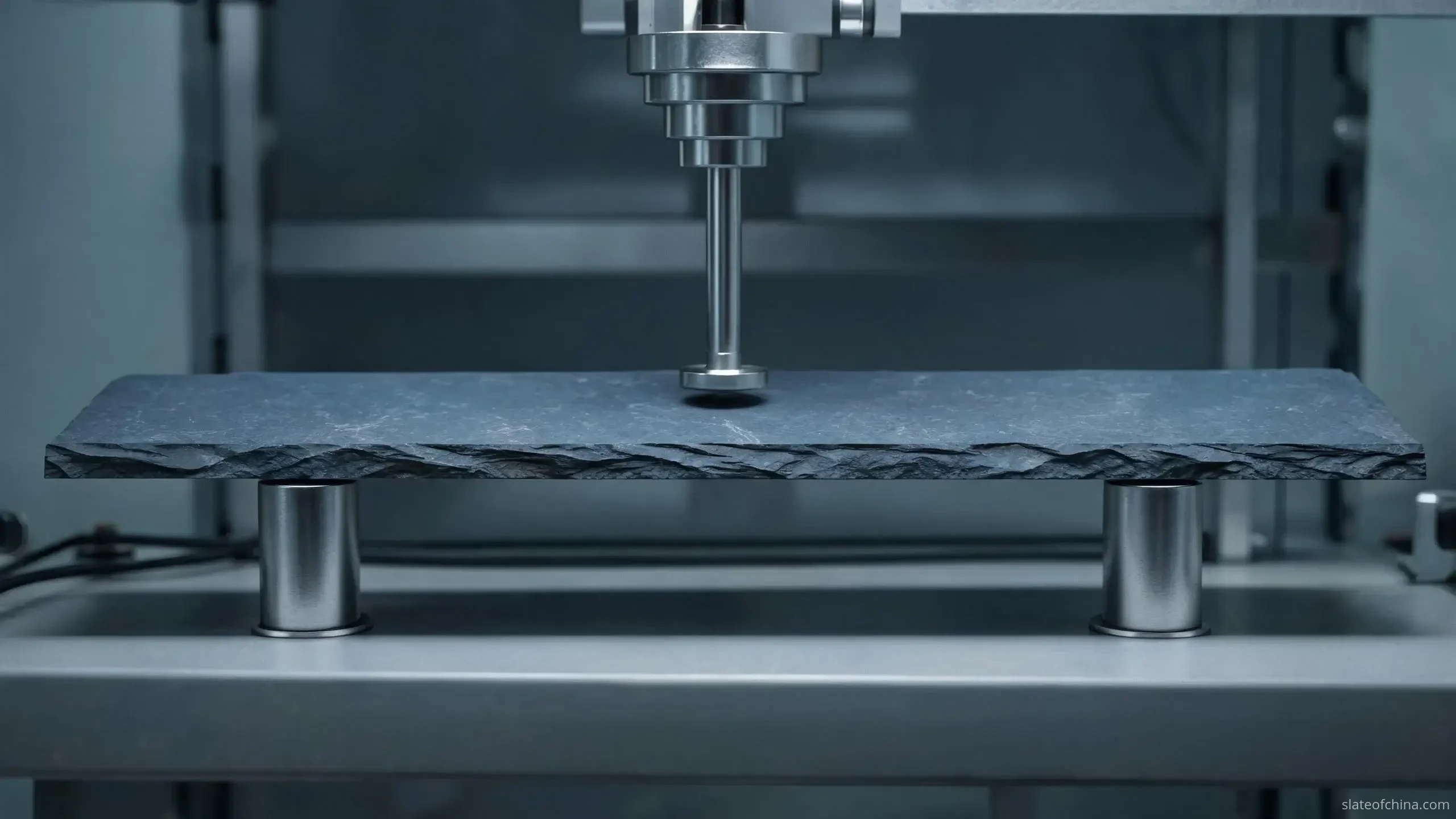
Strength appears on a report under a few names — breaking load, flexural strength, modulus of rupture. They are cousins, not twins: breaking load is the raw force in newtons or pounds that snaps the sample; flexural strength and modulus of rupture re-state that force per unit of size and thickness. Different standards slice the same event differently, which is why our flexural strength page treats them as two numbers asking one question: will it stay whole when it has to?
Here is the reading trick that catches more wrong reports than any other: strength only means something in the context of thickness. Slate thickness can shift the measured breaking load under a given test set-up — a thicker tile generally breaks under a higher load than a thinner tile of the same stone. But flexural strength is a calculated material property that accounts for the specimen geometry, so the two numbers answer different questions. Before comparing two reports, check the test method, the sample dimensions, the loading arrangement and the reported units. Our Lushan material has submitted a flexural value around 60 MPa in its test data — an example figure to verify against the full report, not a number to set against an ASTM C406 grade directly, because that grading runs on absorption and a separate breaking-load requirement rather than on a stress figure in MPa.
The freeze–thaw row: what to notice before the number
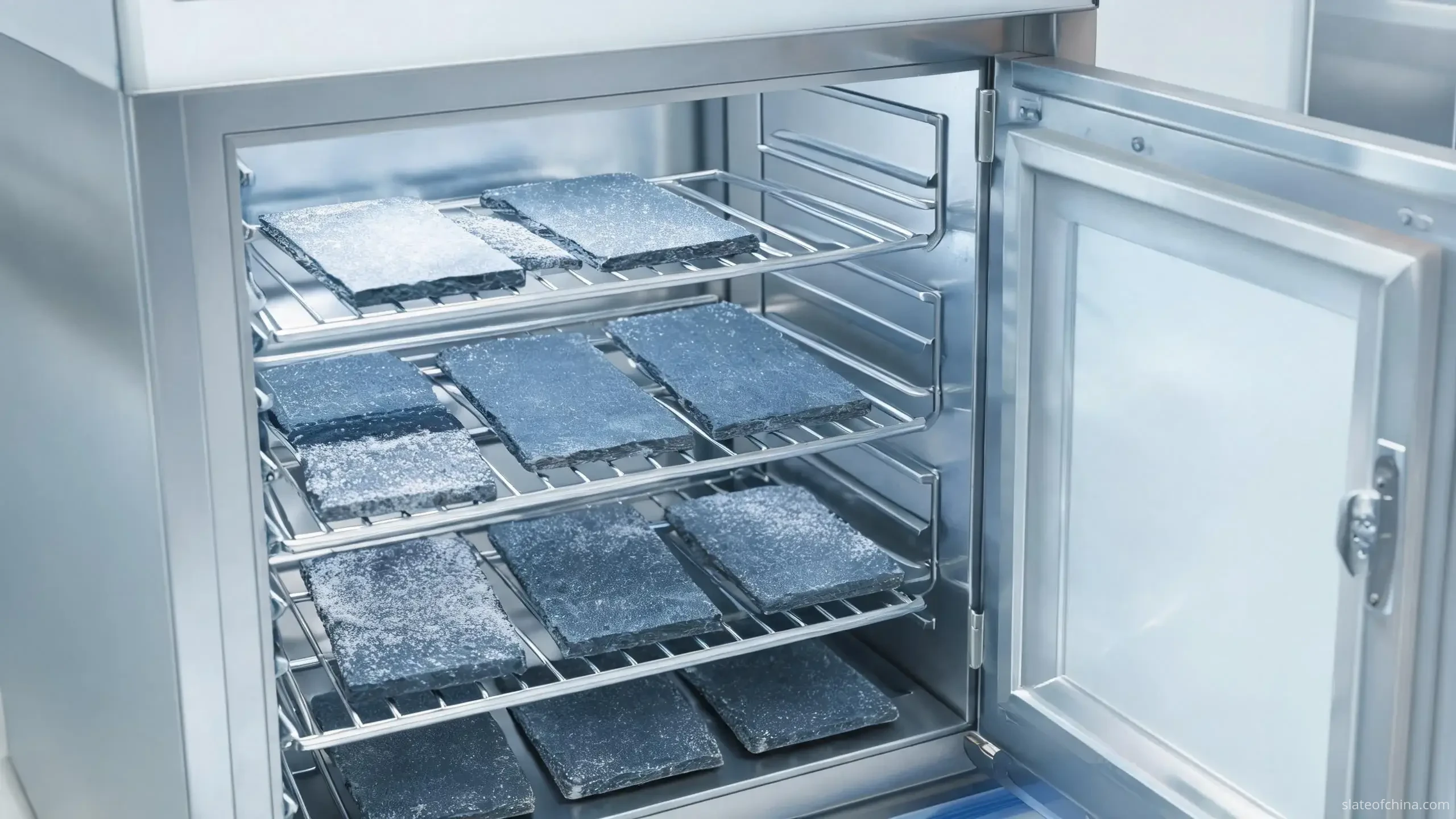
Freeze–thaw is the test that decides a cold-climate roof. The lab saturates samples with water and cycles them between deep freeze and thaw, then weighs them looking for loss. Two figures matter on this row: the weight loss (you want 0.0%, or near it) and the cycle count. The cycle count is set by the standard and test method named in the header of your report — it is not a single universal number, so read the count together with the method rather than assuming one global figure. A report that says "freeze-thaw tested" without a cycle count is a report that hasn't finished its sentence — and our full freeze-thaw explainer has a home-freezer screening test you can run yourself on any sample.
For our own material, an extended freeze–thaw protocol has carried the stone to 120 cycles with zero measurable loss, with that report available on request — a long-lived roof in a cold climate is exactly where a generous margin on this row shows its worth. The point of reading the margin is that a number that survives well inside the cycle that your own report sets is the shape of a slate that can sit in a frozen climate for decades.
The chemistry rows: carbonate, sulphur, iron — the quiet arithmetic
Some reports include a chemical block, often near the back: carbonate (CaO), sulphur (SO₃), iron oxide (Fe₂O₃) and friends. These numbers are boring until the day they aren't. Carbonate is the mineral acid rain eats first; a stone that fizzes under a drop of dilute acid is a stone whose edge can slowly erode over decades, and the chemistry behind it is unpacked in our carbonate explainer. What matters is to read the row for what it is being named: CaO is an oxide value from chemical analysis, not necessarily the same figure as a direct carbonate test. A common working reference in European specification is carbonate below about 5%, but the applicable limit depends on the standard your report cites, so confirm the parameter and the version before treating any single number as a universal gate. Our Lushan slate reports CaO around 0.56% in its chemical block — a low value on that oxide row, and a useful example to verify against the report's stated standard.
The last row on the page: thickness tolerance — where CNC hides
Most buyers never glance at this block, and it is one of the biggest tells of a professional producer. The report will give the nominal thickness and a measured range. The tighter the range, the more controlled the process: a CNC-dressed slate holds around ±0.5 mm, while hand-split material drifts by a millimetre or more. A tight thickness row is the print the quality of the rest of the operation — it says the factory measures what it makes. It is also the row that, on site, protects the installer from a wall that was pitched for 6 mm and received a mixed bag from 4 to 8. Read this row as a process-control and dimensional check, and don't convert it into a strength verdict — strength is the calculated property in the rows above, not a number you infer from a thickness range.
The part nobody warns you about: four ways the numbers don't add up
A good report is internally consistent. A suspicious one trips over its own arithmetic. In practice, four disconnects are where a report's story breaks:
- 1. A grade that doesn't match its own absorption. The report's summary line says "S1" but the absorption row shows 0.9%. The standard never says this — the two columns contradict each other. Either the summary is a sticker or the sample was swapped. The fix is easy: keep reading past the verdict, at least to the numbers that justify it.
- 2. Strength without thickness. The modulus row shows a healthy number but no sample thickness anywhere in the document. That is not a measurement — it is a fact that refuses to be checked. Always match the strength to the thickness row before you believe it.
- 3. "Tested" without a cycle count. A freeze-thaw row that says "passed" but omits how many cycles — a common short-hand that means the stone was cycled for one winter, not fifty. The cycle count is the honest currency; demand the currency.
- 4. A date that makes the paper irrelevant. The report is beautiful, the batch number is present — but the test date is three years old, or the batch number doesn't match the number on the packing list. Paper tells a story, but a report is only a fact if the story is your story.
The three-minute reading you can do right now
Forget the lab jargon. When the next report lands in your inbox, run the six-line pass:
- Header — laboratory, standard, sample, date, and a batch number you can trace to your order.
- Absorption — the % itself. Below 0.6% EN water-absorption class W1, below 0.25% the US S1 gate, our Lushan around 0.2%; read it with the frost row, not alone.
- Strength — flexural or modulus, the thickness of the sample on the same line, and the unit (MPa and psi are stress units; lbf is a force unit).
- Freeze-thaw — weight loss plus a cycle count set by the method named in the header, not an assumed universal number.
- Chemistry — the oxide row (CaO, SO₃, Fe₂O₃); carbonate by the standard your report cites; a fizz test in the yard as a quick screen.
- Verdict vs numbers — cross-check every rating against its own rows. If they disagree, the paper is a sales sheet.
That pass takes three minutes and it will outlast any vendor's PowerPoint. And when you find a producer whose report is consistent six rows deep — whose test results are public, whose batches are numbered, whose numbers you can follow from the quarry shed to a pallet — you have found the supplier everyone else is looking for. That's what a quality evaluation eventually reduces to: trust, but verify — and verification is nothing but reading the numbers in order.
Questions buyers ask most
How do I know the report belongs to my batch — not the brochure batch?
Look for the batch or lot number in the header and compare it with the packing list of your container. Ask for the production date and the test date side by side: a report that names the same batch and a recent date is a statement about your stone. A report that names no batch is a statement about some stone — and that is not your business document.
What if the report is in a language I can't read, or uses units I don't know?
Check the units before you compare. MPa and psi are stress units (force per area); lbf is a force unit — they are not interchangeable. Note the unit and the test method together, and any laboratory that issues a real report will send an English edition or a translation key on request — a serious supplier treats translation as routine. The reading method is identical: find the six rows, read them in the order above, and cross-check the verdict against the numbers.
If I only check one number, which should it be?
Water absorption is the usual first choice. It is the quiet engine of a slate's future: the less the stone drinks, the less frost has to work with, the longer the roof lives. On the report it is one small percentage — and a report with an absorption below 0.6% and a batch you can trace is already the shape of a good deal. That said, absorption is a screening shortcut, not a standalone verdict: pair it with the frost row, the flexural value and the climate before you finalise. If you're buying for a natural slate roof, ask to see that row before you discuss the price.
Keep Reading
Ask to see the report — before the price.
We believe roofing slate quality should be supported by verifiable test data. Buyers can request available laboratory reports, product specifications and batch-related quality documentation for review before placing an order. Additional testing requirements can be discussed according to the project specification.
Request the Test Report