
How Much Slate Fits in a Shipping Container?
The short answer: it depends on which ceiling the load hits first — weight or cube. Architectural slate of the same density loads very differently by product family: a 20ft container carries roughly 620–890 m² of thin 10–12 mm floor tile, about 390–590 m² of 15–20 mm tile, about 260–440 m² of 20–30 mm paving, and as little as 195–350 m² of 30 mm heavy slabs — before packaging, crate mass and route limits are subtracted. The same box, three very different answers, and the reason is pure geometry times density. This page shows you how to work the two ceilings out for the product you are buying, so no one's estimate is a pleasant surprise.
Part of the Architectural Slate Guide's Buying & Shipping section — the arithmetic companion to how the crates are built, and the slate-loaded half of the story whose density lives in the slate density guide.
Ask a supplier "how many square metres fit in a container?" and you will get a number. The number is rarely wrong, but it is rarely useful either, because it assumes a product, a thickness, a pack method and a route that may have nothing to do with your order. The useful question is not "how much fits" but "which ceiling does my load hit first—weight or cube?" Answer that, and the square-metre figure stops being a guess and becomes arithmetic you can check in about four minutes.
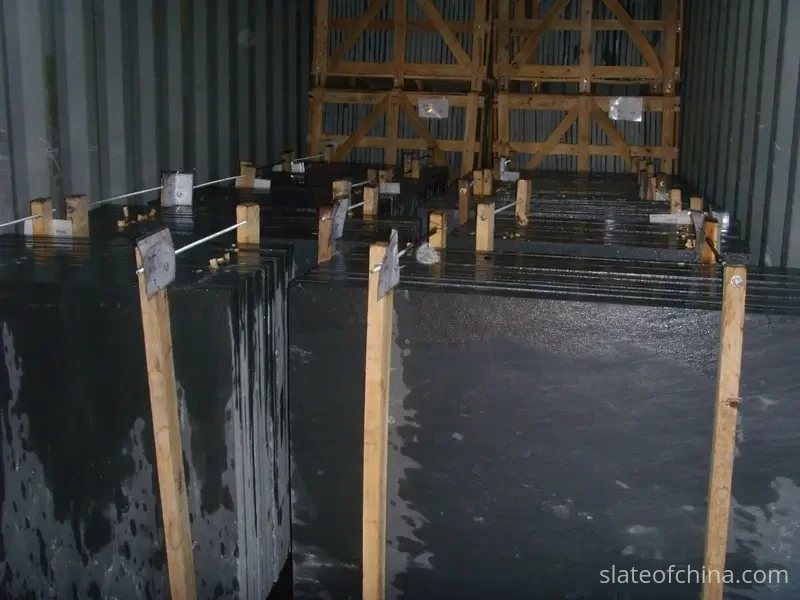
Two Ceilings, One Container: Weight and Cube
A freight container is not a room that holds a pile of stone. It is a box with two separate ceilings, and you hit one of them long before the other. Every "how much fits" question in this guide is really a question about which ceiling your product reaches first.
- The weight ceiling. The box can carry only so many tonnes. The limit is set by the container's rated maximum gross mass and payload, the road and rail limits on the route, and the shipping line's own figures—not by a single universal number. A heavy slate product reaches this ceiling before the box is full of air. Most thick paving, cladding and large-format slabs do.
- The cube ceiling. The box has a volume, and a light or thin product can fill that volume before it reaches the weight limit. Thin 12–15 mm interior tile, and any product packed so it uses the box's height efficiently, tends to land closer to this ceiling. Cube is the ceiling thin slate trips over.
The whole trick of the trade is knowing, before you book, which one applies to your order. The arithmetic below gives you the tool; the product table gives you the starting point.
The One Rule That Does All the Work: Density × Thickness = Weight per m²
Slate weighs about 2,700 kg per cubic metre as an illustrative working figure—the density guide explains what that does and does not mean. Every millimetre of thickness adds roughly 2.7 kg per square metre. So:
- 10 mm slate ≈ 27 kg/m²
- 12 mm slate ≈ 32 kg/m²
- 15 mm slate ≈ 41 kg/m²
- 20 mm slate ≈ 54 kg/m²
- 25 mm slate ≈ 68 kg/m²
- 30 mm slate ≈ 81 kg/m²
That little table is the engine of every estimate. It assumes a nominal density of 2,700 kg/m³; the real figure for a given source and finish should come from your supplier's measured values, not from this guide. But as a first pass, thickness times 2.7 tells you the tonnes your slate will weigh, and that immediately tells you which ceiling you are near.

By Product Family: How Much Fits in a 20ft
The table below is illustrative. It assumes a nominal density of 2,700 kg/m³, net slate m² before crates and packaging, and a 20ft container loaded to a typical working payload around 21–24 tonnes of net stone, leaving a margin under the box's rated limit. Actual figures depend on the real thickness, the measured density, the pack method and the route—so treat these as a sanity check, not a promise.
| Product family | Typical thickness | Weight per m² (≈) | ≈ m² in a 20ft | Which ceiling |
|---|---|---|---|---|
| Thin floor tile | 10–12 mm | 27–34 kg/m² | ≈ 620–890 m² | Weight-first (approaching) |
| Mid floor tile | 15–20 mm | 41–54 kg/m² | ≈ 390–590 m² | Weight-first |
| Wall cladding | 12–20 mm | 34–54 kg/m² | ≈ 390–700 m² | Weight-first |
| Paving slab | 20–30 mm | 54–81 kg/m² | ≈ 260–440 m² | Weight-first |
| Heavy slab / large format | 25–40 mm | 68–108 kg/m² | ≈ 195–350 m² | Weight-first, cube-limited by size |
You will notice a pattern: for almost every architectural slate product, the weight ceiling comes first. The only place the cube ceiling really bites is very thin, or very large, or very light — and even then it is a second-order limit. That is the fundamental difference between this slate and, say, a low-density ceramic: slate is a weight cargo. When you are told "this box holds 800 m²", the number is almost always a weight-derived number, not a volume one.
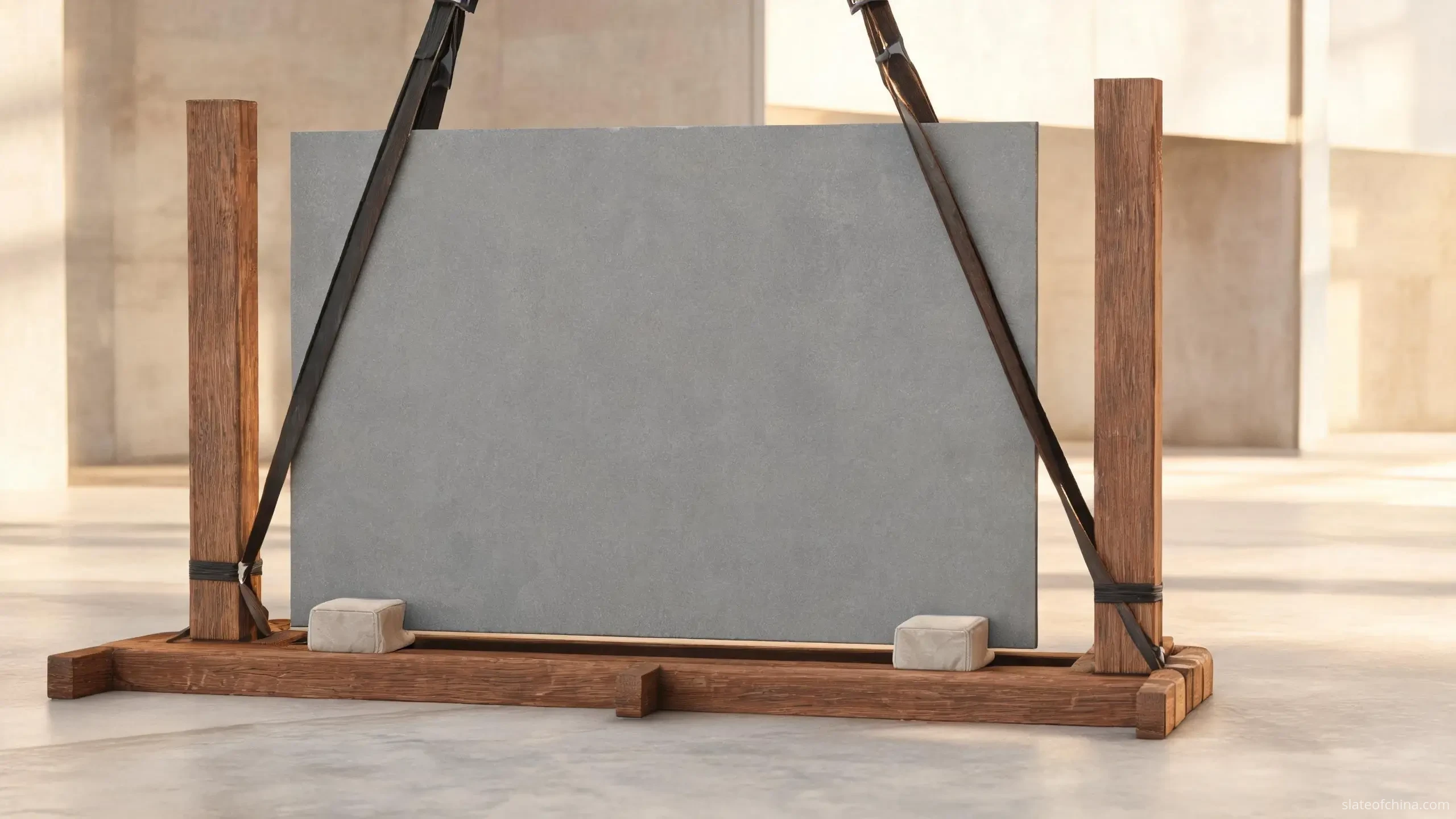
20ft vs 40ft: A Longer Box Doesn't Carry More Slate
Here is the counter-intuitive rule that saves more than freight: a 40ft container has roughly twice the volume of a 20ft, but very little more weight capacity. Its rated payload is typically only slightly higher than a 20ft box's, not double. Since architectural slate is a weight cargo, a 40ft box usually carries only a modest number of extra square metres over a 20ft—the extra cube is mostly air.
The genuinely useful case for a 40ft is when the piece size needs it: a very long, or very wide, large-format slab that physically will not lie across a 20ft floor. Choose the box for the piece, not for the m². If you are buying ordinary 600×600 or 300×600 formats that pack efficiently in a 20ft, the extra length of a 40ft buys you almost nothing in slate, and you pay for the extra route. The large-format guide covers which pieces genuinely need the longer box.
The Route and Load Caveats Every Estimate Carries
A m² figure is only as good as the assumptions beneath it. Before you let it drive an order, check these:
- The container's rated limits, not a default number. A "27.5-tonne payload" is a starting figure for a typical 20ft, not a universal ceiling. The real limits are on each container's data plate and in the shipping line and road limits for the actual route. Net weight, packaging weight, the container's tare, the maximum gross weight and the verified gross mass (VGM) are distinct figures; the loaded weight is verified against the real plate and the carrier's requirements before the doors close.
- Net m² ≠ loaded m². Crates, dunnage, corner protection and separators all take up weight and some cube. The net m² table above is before the pack; the loaded m² is what survives. Ask for a pack-inclusive figure.
- Shared containers. In a less-than-container-load (LCL) shipment, your share of the box is a volume-and-weight allocation, not a floor plan. The "how much fits" answer for an FCL and an LCL are different animals.
- The actual density. 2,700 kg/m³ is illustrative. A dense, heavy production runs higher; a light bed runs lower. The single biggest correction to any estimate is replacing the nominal density with the supplier's measured weight per m².
The result: never ask a supplier "how many square metres fit in a container" in a vacuum. Give them the product family, the thickness, the finish and the destination, and ask for a weight-based m² estimate plus a verified weight plan. That is the number you can plan on. Our buying guide covers what else belongs in that first enquiry.
Worked Example: A Slab of Paving
Say you are quoting 600 × 600 mm paving, 20 mm thick, to a 20ft container.
- Thickness 20 mm × 2.7 ≈ 54 kg/m².
- One slab is 0.36 m², so one slab ≈ 54 × 0.36 ≈ 19.4 kg (before rounding).
- A 20ft with, say, ~22 tonnes of net stone: 22,000 ÷ 54 ≈ 407 m² → at 0.36 m² per slab, roughly 1,130 slabs before crates.
- Subtract packaging and crates: realistically 350–420 m² loaded. That is the number you plan with.
Run the same thickness into a 40ft and you add only a little m² — because the weight, not the volume, did the work. Confirm the actual measured thickness and density with your supplier before you treat the number as firm.
FAQ: Container Loading for Paving and Cladding
How much slate fits in a 20ft container?
As a first arithmetic step, for architectural slate it is roughly the container's net payload divided by your slate's weight per m² (thickness in mm × ~2.7 kg/m², at a nominal 2,700 kg/m³ density). Thin 10–12 mm floor tiles run to roughly 620–890 m²; 15–20 mm tile to roughly 390–590 m²; 20–30 mm paving to roughly 260–440 m²; heavier 25–40 mm slabs to roughly 195–350 m². All figures are illustrative before packing and should be confirmed with the actual production and pack.
Why do different slate products carry such different m² per container?
Because the same box has a weight ceiling and a cube ceiling, and slate is a weight cargo. A thin tile weighs little per m², so a box can hold many square metres before hitting the weight; a thick slab weighs a lot per m², so the same box holds far fewer. It is not about size, it is about thickness × density.
Is a 40ft container better for slate?
Usually not for square metres. A 40ft has about twice the cube of a 20ft but only slightly more payload, and since slate is weight-limited, the longer box adds little m². It earns its place when a piece is physically too large for a 20ft floor — very long or very wide large-format — or when the route genuinely needs the extra length. Otherwise the extra freight is spent on air.
Which is more important for slate, the weight ceiling or the cube?
For almost all architectural slate, the weight ceiling is the binding one. The cube ceiling matters only for very thin, very light or unusually large pieces. That is why a supplier's "m² per container" figure is really a weight-derived number, and why you should always ask for the weight—not the cube—when you verify a quote.
Should I trust a single m² number from a supplier?
Not alone. The number is only meaningful with the product family, thickness, finish and destination attached, and it should be presented as a weight-inclusive estimate, net and loaded. Ask the supplier for the actual kg/m² of the production and a pack-inclusive m² for the container; a real figure, confirmed against the rated payload and route limits, is the one worth planning on.
What is the VGM and why does it matter for slate?
The verified gross mass (VGM) is the packed container's total mass—container tare plus all cargo, packaging, dunnage and securing—required for sea shipments. Because slate is heavy, the VGM must be established by weighing the packed container or an approved calculation, and it stays under the container's and the route's limits. Getting it wrong at the port is exactly the cost a good weight estimate avoids.
Get the Weight Right Before You Book the Box
We work the container arithmetic for each order before anything ships: the density, the thickness, the pack-inclusive weight and the route limits. Send us the product, the size and the destination, and we will confirm which ceiling your slate hits and how many m² that really means. Request a container estimate · browse the paving range