
OEM and Private-Label Stone Supply: How a Custom Order Changes the Drawing, the Sample and the Inspection
Quick answer. A standard wholesale order buys a slate size. An OEM order buys an approval. When you custom-size, custom-pack and put your name on natural slate, the work shifts from the warehouse to the drawing, the sample and the inspection line — three documents that now carry the whole order. This guide walks each one, in the order you should approve it.
A stone importer, a building-material brand or an architectural supplier usually starts the same way: pick a colour, ask a price. For stock slate that is enough. The tile is 600 × 400 × 20, the cleft face is standard, and the carton has the mill's name on it. You buy a size.
An OEM order is different. The size is yours, the edge is yours, the packing list is yours, and the crate mark is yours. Somewhere between the enquiry and the container, a drawing has to be approved, a sample has to be signed off, and an inspection has to be run against that drawing, not against "good quality". A standard order buys a size; an OEM order buys an approval, and an approval has to live somewhere. This guide keeps the whole file in order so the approval lives on paper, before the stone moves.
The Drawing Opens the Order
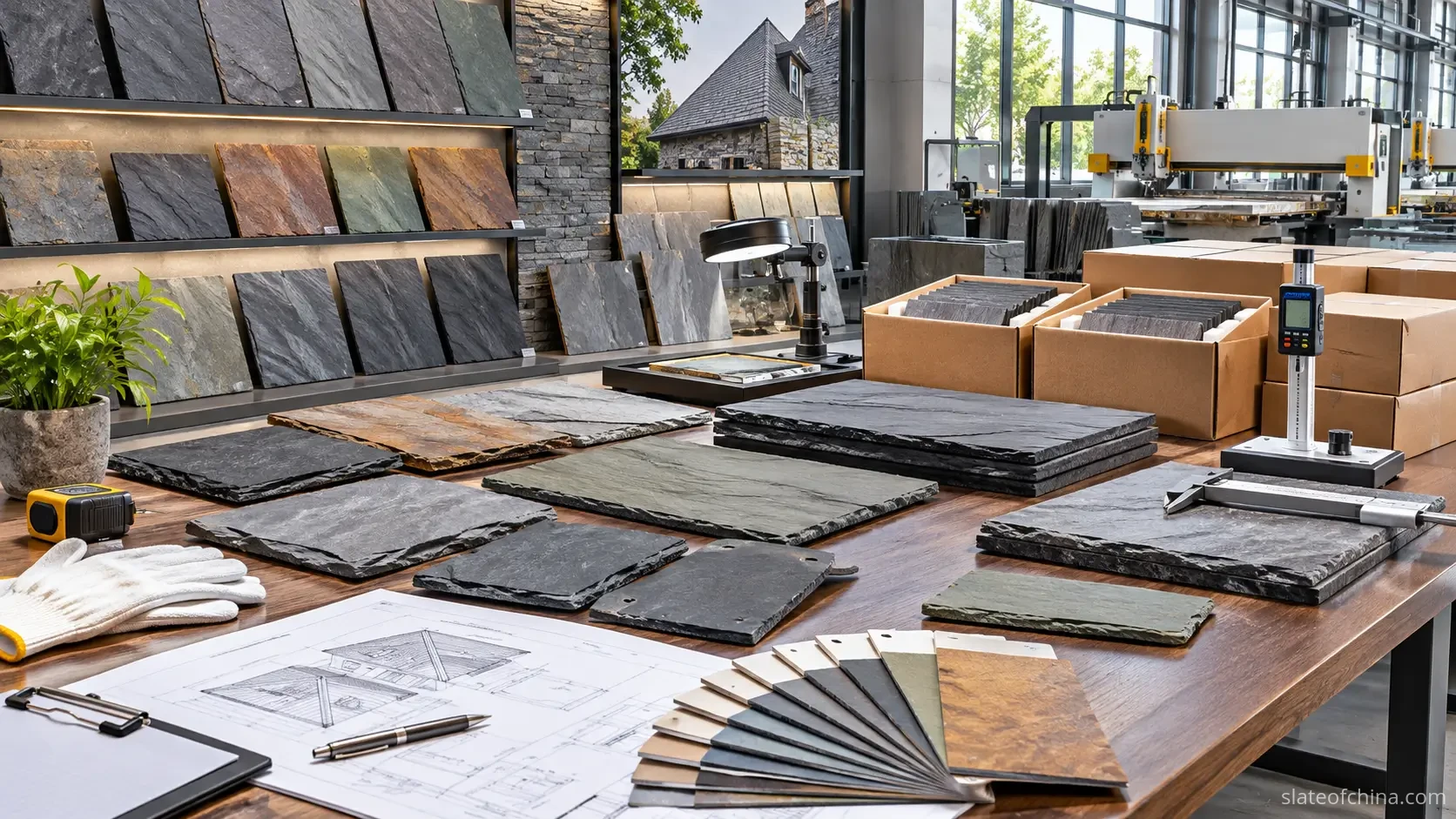
Before any stone is cut, the OEM slate drawing is the first document that has to be right. A quotation that reads "slate treads, 1200 × 350 × 30 mm" is not a specification. It leaves the questions that decide the cost and the delivery time unasked.

Is 30 mm a nominal thickness or a finished thickness? Is the top face naturally cleft or calibrated? Is the front edge sawn, eased or bullnosed? Does the piece need fixing holes, a support detail, a chamfered corner? Two suppliers can quote identical headline dimensions with completely different fabrication — and completely different prices — if these are left open. That is why an architectural slate wholesale buyer treats custom slate sizes as a specification, not a number on an order line.
So a capable OEM natural slate manufacturer asks for one thing first: a drawing or a written technical specification. It does not have to be a CAD file. A clear sketch with the finished length, width, thickness and their tolerances, the surface and edge, the hole and slot positions, and the grain direction, is enough. What matters is that the workshop and the inspector read the same drawing.
Practical buying tip: keep a single approved revision. When a change is agreed by message, fold it into the drawing before production continues, and stamp the new revision number. A drawing that changes quietly is a drawing that cannot be inspected against. The OEM slate supplier that reads your drawing back to you in writing is the one to keep on the shortlist.
How Drawings Affect Production
An approved drawing does more than confirm the size — it decides which routes the job takes through the workshop, and what each route costs.

Cutting, edge profiling, hole drilling and any special fabrication each follow from what the drawing asks. A tight tolerance, a shaped front edge, or a drilled pattern means more setup, more machining time and more inspection points per piece — and each of those has a cost and a lead-time consequence. Write what you need, and only what you need, into the drawing. For a custom cut slate manufacturer, the cheapest way to keep an OEM order on schedule is to not build optional precision into it.
For complicated shapes a sectional drawing usually works better than a top view alone, because the thickness and the edge detail are what matter most. If a profile is hard to describe in words, draw it, or send a photo of the existing piece next to a ruler — the workshop reads photos as a first check, and a drawing as the final one.
Approval record to retain. One approved drawing, one revision number, and a note of what each dimension means. Until those exist, the job is not open.
Approving the Natural Slate Sample Range
The second approval is the slate sample. For any private label slate product, this is the point where OEM ordering most often goes wrong, because a sample of natural stone is not a synthetic tile. No two pieces of slate are identical in tone, texture or the way they break.
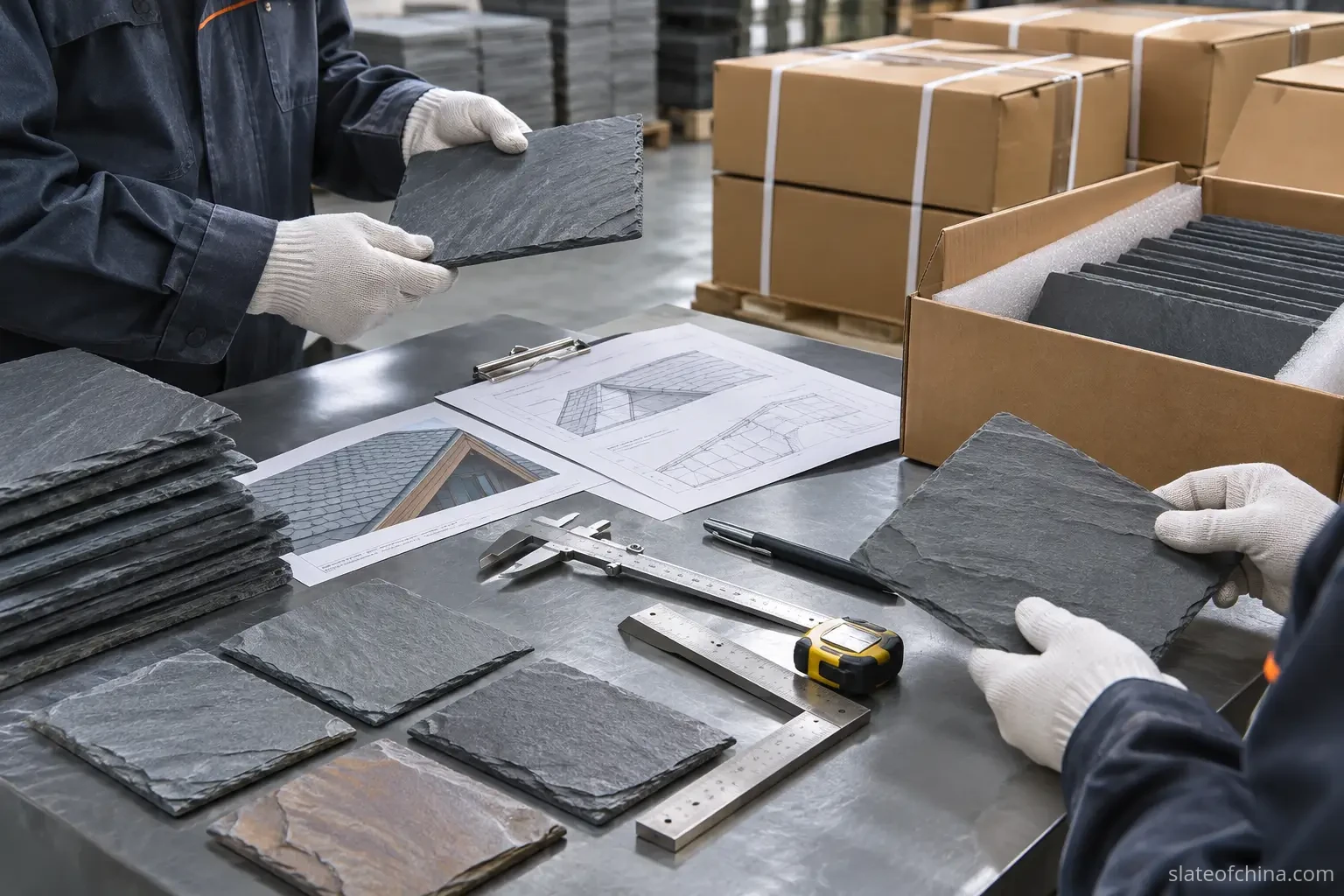
A single small sample shows the general character of the stone. It cannot show the full range of variation that a whole shipment will carry. For a decorative or visually sensitive order, agree on a range: a small set of samples that shows the lightest and the darkest tones you will accept, plus the edge and the surface as they will really be cut. That range — not a single tile — is the golden sample.
Approving in three stages keeps it honest:
- Material selection — the colour, the texture, the natural range and the suitability for the job. Photographs help narrow the shortlist; a physical sample is better when the appearance matters.
- Production sample — one piece made the way the order will be made, with the actual thickness, surface and edge. For a complex profile, this is the first article.
- Golden sample — the reference piece or sample set that the production is judged against, with its identification and approval date recorded.
The golden sample is a reference for acceptable appearance and workmanship, not a promise that every piece will match it. The variation between pieces is normal; the range between the approved samples is what you agree to receive.
Using Golden Samples for Quality Control
The golden sample is the reference the inspector returns to at the inspection line — because if the batch ships with a different edge or a wider tone range than the approved sample, the whole investment in custom sizing, branding and packing is wasted. The same sample you approved on the bench is the one the workshop keeps, and the one the receiving shop will hold, which is why its identification and approval date should be written into the order. The sample is a piece of the contract, not a courtesy.
The sample should also carry the finish the production will use. A piece honed for the photograph will not represent a production face that is natural cleft, and that mismatch surfaces at inspection, when it is too late to change the run.
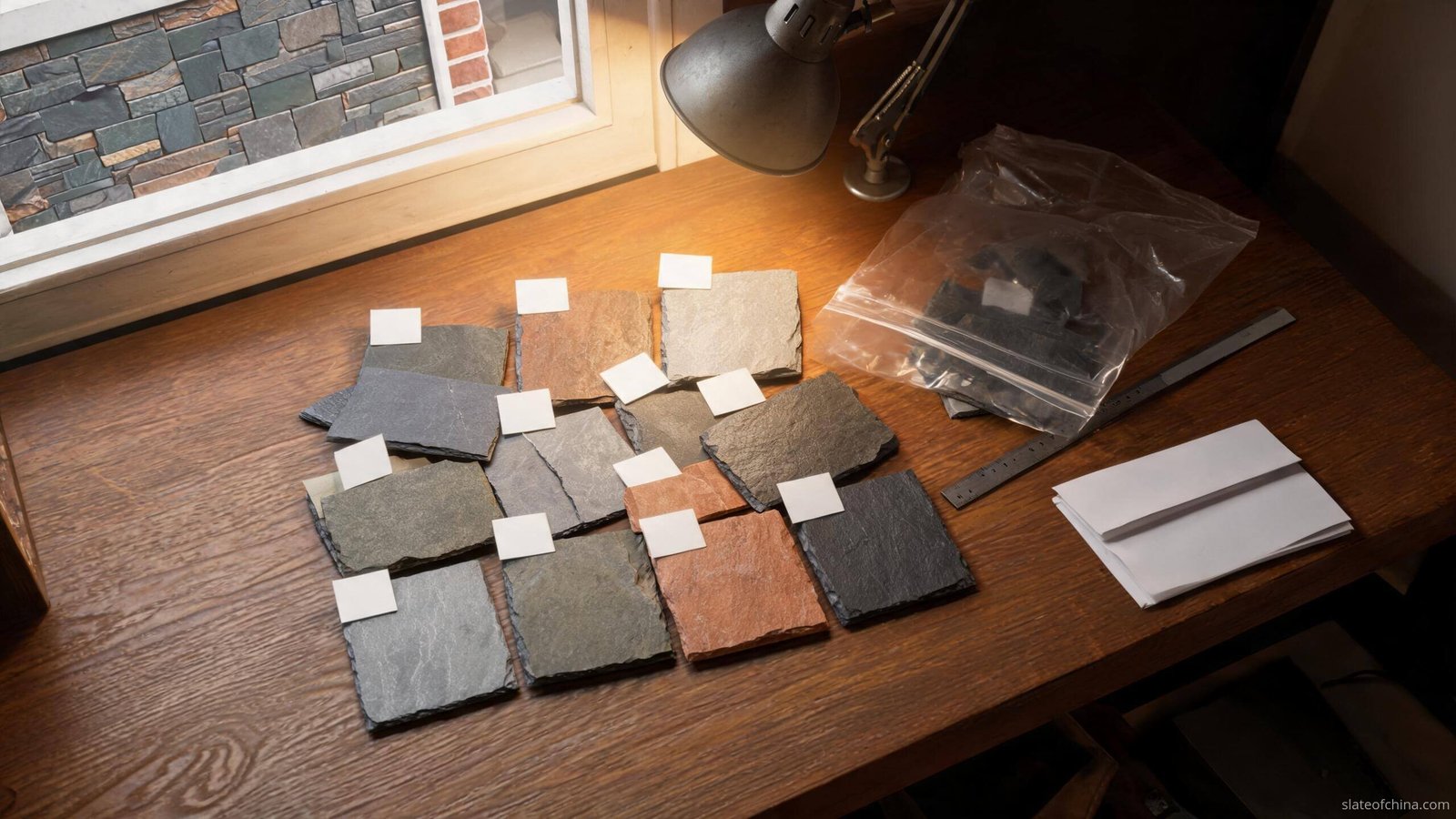
Approval record to retain. The sample range, the approved edge and finish, and the golden sample's identification and date — the yardstick the receiving team uses when the stone arrives.
Private-Label Packaging and Branding
Private label is not a bigger order; it is a different set of documents. The custom slate packaging — the carton, the label and the crate mark — carries your brand, and it has to be approved like the sample, because packing decides two things at once: whether the stone survives the ocean, and whether your name is delivered right.

What the packing carries, the order should say:
- Carton artwork — brand name, SKU, size, batch, handling symbols. Approved as a print proof, not a mock-up.
- Crate marks — destination marks, product identification, pallet and crate numbers, so the receiving warehouse can find each SKU.
- Packing list — product codes, quantities, net and gross weights.
- Protection — separators, corner protection, strapping and the foam or cardboard that actually stops two stones from knocking each other in transit.
For a private label box on a retail shelf, the carton is part of the product, so the artwork is part of the specification. For private label slate products that ship in crates, the crate marking and the packing list matter more than the print, because the receiving end has to sort it. Either way, approve the packing alongside the production sample — not after production, when a change means repacking or a delay.
One export detail deserves a line on its own: solid-wood packaging used in international trade can be subject to ISPM 15 phytosanitary treatment and marking. If you ship in custom wooden crates or pallets, confirm the treatment and the mark with the supplier and with the destination rules, because a mark missing at the arrival port is a whole container that sits.
Approval record to retain. The artwork proof, the crate marks, the packing list format, and the ISPM 15 note for the destination market.
OEM Slate Quality Inspection
The last approval in the OEM file is the custom slate inspection. An OEM inspection runs against the approved drawing and the golden sample — not against a vague "export grade" or a photo.

Decide what is checked, and when. The checklist usually runs:
- Dimensions — length, width and thickness against the approved tolerance.
- Surface — finish, natural texture and any visible defects against the sample range.
- Edges — cutting quality, profile and unacceptable chips.
- Flatness — any warpage that would matter for the application.
- Quantity and labels — piece counts, SKUs, batch, carton and crate numbers.
- Packing — protection, crate integrity and the shipping marks.
Inspection is not one event. It is four checkpoints the batch passes: incoming material, the first finished piece (first-article), the in-process batch, and the pre-shipment check before the container closes. For a larger order, an independent inspection company can sit at the fourth point. Either way, agree the sampling method and the acceptance criteria in advance, and write the result down — the inspection record is the paper that closes the order.
One caution: an agreed AQL-based sampling plan can be right for a large batch, but it should not replace full checks of the critical dimensions or a project-specific piece like a shaped tread or a corner unit. If a single wrong piece stops a build, inspect that piece, not a statistical sample of it.
Approval record to retain. The inspection plan, the sampling method, the acceptance criteria and the final report — the record both sides can refer to once the container is closed.
What Customization Changes on the Order
An OEM slate order is more work for the factory than a stock size, and the extra work shows in the cost, the minimum quantity and the lead time. None of these are numbers that apply to every order — they depend on the stone, the size, the finish, the packaging and the schedule. What they always depend on is the same discipline you have already used:
| Customization | It tends to change… |
|---|---|
| Nonstandard dimensions | More cutting, sorting and material waste. |
| Tight tolerances | More machining, more inspection, more rejection risk. |
| Special edge profiles | Extra processing and setup. |
| Custom samples | Prototype and sample freight. |
| Branded cartons | Printing setup and a minimum print quantity. |
| Mixed SKUs | More sorting, labelling and packing. |
The way to keep an OEM order controllable is to standardize the parts that do not create value. A distributor running several private-label slate products can keep one carton format, one label position and one pallet dimension, so the branding is different but the logistics stay the same. And when the stone size uses the raw material efficiently, the waste — and the cost — goes down.
For the numbers on minimum order quantity and delivery, the countback method belongs to its own guide: architectural stone MOQ and lead times explains how to read a delivery date back from the site. The point here is only this: a custom order moves the clock to the approvals — the drawing, the sample, the packaging and the inspection — not to the day the machine starts.
Nine Steps in the Order That Cannot Be Skipped
An OEM order runs in a sequence, and each step has to be documented before the next opens. In practice:
- Submit the RFQ with the drawing, the application, the quantity and the destination market.
- Get the technical review — material availability, feasibility, tolerances, packing and terms.
- Approve the physical samples — the material, the finish, the dimensions and the natural range.
- Approve the packaging — artwork, labels, the packing config and the export protection.
- Release production against the approved drawing and sample.
- Approve the first article — the first finished piece is checked against the drawing and the golden sample before the run continues.
- Inspect the finished goods, the quantities, the labels and the packing before the container.
- Arrange the shipment on the agreed terms, with the shipping documents and the records.
- Check the arrival and the receiving-side checks against the same file.
Skip a step and the problem does not disappear — it moves down the chain to the site. The file is only as strong as its weakest approval.
Where Private-Label Slate Orders Usually Go Wrong
Five mistakes come back in a private-label slate program, and they are all mistakes of the paper, not the stone.
- Approving a photograph — a photo cannot carry the thickness, the relief, the edge or the full tone range. Approve a physical sample and the acceptance criteria.
- Using an ambiguous dimension — "about 20 mm" means different things to a calibrated product and a natural cleft one. Write nominal vs finished and the tolerance separately.
- Designing the packing after production — a late packing decision delays the shipment or forces a repack. Approve the artwork with the production spec.
- Ignoring warehouse identification — the right stone with mismatched labels and crate numbers is a hard arrival. Set the SKU and batch system once, and use it.
- Assuming every variation is a defect — natural tone, cleavage and surface variation are normal. Define the acceptable range, and define unacceptable damage and workmanship separately.
What the OEM Supplier Needs From You
The fastest RFQ is a complete RFQ. The supplier that can review the job properly and answer it accurately is the one that has what it needs to judge: the drawing, the application, the quantity, the destination and the packaging. If the range is still open, the paving slate and wall cladding slate catalogues show the standard sizes a custom order can depart from.
A compact OEM slate RFQ checklist keeps the first enquiry complete:
| What to specify | What to write |
|---|---|
| Product application | Paving, wall cladding, stair treads, tiles — where the stone will serve. |
| Dimensions and thickness | Finished size, nominal vs finished thickness, and the tolerance you need. |
| Surface finish and edge | Natural cleft or calibrated; sawn, eased or bullnosed edge. |
| Quantities | Pieces or m² per size, and per SKU if the order mixes sizes. |
| Destination market | Country, port and any import requirements to plan for. |
| Private-label packaging | Labels, cartons, barcodes, crate marks and artwork if it exists. |
| Drawing reference | Drawing number and revision, or the sketch that stands in for one. |
Attach to the enquiry — in PDF or CAD, with a photo of the shape next to a ruler if it is a profile: the drawing, reference photographs, the packaging artwork if you have it, and any project-specific test or certification you need. And take a complete envelope from questions to ask a slate supplier before you send it, so the answering comes back with the numbers you need to decide.
For the sheet to hand to a supplier, the worked example lives in our slate specification sheet — the row-by-row template that keeps the dimensions, the finish and the tolerance in one place.
Frequently Asked Questions
Can I order custom-size slate directly from a manufacturer?
Yes — an OEM slate supplier with in-house fabrication can produce many architectural products to custom dimensions, subject to raw material availability, fabrication feasibility, tolerances and quantity. A detailed drawing is the starting point the workshop uses to judge the job.
Will a supplier put my brand on natural slate packing?
Private-label packing can carry your logo, product labels, cartons, barcodes and crate marks, depending on the supplier's setup and the order requirements. Confirm the artwork, the cost and the minimum print quantity before production.
What is the MOQ for private-label slate products?
There is no universal MOQ. It depends on the product, the size, the manufacturing process, the packaging design and the supplier capacity. Custom-printed packaging often has its own minimum, separate from the stone.
How do I check quality before importing slate from China?
Use the approved drawing and the golden sample, establish measurable inspection criteria, request production and pre-shipment inspection records, and consider a third-party inspection for a larger or complex order. The file is the quality.
What is the difference between an OEM slate order and a standard wholesale order?
A standard wholesale order uses existing product specifications. An OEM order introduces buyer-specific sizes, finish, packing and branding, so it needs more detailed technical approval and quality control.
Can I combine different slate sizes in one container?
Mixed-size shipments are often possible, depending on production scheduling, packing, cargo weight, loading safety and container capacity. Label every SKU clearly and confirm the packing plan before the container is booked. See importing mixed stone orders for loading layouts and pricing.
Should I approve a golden sample before ordering?
For a custom or visually sensitive slate product, yes. Approve a representative sample range rather than a single tile: it establishes the shared reference for appearance, dimensions and workmanship, and the sample becomes part of the order.
Planning an OEM or private-label slate order?
Send us your drawing, estimated quantity, destination market and private-label requirements for a technical feasibility review. The drawing is read, the sample range is pinned, the packing is proven and the inspection is agreed — before the stone moves.