
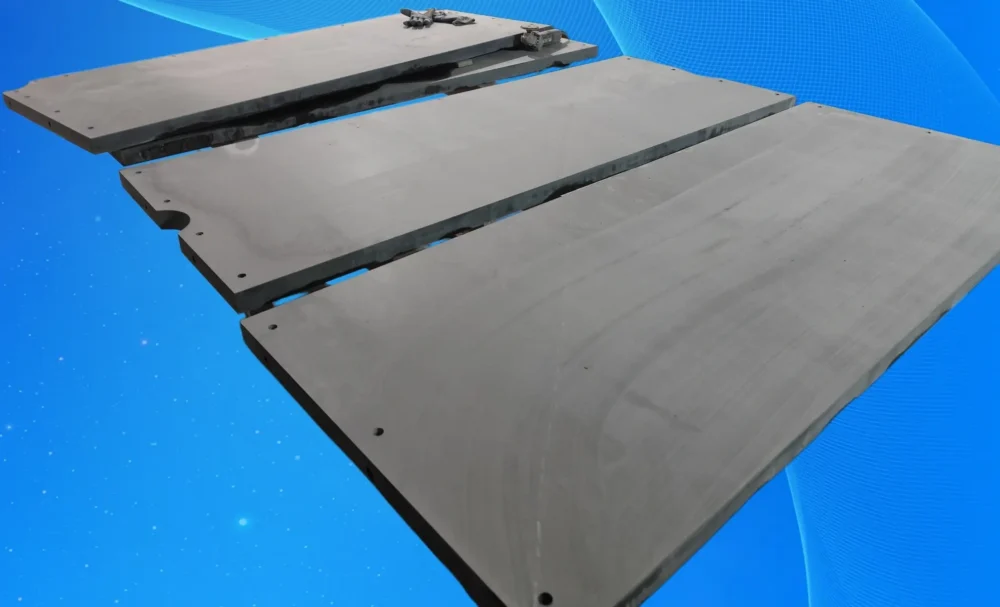
For a 12ft professional snooker table, the slate is not a single piece — it is typically a five-piece slate set.
While flatness and thickness are critical, another factor determines final performance:
Seam alignment.
Even if each slate piece meets flatness tolerance individually, poor matching between pieces can result in:
Visible seam lines after cloth installation
Height differences between joints
Uneven ball roll across seams
Increased filler usage during installation
In professional snooker slate manufacturing, proper five-piece slate matching is essential.
This article explains how we control seam alignment during 45mm snooker slate production.
Why 5-Piece Matching Is Critical for 12ft Snooker Tables
A 12ft snooker table spans nearly 3.6 meters.
Because of transport and handling limitations, slate is divided into five sections.
However, dividing slate creates one challenge:
Each piece must behave like part of a single continuous surface.
If pieces differ in:
Density
Thickness
Grinding calibration
Structural stress distribution
Seam misalignment becomes inevitable.
Professional seam alignment begins long before final inspection.
Step 1: Batch-Controlled Production
We do not randomly combine slate pieces.
For each 12ft snooker slate set:
✔ All five pieces are produced within the same manufacturing batch
✔ Material is sourced from the same quarry block group
✔ Grinding calibration is performed within the same equipment cycle
This minimizes:
Density variation
Surface behavior differences
Stress imbalance
Batch consistency is the foundation of seam alignment.
Step 2: Density and Structural Consistency Evaluation
Even high-quality quarry material may have slight density variations between blocks.
Before matching pieces:
✔ We evaluate material density consistency
✔ We avoid mixing slabs from different density ranges
✔ Structural integrity is visually checked
Different density levels can cause:
Uneven long-term deflection
Slight height difference after installation
Seam movement over time
Matching pieces with similar structural characteristics ensures stable alignment.
Step 3: Thickness Harmonization Across All Pieces
Even within ±0.2mm tolerance, minor differences can affect seam level.
Therefore:
✔ Thickness is measured at multiple points on each piece
✔ Data is recorded and compared across all five pieces
✔ Slight adjustments are made during final grinding if necessary
The goal is not just tolerance compliance — but harmonized thickness across the full set.
This step significantly reduces installation adjustment work.
Step 4: Seam Height Pre-Verification
Before packaging:
✔ Adjacent pieces are temporarily aligned
✔ Seam height is manually checked
✔ Straight-edge testing is applied across joint areas
This pre-verification simulates installation conditions.
It allows detection of:
Edge lifting
Joint unevenness
Localized height difference
Many suppliers skip this step — leading to on-site correction problems.
Step 5: CNC Edge Accuracy Control
Seam alignment also depends on machining accuracy.
For each 45mm snooker slate piece:
✔ CNC-machined edges are inspected
✔ Bolt hole positioning is verified
✔ Alignment slot precision is checked
Misaligned bolt holes can cause forced adjustment during installation, which increases seam stress.
Precision machining supports natural alignment without excessive pressure.
Step 6: Controlled Packaging Sequence
Even after matching, incorrect packaging can cause mix-up.
To prevent this:
✔ Each five-piece set is labeled as a complete unit
✔ Packaging sequence follows matching order
✔ Installation position is clearly marked
Proper labeling ensures the correct pieces remain together during export and installation.
Common Seam Alignment Problems in Low-Control Production
Without structured five-piece matching, buyers often face:
Visible seam lines after cloth installation
Uneven surface between joints
Excessive use of seam filler
Long-term seam movement
These issues are rarely caused by a single defect — but by poor matching control.
Seam alignment is a system-level discipline.
Why 45mm Snooker Slate Requires Higher Matching Precision
Thicker slate means:
Greater weight per section
Higher stress during tightening
Increased load across seams
For 45mm snooker slate used in professional tables, seam alignment must meet stricter control standards compared to thinner pool table slate.
This is especially important for tournament-grade tables where ball roll consistency is critical.
Our Seam Alignment Control Standard
For each 12ft five-piece slate set:
✔ Same-batch production
✔ Density consistency evaluation
✔ Multi-point thickness comparison
✔ Seam height pre-verification
✔ CNC edge accuracy inspection
✔ Correct packaging identification
Seam alignment is treated as part of structural engineering — not cosmetic finishing.
What Professional Table Manufacturers Look For
Serious snooker table brands understand:
Even perfect flatness per piece does not guarantee perfect seams.
They evaluate suppliers based on:
Batch consistency
Matching control process
Inspection documentation
Installation efficiency
Reliable five-piece matching reduces:
On-site adjustment time
Labor cost
Risk of post-installation complaints
For long-term partnerships, seam alignment reliability matters.
Final Thoughts
In 12ft snooker slate manufacturing, performance depends on how well five pieces function as one.
Perfect seam alignment requires:
Material consistency
Thickness harmonization
Precision machining
Pre-installation verification
Controlled packaging
Professional snooker slate production is not about individual pieces — it is about system integration.
Request Technical Details for Our 5-Piece Matching Process
We can provide:
Matching procedure explanation
Thickness comparison method
Seam verification standards
Technical specification sheet for 45mm snooker slate
Contact us to request full documentation or send your project specifications for evaluation.