
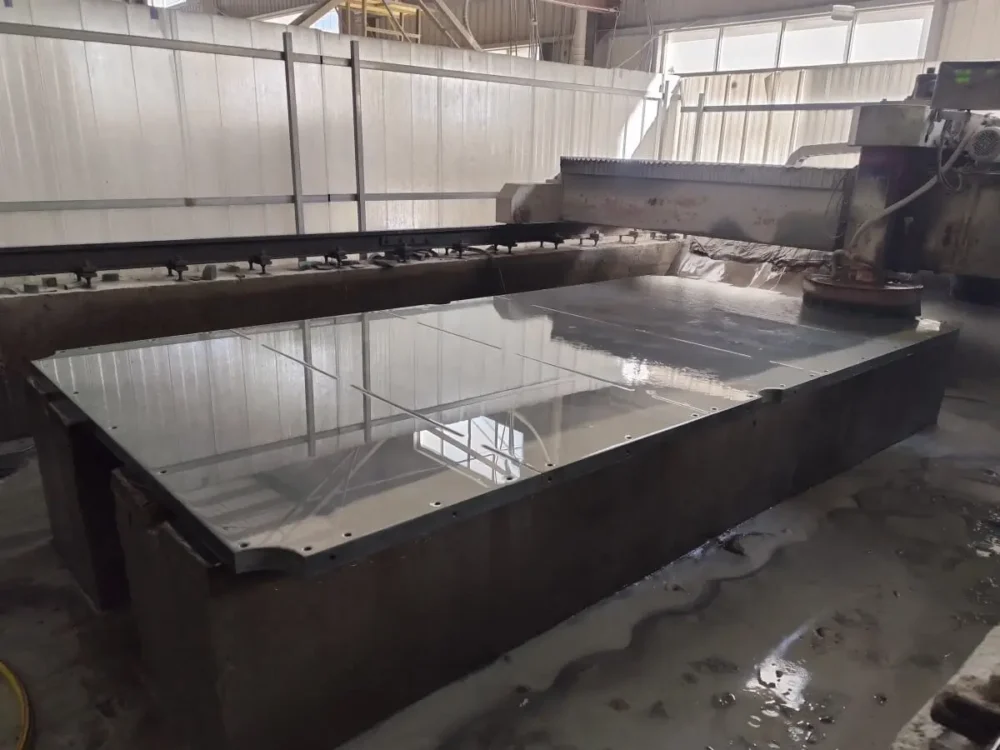
When sourcing 45mm snooker slate for professional tables, one concern always comes first:
Flatness.
Even a slight deviation can affect:
Ball roll accuracy
Seam alignment
Cloth installation
Long-term table stability
For tournament-grade snooker tables, flatness is not optional — it is fundamental.
In this article, we explain how we control snooker slate flatness tolerance through strict manufacturing processes, precision grinding equipment, and multi-stage inspection.
Why Flatness Matters in 12ft Snooker Tables
A full 12ft snooker table uses a five-piece slate set weighing nearly 1000 kg.
If flatness deviation exceeds acceptable tolerance:
Seams become visible after cloth installation
Balls drift subtly off line
Installers must use excessive filler
Frame stress increases over time
Professional table manufacturers typically require:
Surface flatness tolerance within ±0.1mm
Thickness consistency within ±0.2mm
Anything beyond this increases installation cost and performance risk.
Stage 1: Oversize Cutting for Precision Calibration
Flatness control begins before grinding.
During primary block cutting:
Slate slabs are cut 2–3mm thicker than final size
Extra allowance ensures precise surface calibration later
Internal stress is minimized through controlled cutting speed
For 45mm snooker slate, we typically cut at 47–48mm before grinding.
This step prevents uneven material removal during surface finishing.
Stage 2: Large-Format Surface Grinding
Grinding is the most critical stage in snooker slate manufacturing.
We use large-format precision grinding machines capable of handling:
Full 12ft slate sections
Heavy 45mm thickness
Wide surface calibration
The grinding process includes:
Rough leveling
Cross-direction grinding
Final precision finishing
This multi-direction grinding method prevents:
High spots
Surface waves
Edge lifting
Flatness is calibrated across the entire surface, not just center areas.
Stage 3: Thickness Equalization Control
Uneven thickness between slate pieces is one of the most common industry problems.
To prevent this:
Each piece is measured individually
Thickness is calibrated across multiple points
Data is recorded before final approval
For five-piece snooker slate sets, pieces are matched from the same batch to ensure uniform density and thickness behavior.
This prevents seam height difference after installation.
Stage 4: Straight-Edge and Dial Gauge Inspection
After grinding, every slate piece undergoes manual and mechanical inspection.
Inspection methods include:
Precision straight-edge testing
Dial gauge measurement
Multi-point surface mapping
We verify flatness tolerance within ±0.1mm across the entire surface.
This inspection ensures the slate meets tournament-level performance standards before packaging.
Common Flatness Problems in Low-Quality Slate
Buyers often encounter flatness issues due to:
Small grinding equipment
Inconsistent quarry material
Lack of thickness allowance
No final inspection process
The result:
Uneven seams
Ball roll deviation
Rework at installation site
Increased labor cost
Flatness control requires both equipment capability and process discipline.
How Flatness Affects Long-Term Stability
Flatness is not only about immediate installation.
If the slate surface is uneven:
Load distribution becomes irregular
Frame stress increases
Over time, micro-movement may occur
For professional snooker table brands, consistent flatness protects brand reputation.
Our Flatness Control Standard
For 45mm snooker slate production, our internal quality standard includes:
✔ Surface flatness tolerance: ±0.1mm
✔ Thickness tolerance: ±0.2mm
✔ Multi-direction grinding
✔ Piece-by-piece inspection
✔ Batch matching for 5-piece sets
Flatness is treated as a core performance parameter — not a secondary feature.
Why Professional Manufacturers Focus on Flatness
For premium snooker table manufacturers supplying:
Tournament projects
Professional clubs
High-end distributors
Flatness control determines:
Ball roll accuracy
Installation efficiency
Long-term durability
Customer satisfaction
This is why serious buyers always evaluate the snooker slate flatness tolerance standard before confirming orders.
Final Thoughts
In snooker slate manufacturing, flatness is engineering — not marketing.
Achieving consistent ±0.1mm tolerance requires:
Stable quarry resources
Oversize cutting strategy
Large-format grinding equipment
Multi-stage calibration
Strict inspection procedures
For 45mm snooker slate used in 12ft professional tables, flatness control is the foundation of performance.
Need Detailed Flatness Inspection Data?
We can provide:
Thickness measurement reports
Grinding process explanation
Inspection procedure details
Technical specification sheet for 45mm snooker slate
Contact us to request full technical documentation or send your table drawing for evaluation.