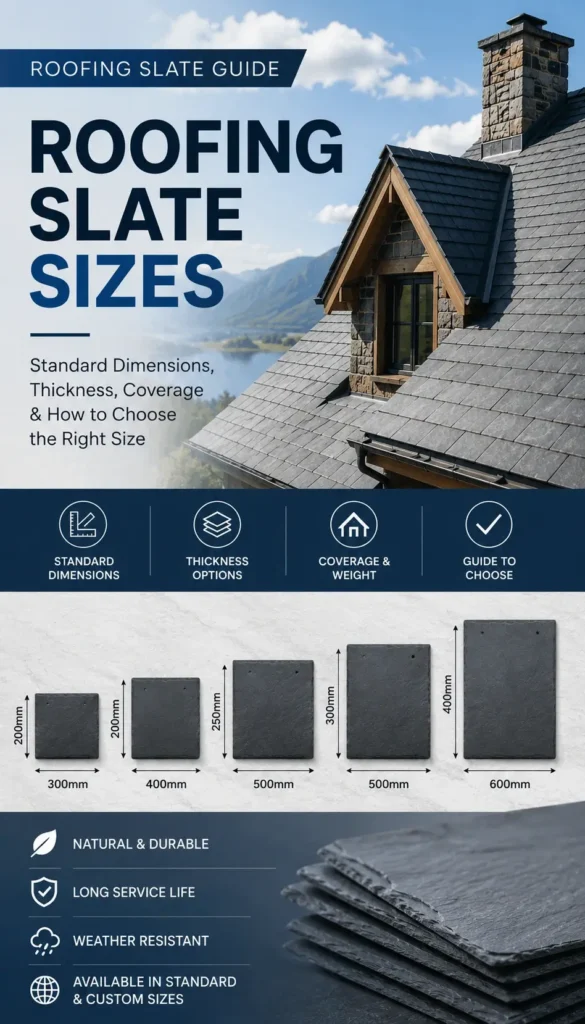
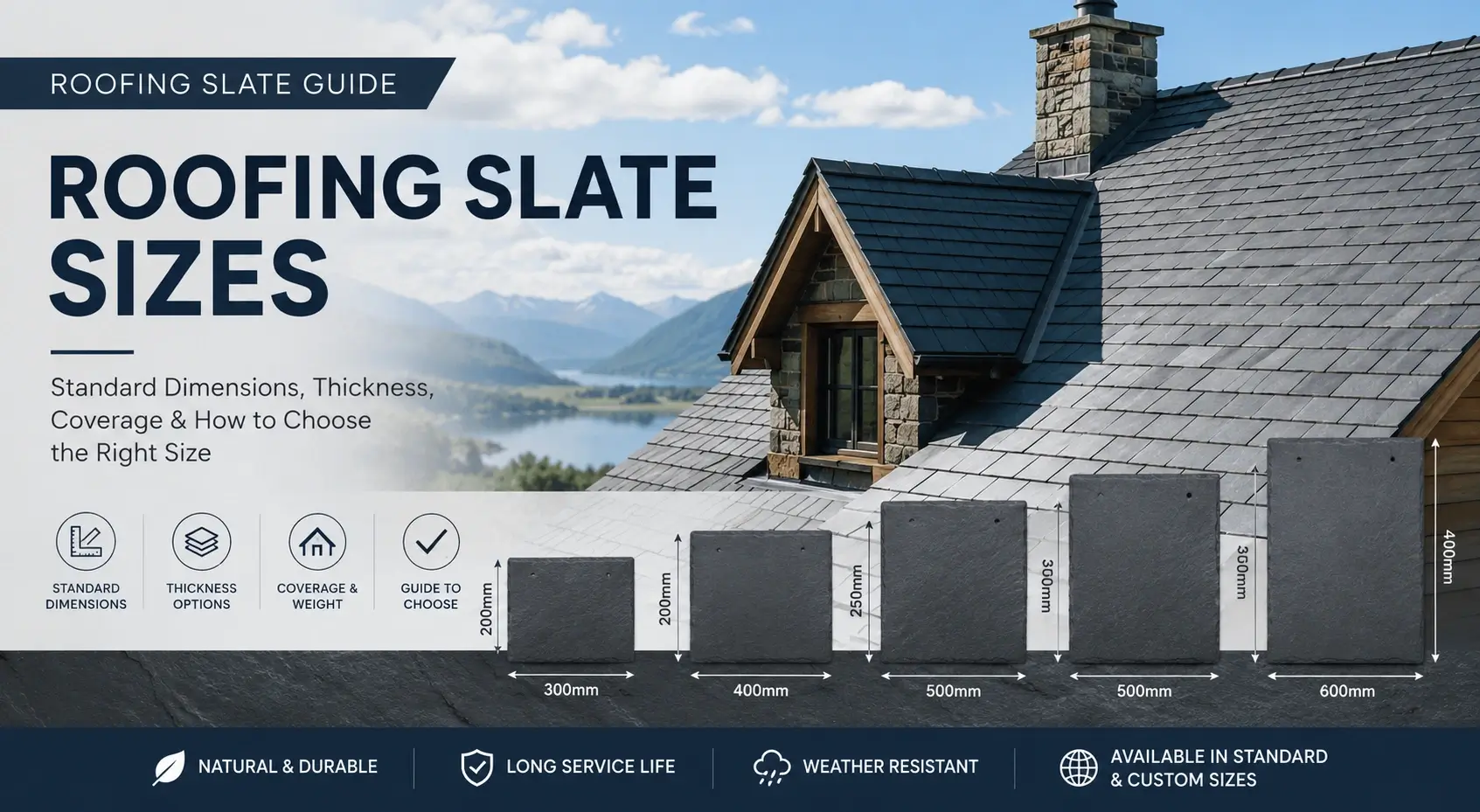
Roofing slate sizes guide showing standard slate tile dimensions, thickness options and common roofing slate sizes.

Roofing Slate Sizes: Complete Guide to Slate Tile Dimensions

Natural roofing slate is available in a wide range of standard sizes, but there is no single international standard. Roofing slate dimensions vary by country, building tradition, roof design, and installation method. For example, the UK, Spain, France, Germany, and North America each use different standard slate tile sizes and thicknesses.

Choosing the right roofing slate size affects far more than appearance. It influences roof coverage, material consumption, installation cost, roof weight, wind resistance, and long-term performance. Whether you’re specifying slate for a heritage restoration, a modern home, or a commercial roofing project, understanding standard slate dimensions is essential.

As one of China’s leading natural slate producers, Jiujiang Slate manufactures almost all internationally recognized roofing slate sizes, including standard UK and European dimensions, as well as custom-made sizes for OEM projects.

In this guide, you’ll learn everything you need to know about roofing slate sizes, including standard dimensions, thickness, effective roof coverage, weight, size charts, and practical tips for choosing the best slate for your project.

Quick Answer

There is no universal standard roofing slate size. The most common slate dimensions range from 300 × 200 mm (12 × 8 in) to 600 × 300 mm (24 × 12 in), with thickness typically between 4–8 mm. The best size depends on roof pitch, architectural style, local building standards, and installation requirements.

Table of Contents

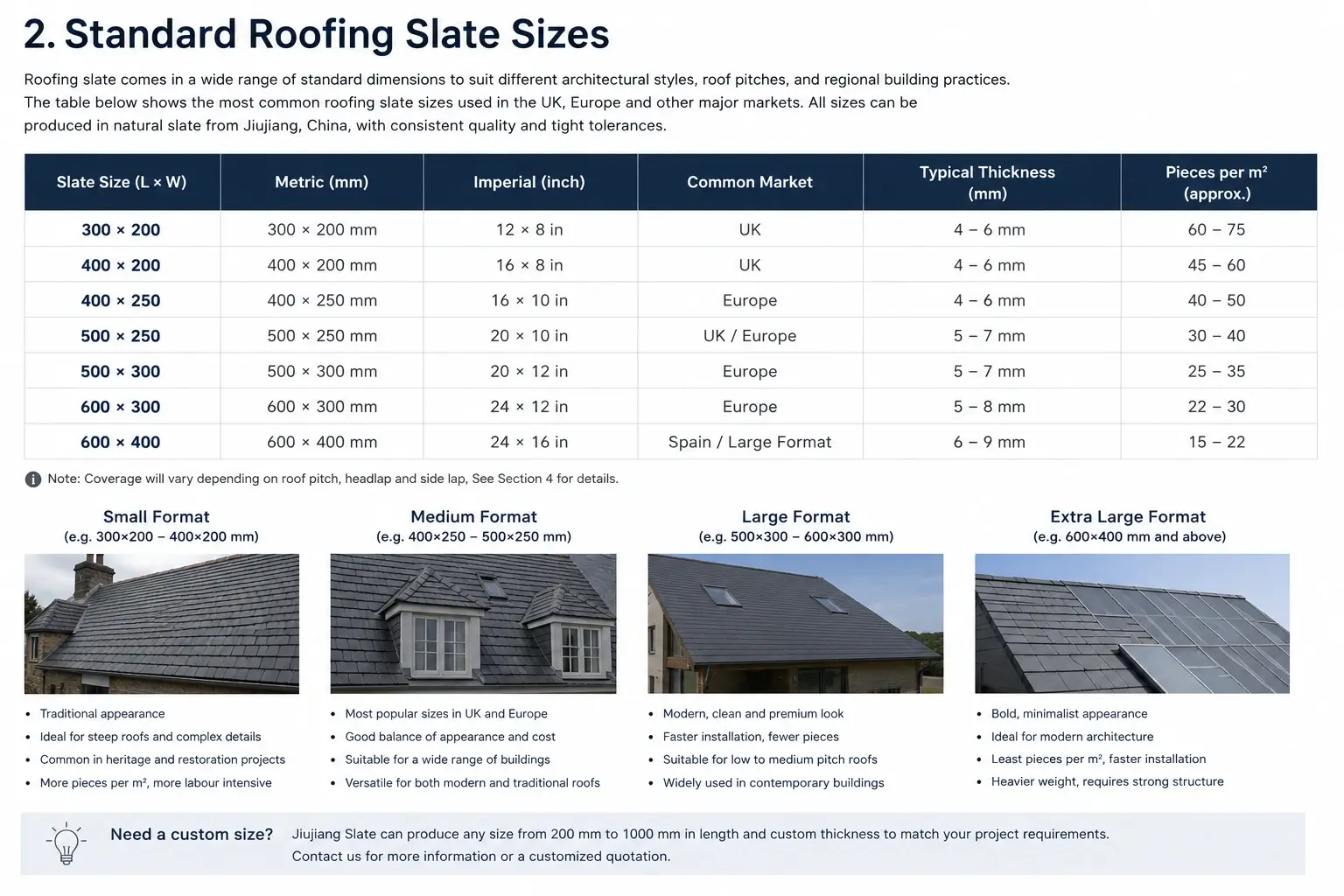
Standard Roofing Slate Sizes

Natural roofing slate is manufactured in a wide range of standard sizes to suit different architectural styles, roof pitches, and regional building traditions. Unlike many manufactured roofing materials, there is no universal roofing slate size. Standard dimensions vary between the UK, Spain, France, Germany, North America, and other markets.

The most common roofing slate sizes range from 300 × 200 mm (12 × 8 in) for traditional projects to 600 × 400 mm (24 × 16 in) for large-format contemporary buildings. Choosing the correct slate size not only affects the appearance of the roof but also influences installation speed, material usage, roof weight, and overall project cost.

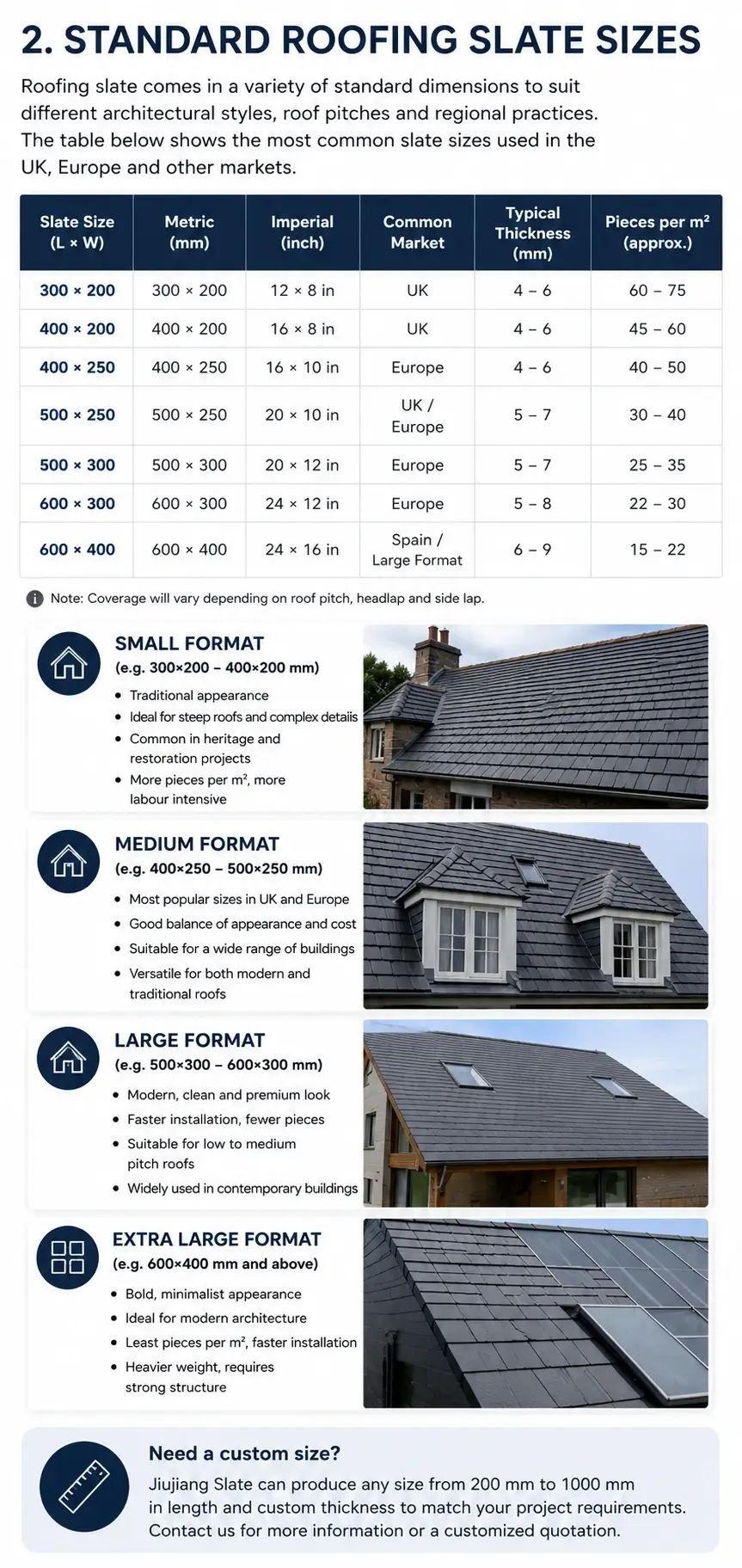
The table below lists the most widely used standard roofing slate dimensions in international markets. As a professional natural slate manufacturer, Jiujiang Slate can supply all common UK and European sizes, as well as custom dimensions to meet specific project requirements.

Standard Roofing Slate Size Chart

Slate Size (mm)Imperial SizeTypical ThicknessPieces per m²*Common MarketTypical Applications
300 × 20012 × 8 in4–6 mm60–75UKHeritage buildings, cottages
400 × 20016 × 8 in4–6 mm45–60UKTraditional residential roofs
400 × 25016 × 10 in4–6 mm40–50EuropeResidential housing
500 × 25020 × 10 in5–7 mm30–40UK / EuropeMost popular residential size
500 × 30020 × 12 in5–7 mm25–35EuropeVillas and commercial buildings
600 × 30024 × 12 in5–8 mm22–30EuropeModern architecture
600 × 40024 × 16 in6–9 mm15–22SpainPremium large-format roofing

Note: Pieces per square metre are approximate and vary depending on roof pitch, headlap, sidelap, and installation method.

Small Format (300 × 200 mm – 400 × 200 mm)

Small-format roofing slates create a classic, traditional appearance and are widely used on historic buildings, churches, cottages, and heritage restoration projects. Their smaller size makes them ideal for steep roofs, curved roof sections, dormers, valleys, and other complex roof details, where greater flexibility is required.

Because more slates are needed to cover each square metre, installation takes longer and labour costs are generally higher. However, many architects prefer small-format slate for projects where authenticity and craftsmanship are a priority.

Best for:

  • Heritage restoration
  • Traditional architecture
  • Steep roofs
  • Complex roof designs

Medium Format (400 × 250 mm – 500 × 250 mm)

Medium-format slates are the most commonly specified roofing slate sizes in both the UK and Europe. They offer an excellent balance between appearance, installation efficiency, and material cost, making them suitable for a wide variety of residential and light commercial buildings.

The 500 × 250 mm slate is particularly popular because it provides an attractive roof pattern while reducing the number of slates required compared with smaller formats.

Best for:

  • Residential housing
  • New-build homes
  • Renovation projects
  • General roofing applications

Large Format (500 × 300 mm – 600 × 300 mm)

Large-format roofing slates have become increasingly popular in modern architecture thanks to their clean lines and contemporary appearance. Their larger surface area means fewer slates are required per square metre, helping reduce installation time and labour costs.

These sizes are often specified for luxury homes, hotels, commercial buildings, and public projects where a bold, elegant roof design is desired.

Best for:

  • Modern homes
  • Villas
  • Commercial buildings
  • Contemporary architecture

Extra Large Format (600 × 400 mm and above)

Extra-large roofing slates create a striking architectural appearance with fewer visible joints and a minimalist aesthetic. They are commonly used on high-end residential projects, public buildings, and landmark architecture.

Because these slates are heavier than standard sizes, the roof structure should be designed to support the additional load. Professional installation is also recommended to ensure long-term performance.

Best for:

  • Premium residential projects
  • Landmark buildings
  • Luxury developments
  • Contemporary architecture

Expert Tip

There is no single “best” roofing slate size. The right choice depends on your roof pitch, local building regulations, architectural style, climate, installation method, and budget. For most residential projects, 500 × 250 mm remains the most popular and versatile option, while larger formats are increasingly preferred for modern architectural designs.

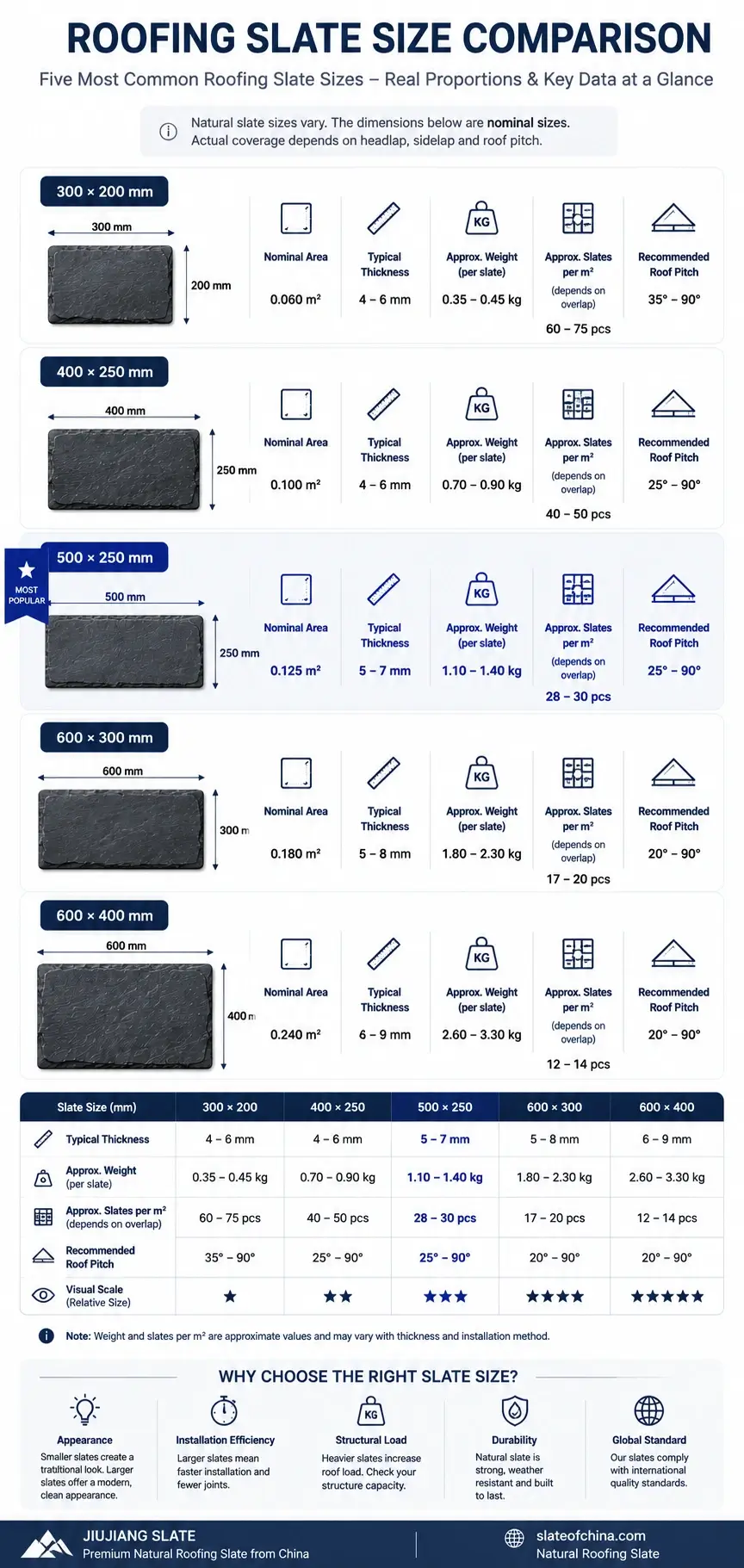
standard roofing slate sizes chart
standard roofing slate sizes chart mobile

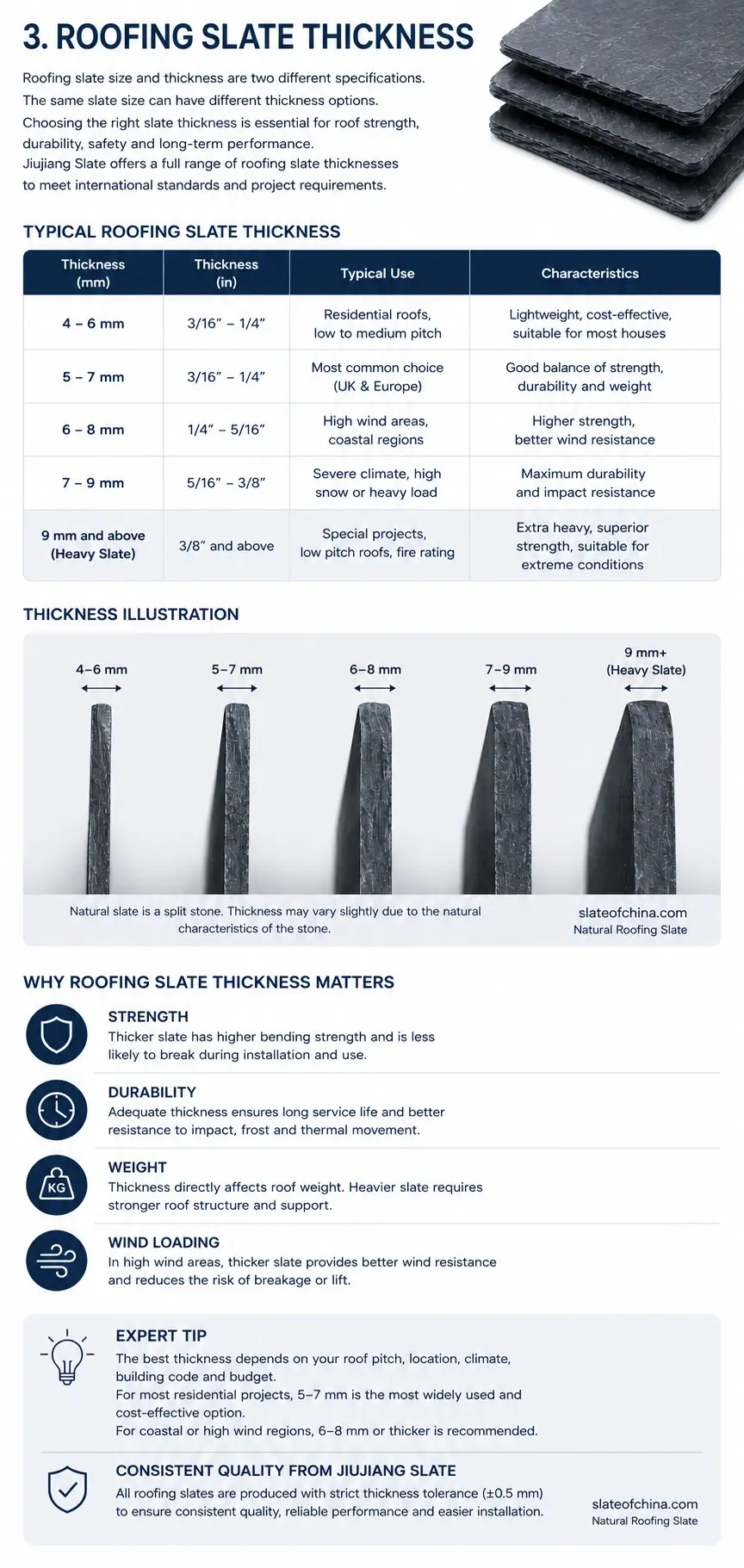
Roofing Slate Thickness

Many buyers focus on roofing slate sizes, but overlook another equally important specification—roofing slate thickness. In fact, slate size and slate thickness are two separate measurements. The same slate dimensions, such as 500 × 250 mm, can be produced in several different thicknesses depending on the project requirements.

Choosing the correct roofing slate thickness affects much more than appearance. It directly influences the slate’s strength, durability, weight, wind resistance, installation method, and overall roofing performance. Selecting the right thickness helps ensure your roof meets local building standards while providing reliable protection for decades.

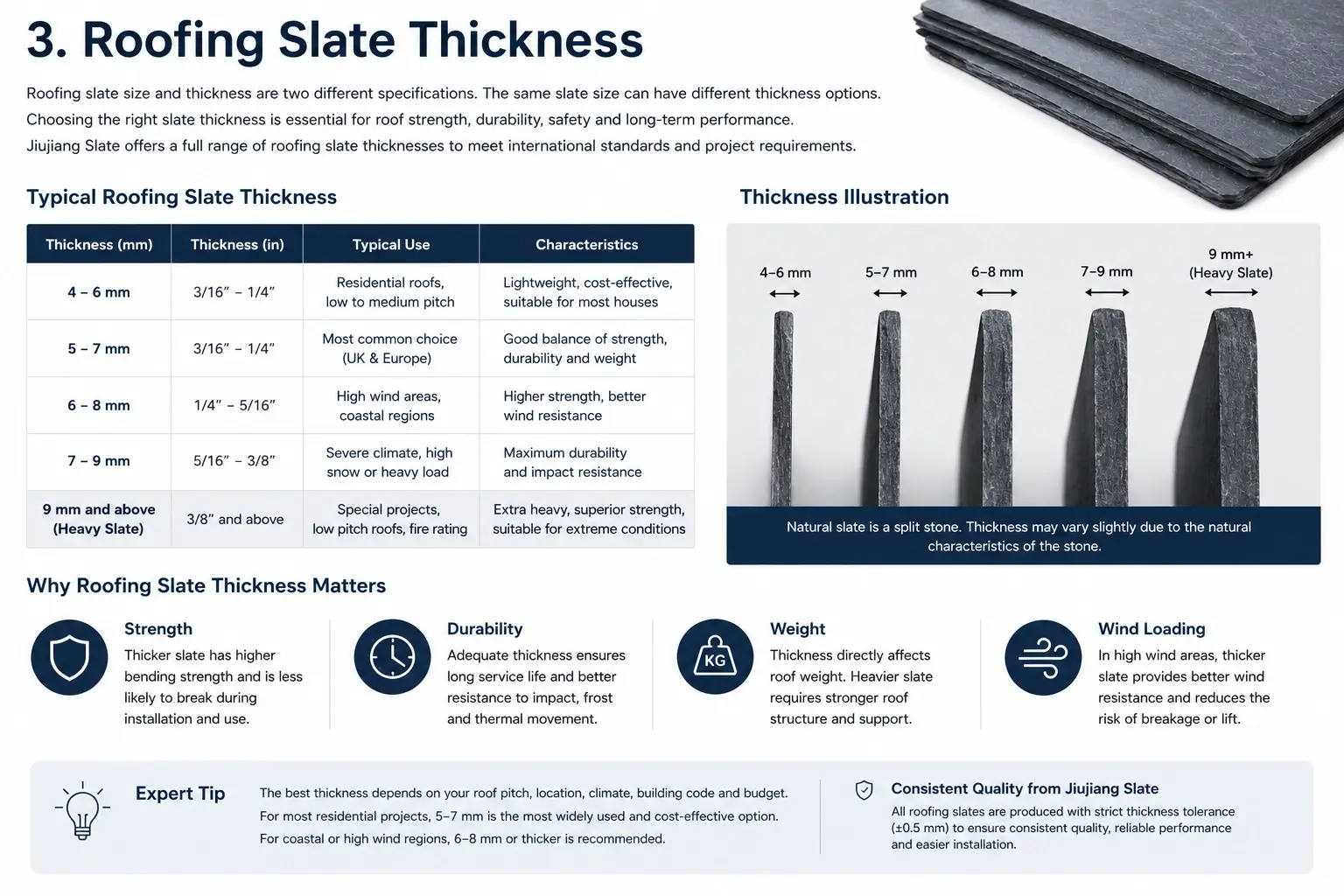
Natural roofing slate is available in several standard thickness ranges. The most suitable option depends on factors such as roof pitch, climate, structural design, and local building regulations.

Typical Roofing Slate Thickness

The table below shows the most commonly supplied roofing slate thicknesses and their typical applications.

ThicknessTypical ApplicationsMain Characteristics
4–6 mmResidential roofs, low to medium roof pitchesLightweight, economical and suitable for most standard housing projects
5–7 mmStandard residential and commercial roofingThe most popular choice, offering an excellent balance of strength, durability and weight
6–8 mmCoastal areas, windy regions, premium projectsHigher strength and improved resistance to wind uplift and impact
7–9 mmHeavy-duty roofing, mountain or snow regionsExcellent durability, greater load capacity and longer service life
9 mm and aboveHeavy roofing slate, special architectural projectsMaximum strength and a distinctive natural appearance, but requires stronger roof structures

Note: Thickness may vary slightly because natural slate is split from stone rather than manufactured by moulds. Reputable manufacturers control thickness within specified tolerances to ensure consistent quality.

Why Roofing Slate Thickness Matters

The thickness of natural roofing slate has a significant impact on both roof performance and installation. Selecting the right thickness helps balance durability, appearance, structural requirements, and project cost.

Strength

Thicker roofing slates generally provide greater bending strength and are less likely to crack during transportation, installation, or long-term service. They are often preferred for demanding environments or projects requiring enhanced structural performance.

Durability

Roofing slate is already one of the longest-lasting roofing materials available. Choosing an appropriate thickness further improves resistance to impact, freeze-thaw cycles, and long-term weather exposure, helping maximise the roof’s service life.

Weight

As thickness increases, so does the weight of each slate. While heavier slates can improve roof stability, they also place greater loads on the roof structure. Always ensure the roof framing is designed to support the selected slate thickness.

Wind Resistance

In coastal regions and areas exposed to strong winds, slightly thicker slates often provide better resistance to wind uplift and mechanical damage. However, correct fixing methods and installation quality are equally important for long-term performance.

Expert Advice: Which Roofing Slate Thickness Should You Choose?

There is no single “best” roofing slate thickness for every project. The ideal choice depends on several factors, including:

  • Local climate and weather conditions
  • Roof pitch and structural design
  • Building type and architectural style
  • Local building regulations
  • Budget and installation requirements

For most residential roofing projects in the UK and Europe, 5–7 mm is the most widely specified thickness because it offers an excellent balance between durability, weight, appearance, and cost. In regions with high winds, heavy snowfall, or demanding environmental conditions, 6–8 mm or thicker slates may provide additional long-term benefits.

Why Choose Jiujiang Slate?

Jiujiang Slate manufactures natural roofing slates in a wide range of standard and custom thicknesses to meet international market requirements. Every slate is carefully selected and processed to ensure consistent thickness, accurate dimensions, and reliable performance.

We can supply:

  • Standard thicknesses from 4 mm to 9 mm+
  • Custom thicknesses for special projects
  • UK and European roofing standards
  • Strict quality control and dimensional consistency
  • OEM and project-specific production

Whether you require lightweight residential slates or heavy-duty architectural roofing slate, our team can recommend the most suitable thickness for your project.

roofing slate thickness guide
roofing slate thickness guide mobile

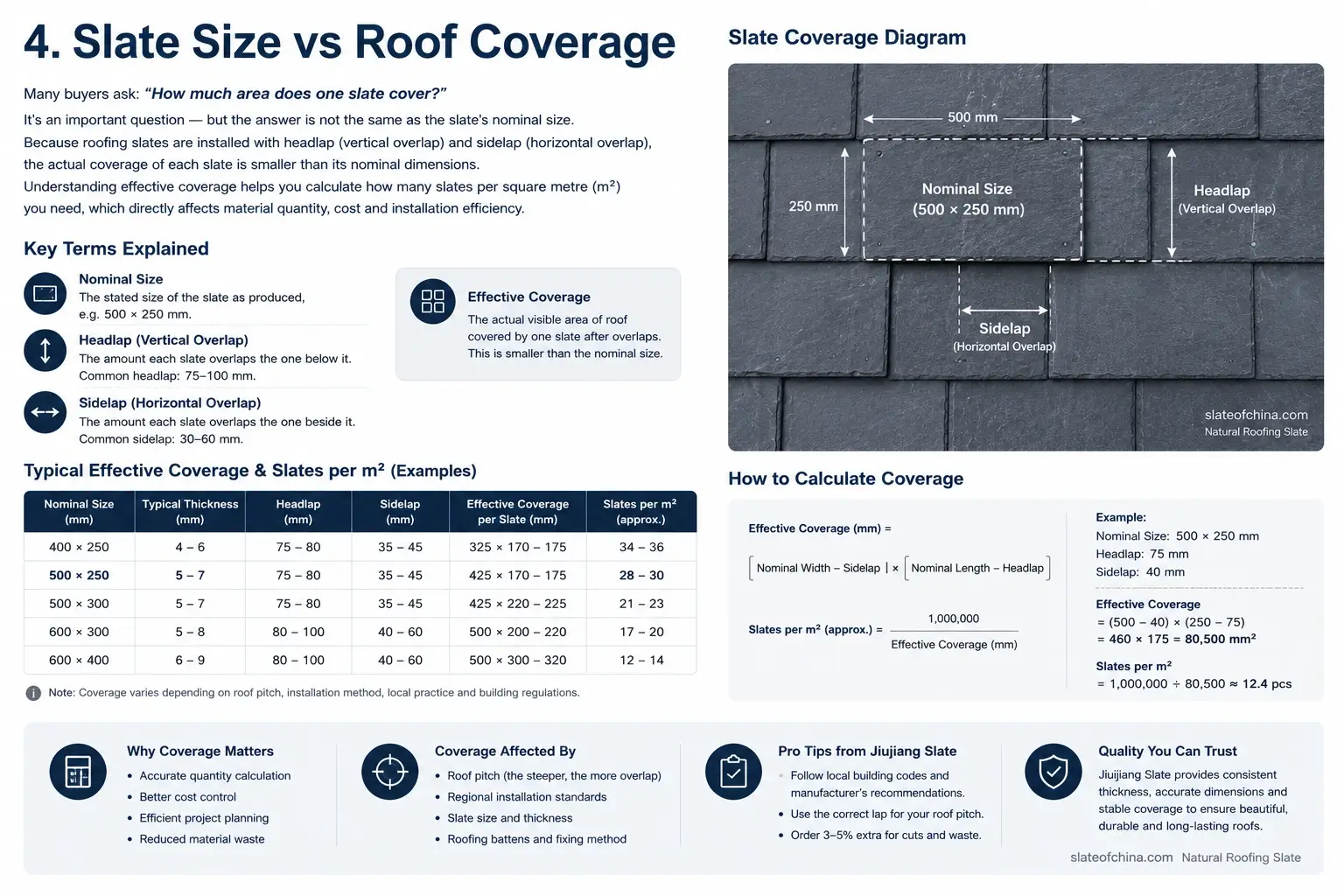
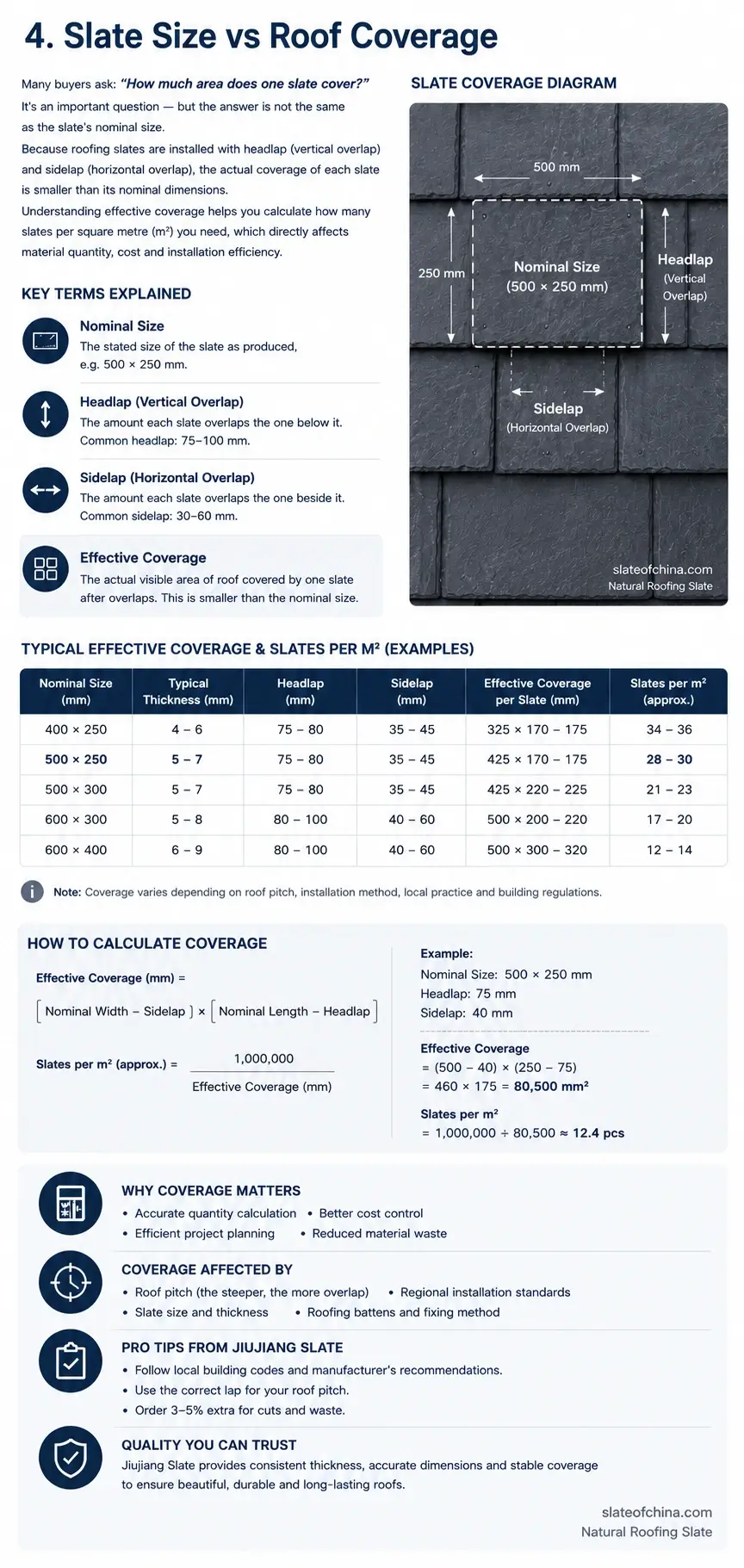
Slate Size vs Roof Coverage

One of the most common questions from homeowners, contractors, and roofing distributors is:

How much area does one roofing slate actually cover?

The answer is not the same as the slate’s nominal size.

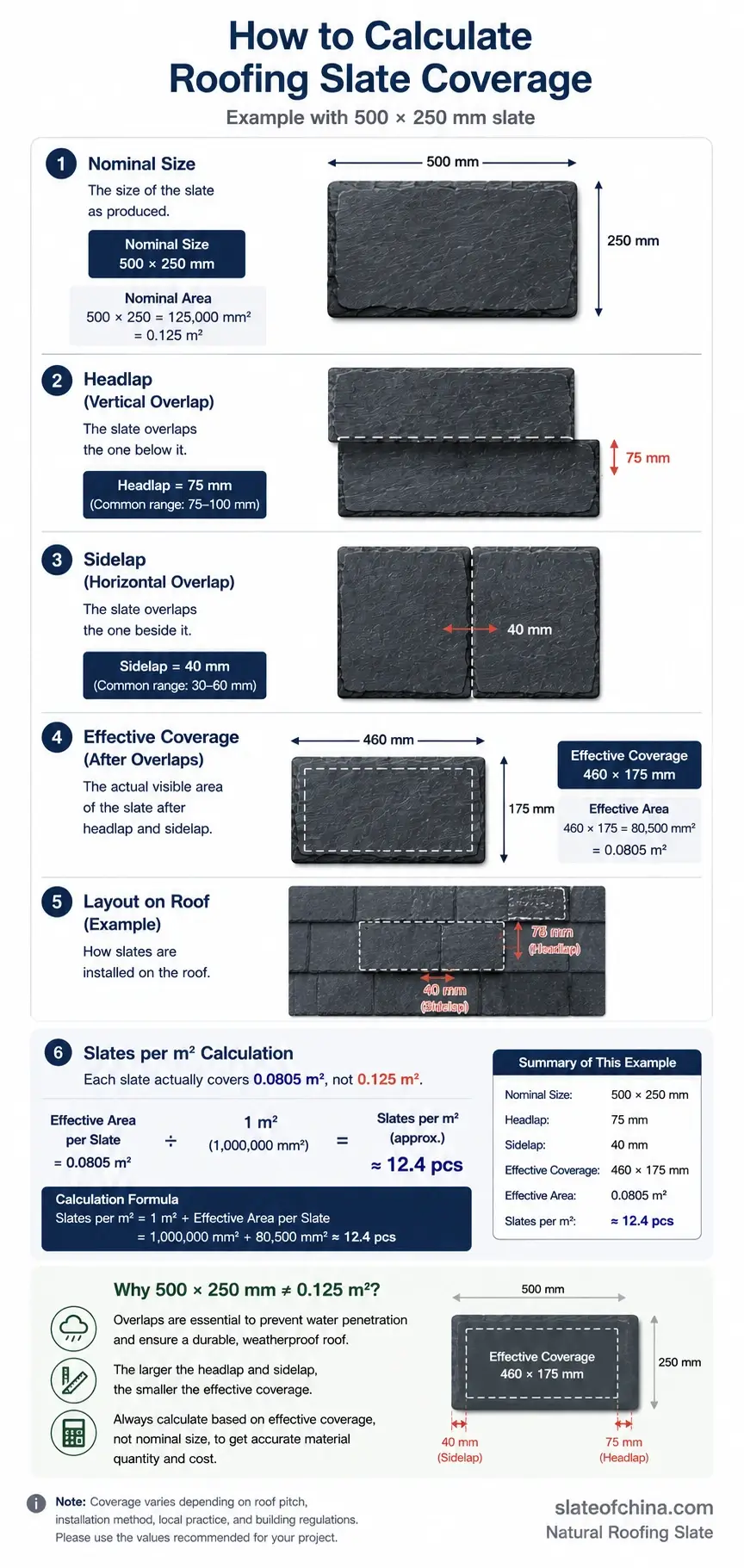
Although a roofing slate may be manufactured as 500 × 250 mm, only part of that surface remains visible after installation. During roofing, each slate overlaps the slates above and beside it to create a weatherproof roof. As a result, the effective roof coverage of each slate is always smaller than its actual dimensions.

Understanding the relationship between slate size and roof coverage is essential for estimating material quantities, calculating installation costs, and selecting the most suitable roofing slate for your project.

Key Terms Explained

Before calculating roof coverage, it’s important to understand a few basic roofing terms.

Nominal Size

The nominal size is the manufactured size of the roofing slate before installation.

For example:

  • 500 × 250 mm
  • 600 × 300 mm
  • 400 × 250 mm

This is the size normally shown in product catalogues and quotations.

Headlap

Headlap is the vertical overlap between two rows of roofing slates.

This overlap prevents rainwater from penetrating beneath the slates and is one of the most important factors affecting roof performance.

Typical headlap ranges from:

  • 75–100 mm for most residential roofs
  • Greater headlap for low roof pitches or severe weather conditions

The larger the headlap, the smaller the effective coverage of each slate.

Sidelap (Horizontal Overlap)

Sidelap is the horizontal overlap between adjacent slates.

Its purpose is to prevent wind-driven rain from entering through the side joints.

The required sidelap depends on:

  • Roof pitch
  • Local building regulations
  • Roofing system
  • Installation method

Effective Coverage

Effective coverage refers to the actual roof area covered by one slate after all required overlaps have been taken into account.

This is the value used to calculate:

  • Number of slates per square metre
  • Material quantities
  • Roofing costs
  • Installation efficiency

For this reason, contractors always calculate roofing materials based on effective coverage, not nominal slate size.

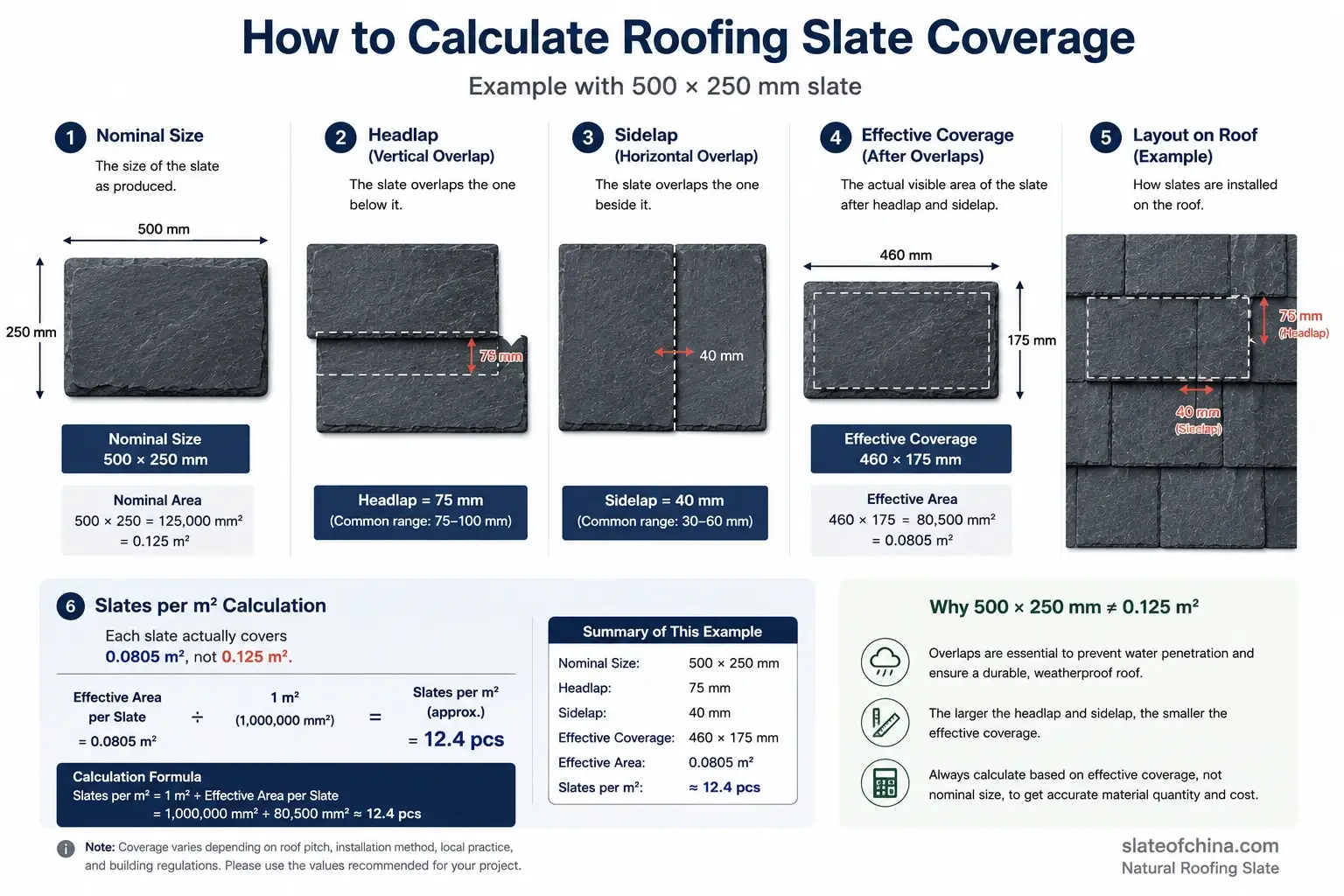
Example: 500 × 250 mm Roofing Slate

Let’s look at a typical example.

A roofing slate measures:

Nominal Size

500 × 250 mm

However, after installation:

  • Headlap = 75 mm
  • Sidelap = 40 mm

The visible roof area becomes approximately:

  • Effective Width ≈ 460 mm
  • Effective Height ≈ 175 mm

This means each slate covers only about:

0.0805 m²

instead of the full 0.125 m² suggested by its nominal dimensions.

As a result, you need more slates to cover one square metre than many first-time buyers expect.

Typical Roof Coverage by Slate Size

The table below provides approximate coverage values for several common roofing slate sizes.

Nominal SizeTypical HeadlapApproximate Effective CoverageApproximate Slates per m²
400 × 250 mm75–80 mm0.055–0.060 m²34–36
500 × 250 mm75–80 mm0.080–0.085 m²28–30
500 × 300 mm75–80 mm0.095–0.100 m²21–23
600 × 300 mm80–100 mm0.110–0.120 m²17–20
600 × 400 mm80–100 mm0.140–0.160 m²12–14

Note: These values are for reference only. Actual coverage depends on roof pitch, local building codes, installation method, headlap, sidelap, and manufacturer recommendations.

What Affects Roof Coverage?

Several factors influence the effective coverage of roofing slate.

Roof Pitch

Steeper roofs generally require less overlap, allowing each slate to cover a larger visible area.

Lower-pitched roofs usually require increased headlap to improve weather resistance.


Slate Size

Larger slates typically cover more roof area per piece, reducing the total number of slates required.

Smaller slates provide greater flexibility for complex roof shapes but increase material quantities and installation time.


Installation Standards

Different countries use different roofing practices.

For example, UK roofing standards, European installation methods, and local building regulations may specify different headlap requirements for the same slate size.


Climate

Regions exposed to heavy rainfall, snow, or strong winds often require greater overlaps to improve roof performance, which reduces effective coverage.

Why Roof Coverage Matters

Understanding roofing slate coverage helps you:

  • Estimate the correct quantity of roofing slates
  • Calculate project costs more accurately
  • Reduce material waste
  • Compare different slate sizes more effectively
  • Improve installation planning
  • Avoid costly ordering mistakes

For contractors, importers, and distributors, accurate coverage calculations are essential for preparing quotations and managing project budgets.

Expert Advice

When selecting a roofing slate, don’t compare products by size alone.

Always consider:

  • Nominal dimensions
  • Required headlap
  • Effective coverage
  • Pieces per square metre
  • Roof pitch
  • Local installation standards

Two slates with the same nominal dimensions may require different quantities depending on the roofing system and installation method.

Jiujiang Slate Recommendation

At Jiujiang Slate, we provide detailed technical data for every roofing slate size, including:

  • Nominal dimensions
  • Thickness
  • Recommended headlap
  • Approximate slates per m²
  • Roof coverage guidance
  • Custom size recommendations

Our technical team can also help you calculate the most suitable slate size and estimated material quantity for your specific roofing project, ensuring accurate ordering and efficient installation.

roofing slate coverage guide
roofing slate coverage guide mobile
how to calculate roofing slate coverage
how to calculate roofing slate coverage mobile

Roofing Slate Size Chart

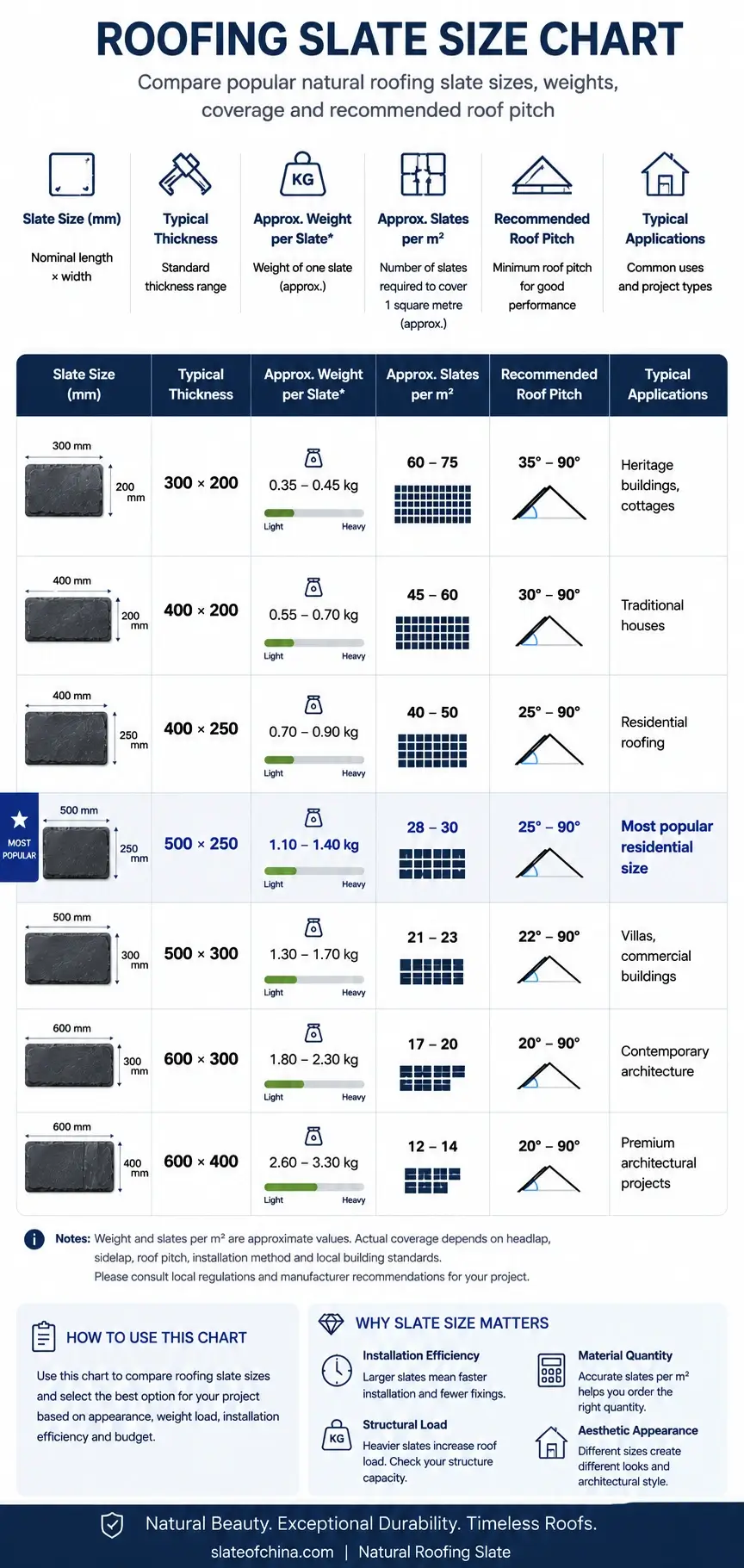
Selecting the right roofing slate size involves more than choosing the dimensions. Buyers should also consider slate weight, roof coverage, pieces per square metre, and the recommended roof pitch. These factors affect installation efficiency, structural load, material quantity, and the overall appearance of the finished roof.

The following roofing slate size chart provides a quick comparison of the most commonly used natural roofing slate sizes. It can help architects, contractors, distributors, and homeowners choose the most suitable slate for residential, commercial, and heritage roofing projects.

Standard Roofing Slate Size Chart

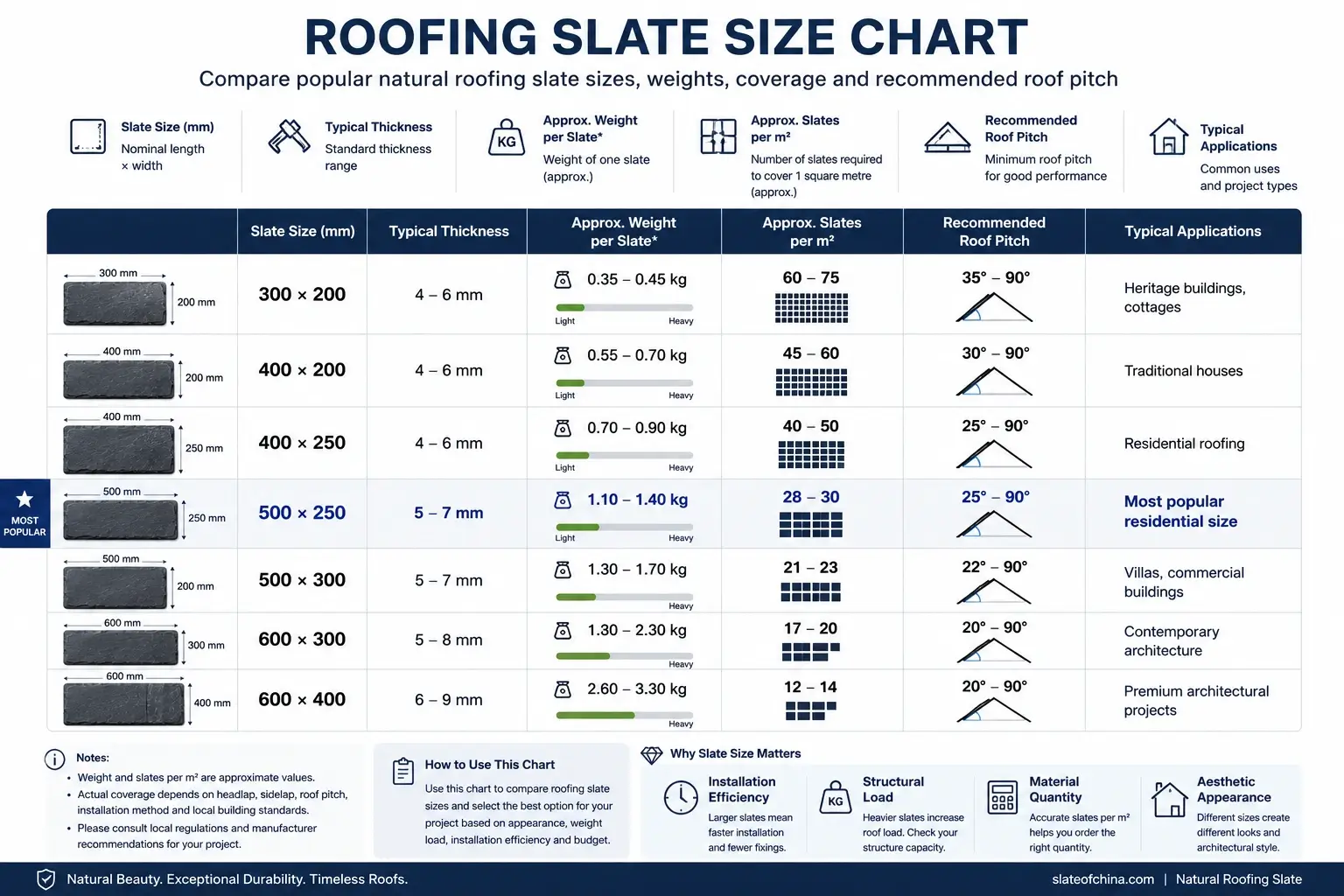
Slate Size (mm)Typical ThicknessApprox. Weight per Slate*Approx. Slates per m²Recommended Roof PitchTypical Applications
300 × 2004–6 mm0.35–0.45 kg60–7535°–90°Heritage buildings, cottages
400 × 2004–6 mm0.55–0.70 kg45–6030°–90°Traditional houses
400 × 2504–6 mm0.70–0.90 kg40–5025°–90°Residential roofing
500 × 2505–7 mm1.10–1.40 kg28–3025°–90°Most popular residential size
500 × 3005–7 mm1.30–1.70 kg21–2322°–90°Villas, commercial buildings
600 × 3005–8 mm1.80–2.30 kg17–2020°–90°Contemporary architecture
600 × 4006–9 mm2.60–3.30 kg12–1420°–90°Premium architectural projects

Note: Weight and coverage values are approximate and may vary depending on slate thickness, density, headlap, installation method, and local building standards.

How to Use This Roofing Slate Size Chart

This chart is intended as a practical reference when selecting natural roofing slate.

When comparing different slate sizes, consider the following:

Slate Size

Larger roofing slates cover more roof area per piece, reducing installation time and the total number of slates required. Smaller slates create a more traditional appearance and are better suited to roofs with complex shapes.

Weight

Slate weight increases with both size and thickness. Before selecting larger or heavier slates, ensure the roof structure is designed to support the additional load.

Pieces per Square Metre

The number of slates per m² is one of the most important figures for estimating project costs and ordering materials.

Generally:

  • More pieces = longer installation time and higher labour costs.
  • Fewer pieces = faster installation and fewer fixing points.

Recommended Roof Pitch

Roof pitch determines the minimum overlap required between slates.

Steeper roofs usually require less overlap, allowing greater effective coverage.

Lower-pitched roofs require larger headlaps to improve waterproof performance.

Always follow local building regulations and manufacturer recommendations when selecting slate sizes for different roof pitches.

Which Roofing Slate Size Is Most Popular?

Although there is no universal standard, several sizes dominate international markets.

UK

The 500 × 250 mm (20 × 10 in) slate is the most widely used size for residential roofing because it offers an excellent balance between appearance, installation efficiency, and cost.

Europe

Common European projects often specify:

  • 400 × 250 mm
  • 500 × 300 mm
  • 600 × 300 mm

depending on the architectural style and local installation practices.

Contemporary Architecture

Modern buildings increasingly favour larger-format slates such as 600 × 300 mm and 600 × 400 mm, creating cleaner roof lines with fewer visible joints.


Expert Buying Tips

When choosing roofing slate, avoid selecting a product based on size alone.

Instead, compare:

  • Slate dimensions
  • Slate thickness
  • Weight per slate
  • Pieces per square metre
  • Roof pitch
  • Effective roof coverage
  • Installation method

The most economical slate is not always the largest one. The best choice depends on the building design, local climate, roofing system, and project budget.

Jiujiang Slate Size Range

Jiujiang Slate manufactures natural roofing slates in virtually all internationally recognised sizes.

We can supply:

  • Standard UK roofing slate sizes
  • European roofing slate dimensions
  • Custom slate sizes
  • Various thickness options
  • Pre-drilled or undrilled slates
  • Natural edge or machine-cut edge finishes

Whether you require standard production or project-specific dimensions, our technical team can recommend the most suitable slate size based on your roofing requirements.

Quick Selection Guide

If You Need…Recommended Slate Size
Traditional appearance300 × 200 mm
Heritage restoration300 × 200 / 400 × 200 mm
Most residential projects500 × 250 mm
Villas & luxury homes500 × 300 mm
Modern architecture600 × 300 mm
Large commercial roofs600 × 400 mm
Roofing slate size chart showing standard slate dimensions, thickness, weight, slates per square metre and recommended roof pitch.
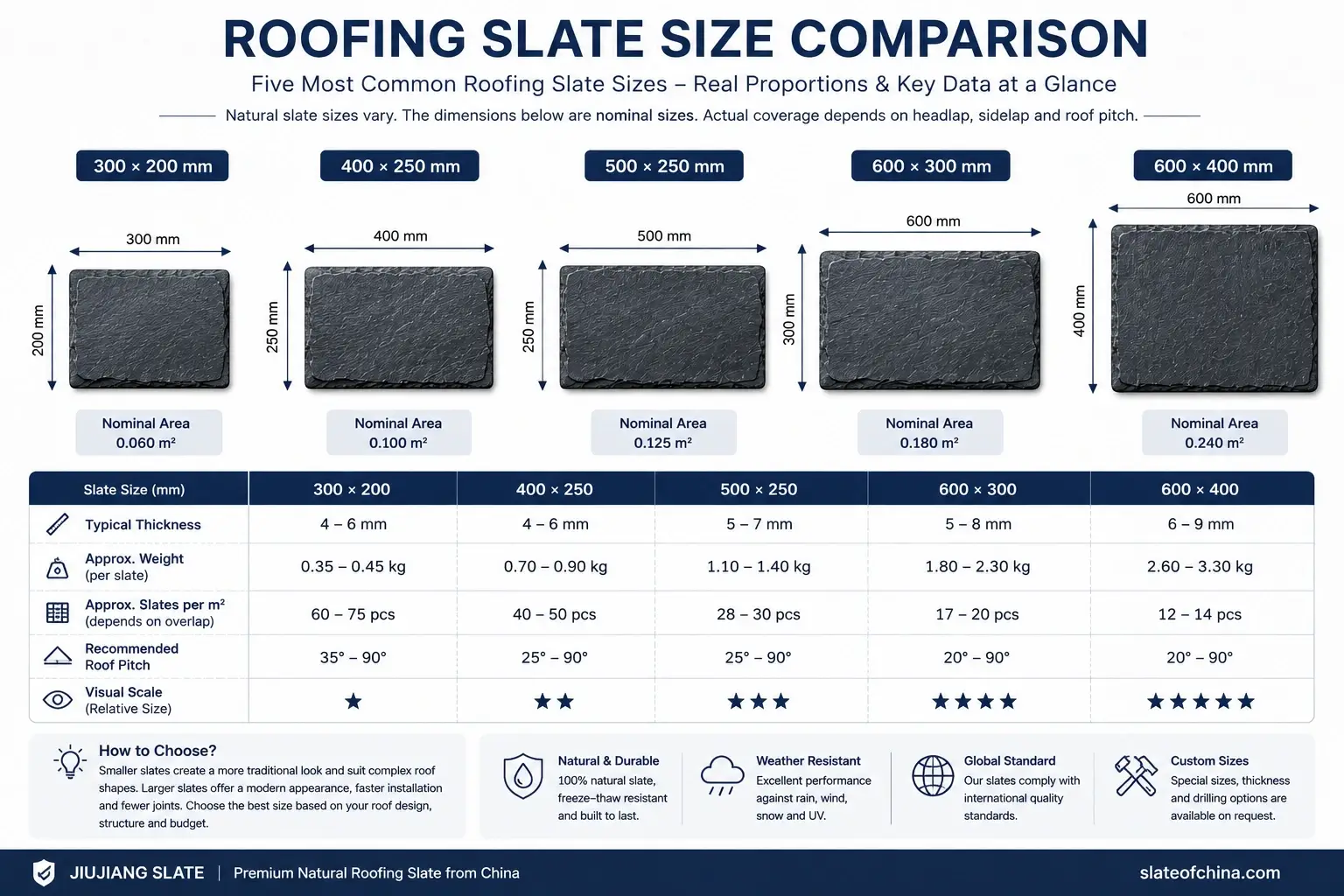
Roofing slate size comparison showing 300×200, 400×250, 500×250, 600×300 and 600×400 mm natural roofing slate sizes in real proportion.
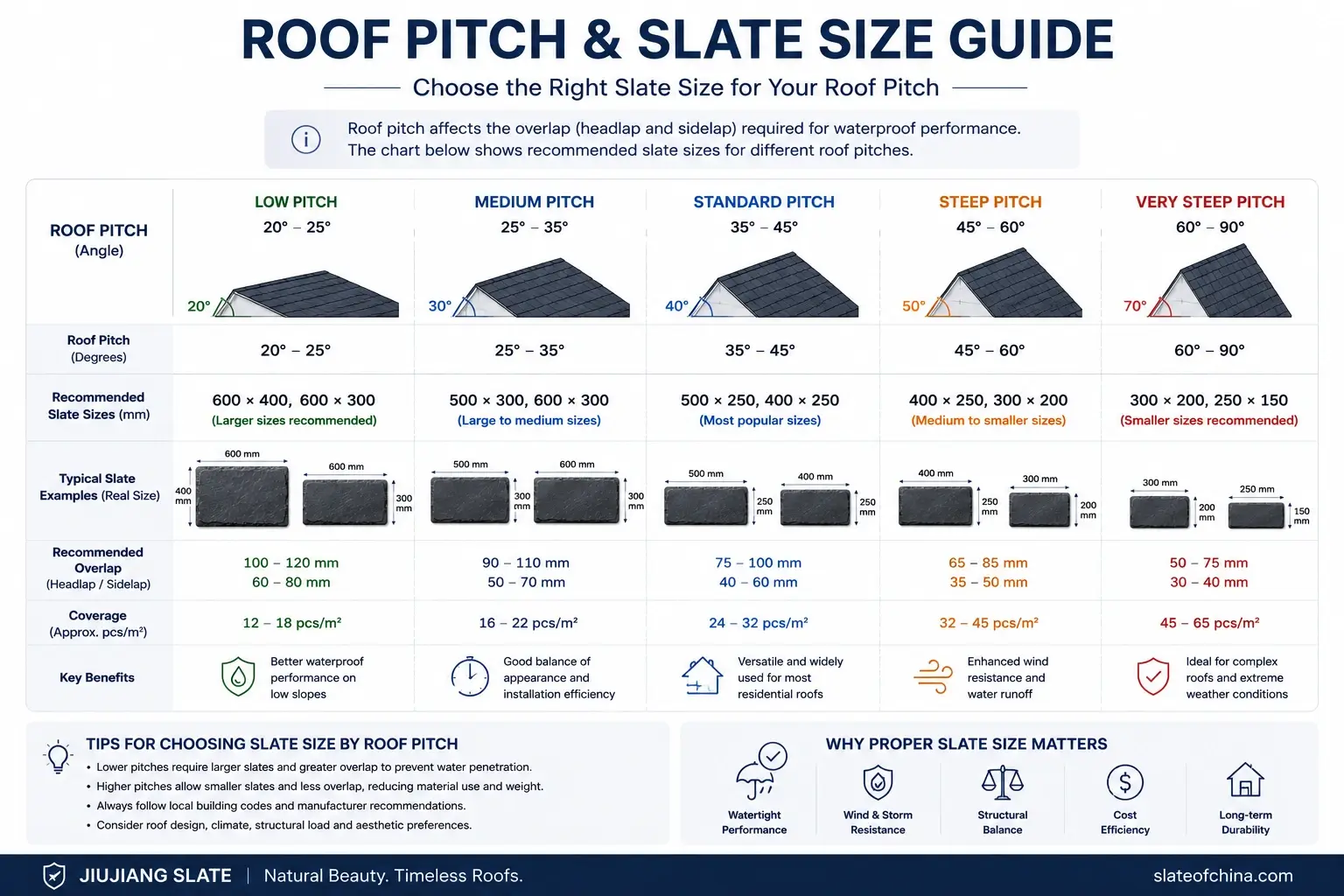
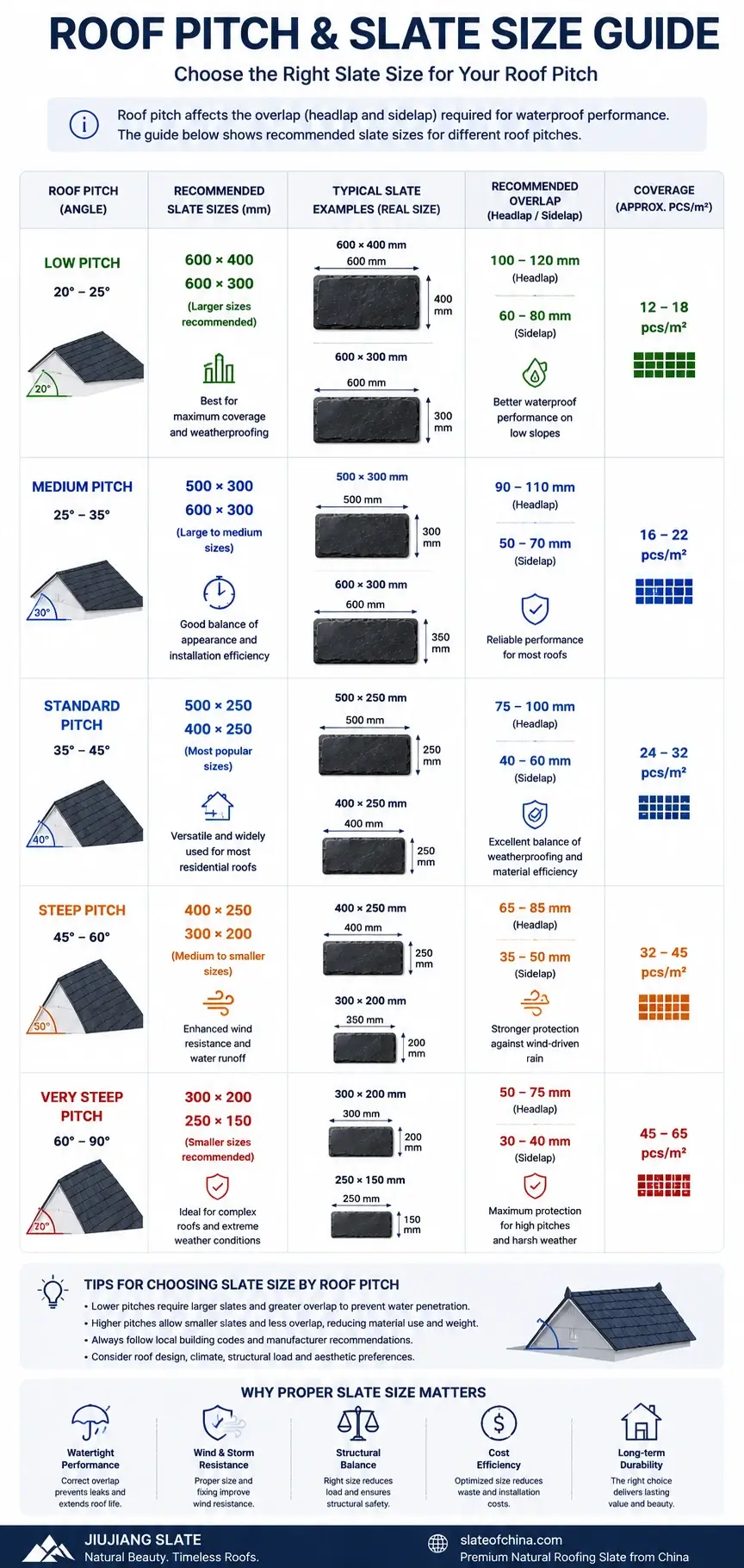
Roof pitch and slate size guide showing recommended natural roofing slate sizes for different roof pitch angles.

Small vs Large Roofing Slate

When choosing natural roofing slate, one of the most common questions is:

Should I choose small roofing slates or large roofing slates?

The answer depends on your building style, roof design, local climate, installation requirements, and budget. While both options provide the exceptional durability and natural beauty of slate, they create very different visual effects and influence installation efficiency, material quantities, and overall project costs.

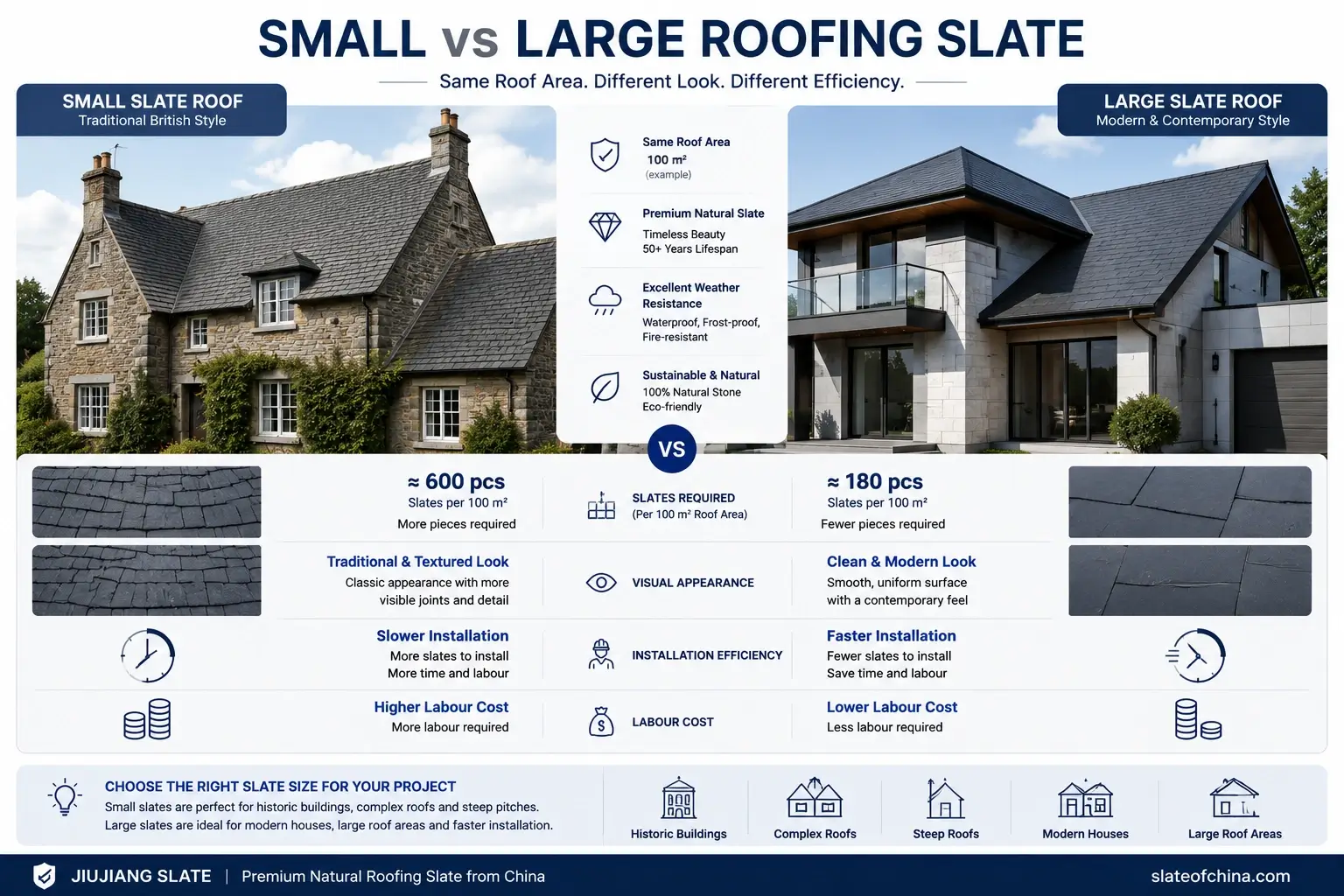
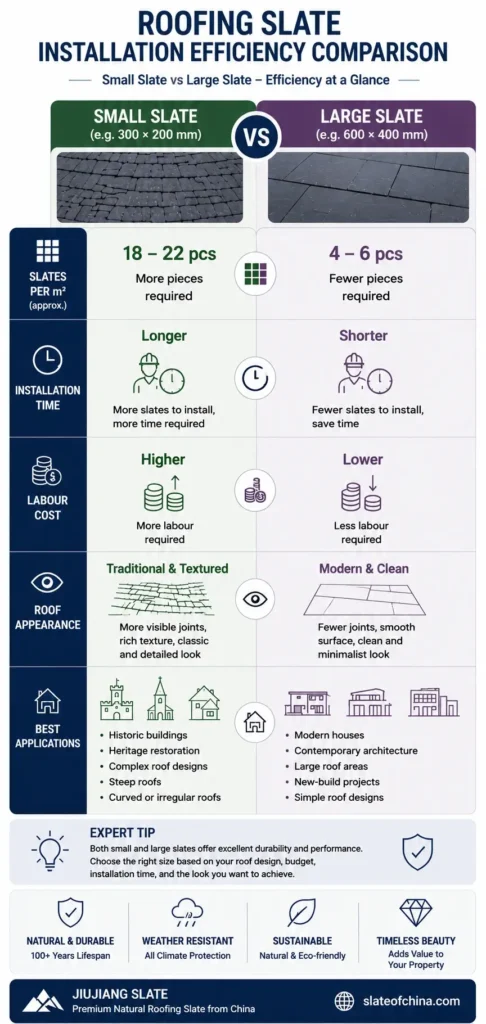
In general, small roofing slates are preferred for traditional architecture and complex roof designs, while large roofing slates are increasingly used for modern homes and commercial buildings where a clean appearance and faster installation are priorities.

Small vs Large Roofing Slate Comparison

FeatureSmall Roofing SlateLarge Roofing Slate
Typical Sizes300 × 200 mm, 400 × 200 mm500 × 300 mm, 600 × 300 mm, 600 × 400 mm
Roof AppearanceTraditional, textured and detailedModern, clean and minimalist
Best ForHeritage buildings, cottages, churchesModern homes, villas, commercial buildings
Complex Roofs★★★★★ Excellent★★ Suitable for simple roof layouts
Installation SpeedSlowerFaster
Slates per m²More pieces requiredFewer pieces required
Labour CostHigherLower
Roof Weight*Usually lighter per pieceHeavier per piece
Wind ResistanceExcellent for complex roof detailsExcellent when correctly fixed
Overall CostHigher installation costLower installation cost

Note: Although large slates are heavier individually, the total roof weight per square metre depends on both slate size and thickness. Always consider the complete roofing system rather than the weight of a single slate.

Small Roofing Slate

Advantages of Small Roofing Slate

Small-format roofing slates are the traditional choice for many historic and architectural roofing projects. Their compact size allows roofers to follow curves, valleys, dormers, turrets, and other intricate roof features with greater precision.

They also create a classic roof texture with more visible joints, making them especially suitable for heritage restoration and period-style buildings.

Ideal Applications

  • Historic buildings
  • Heritage restoration projects
  • Churches and castles
  • Traditional cottages
  • Complex roof layouts
  • Steep roof pitches
  • Curved or irregular roofs

Considerations

Because more slates are required to cover the same roof area, installation takes longer and typically requires more labour. Material handling and fixing costs are therefore generally higher than with larger slate formats.

Large Roofing Slate

Advantages of Large Roofing Slate

Large-format roofing slates have become increasingly popular in contemporary architecture thanks to their clean lines and efficient installation. Fewer slates are needed to cover each square metre, reducing fixing points and installation time while creating a sleek, modern appearance.
They are widely specified for new residential developments, luxury homes, hotels, and commercial buildings.

Ideal Applications

  • Modern houses
  • Villas
  • Contemporary architecture
  • Commercial buildings
  • Large roof surfaces
  • New-build projects

Considerations

Large slates are heavier than smaller formats and require careful handling during transportation and installation. Roof structures should always be designed to support the selected slate size and thickness.

Large-format slates are also less suitable for roofs with numerous valleys, dormers, or complex shapes, where smaller slates provide greater flexibility.

Which Roofing Slate Size Should You Choose?

The best roofing slate size depends on your specific project requirements.

Choose small roofing slate if you need:

  • A traditional architectural appearance
  • Heritage restoration
  • Complex roof geometry
  • Better flexibility around roof details
  • Steep roof applications

Choose large roofing slate if you need:

  • Faster installation
  • Reduced labour costs
  • A clean, modern roof design
  • Large, simple roof surfaces
  • Contemporary architectural projects

Expert Recommendation

There is no universal “best” roofing slate size. The ideal choice should balance appearance, roof design, installation efficiency, structural capacity, and budget.

For most residential projects in the UK and Europe, 500 × 250 mm remains the most versatile option because it combines an attractive appearance with efficient installation and excellent overall performance.

For premium architectural projects, larger formats such as 600 × 300 mm or 600 × 400 mm create a bold, contemporary look. Conversely, 300 × 200 mm and 400 × 200 mm remain the preferred choice for traditional and heritage buildings.

Why Choose Jiujiang Slate?

Jiujiang Slate manufactures both small-format and large-format natural roofing slates to meet the requirements of different international markets.

Our product range includes:

  • Traditional UK roofing slate sizes
  • European standard slate dimensions
  • Large-format architectural slates
  • Custom sizes and thicknesses
  • Machine-cut and natural-edge finishes
  • OEM and project-specific production

Whether you are restoring a historic landmark or building a modern luxury home, we can recommend the most suitable slate size for your roofing project.

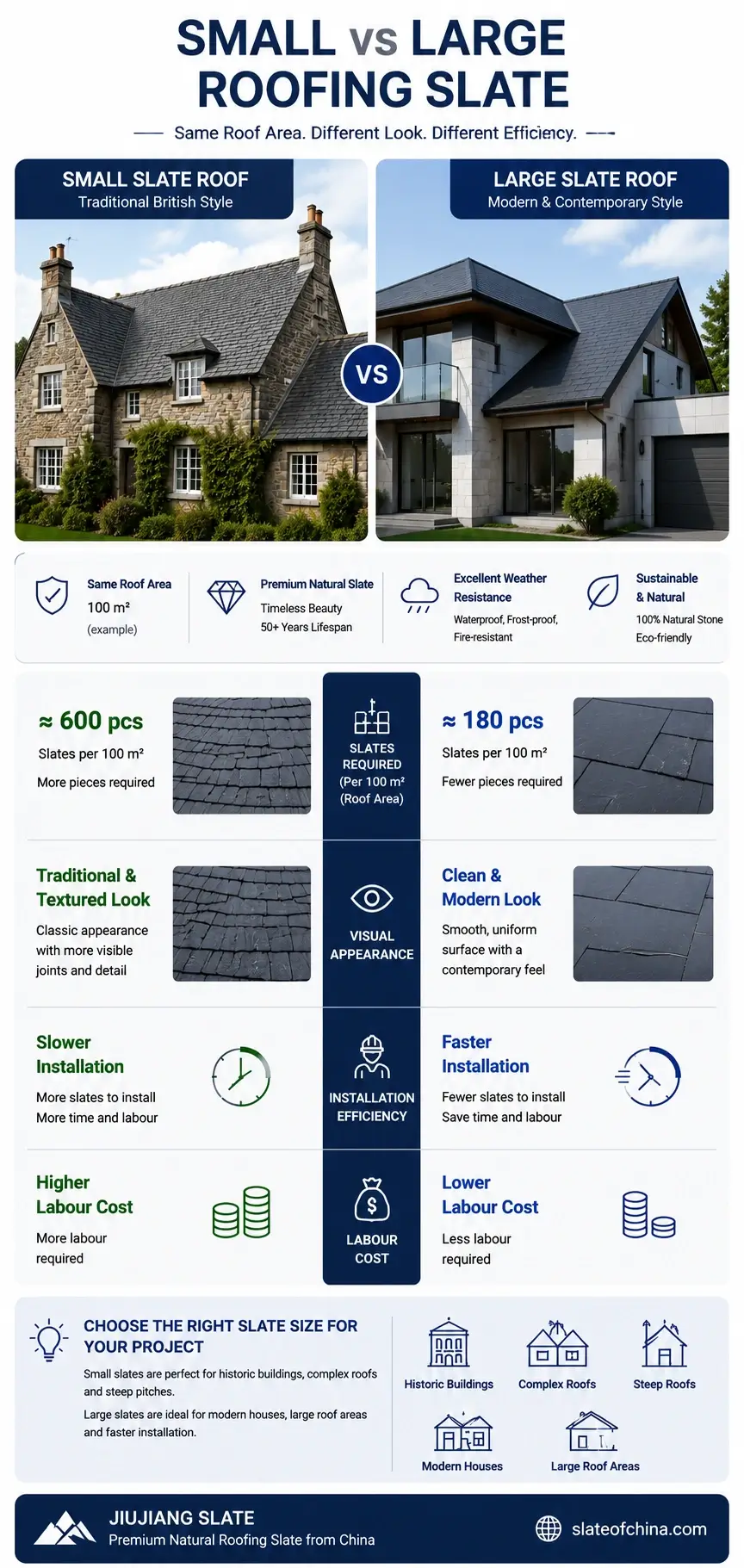
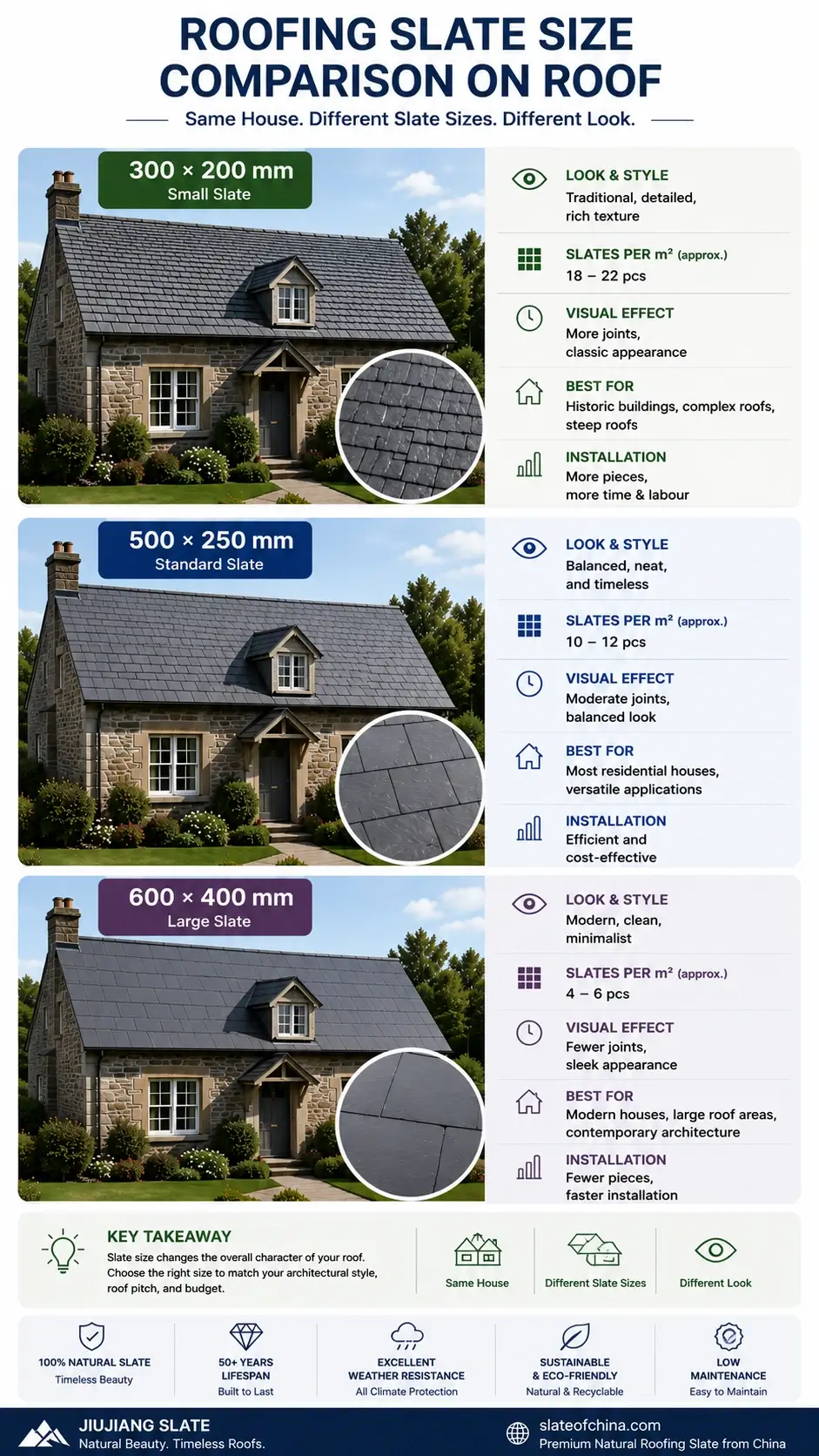
Small vs large roofing slate comparison showing traditional small slate roofs and modern large slate roofs with differences in appearance, installation efficiency and labour requirements.
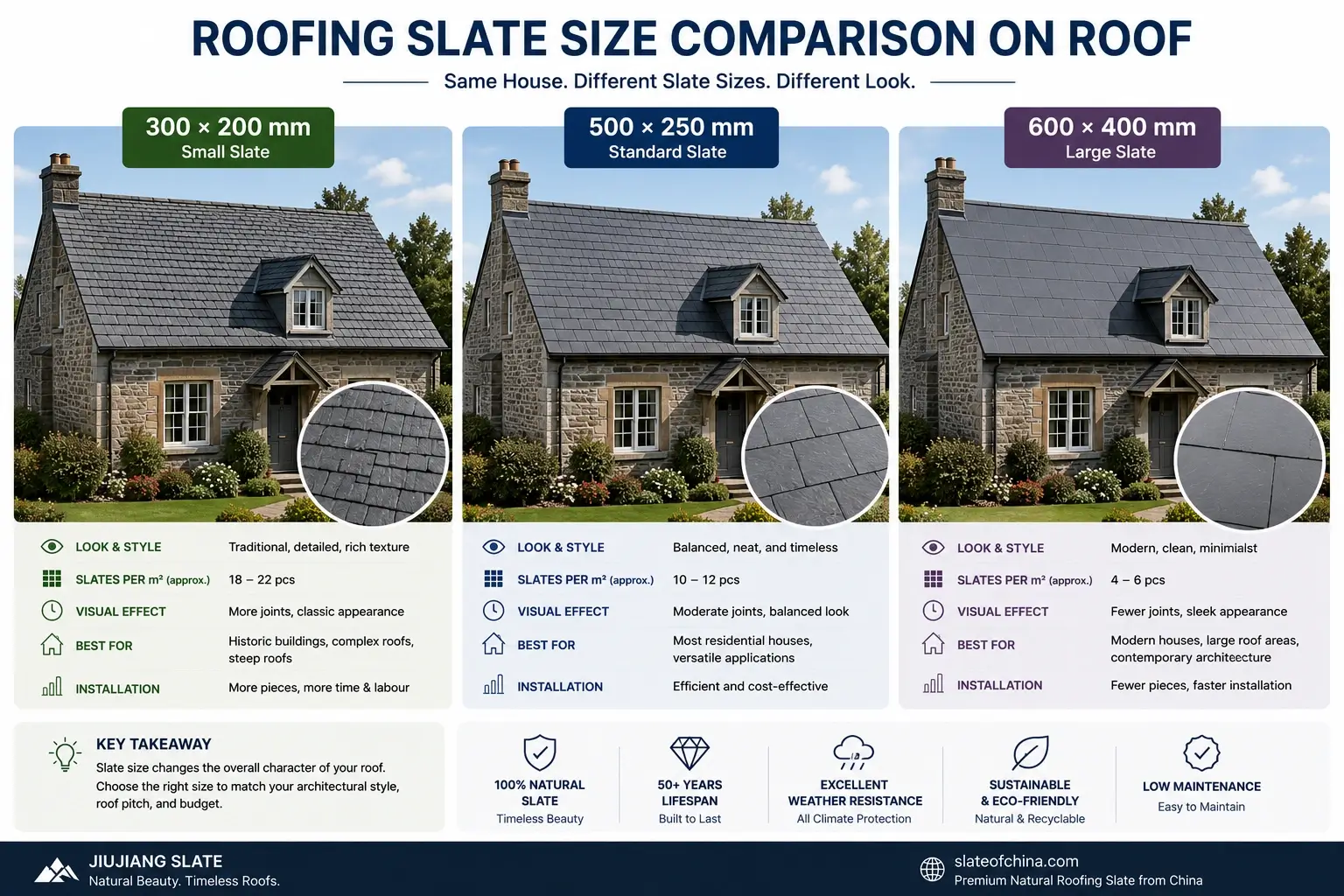
Roofing slate size comparison on the same house showing 300 × 200 mm, 500 × 250 mm and 600 × 400 mm natural slate roofs with different roof textures and visual appearance.
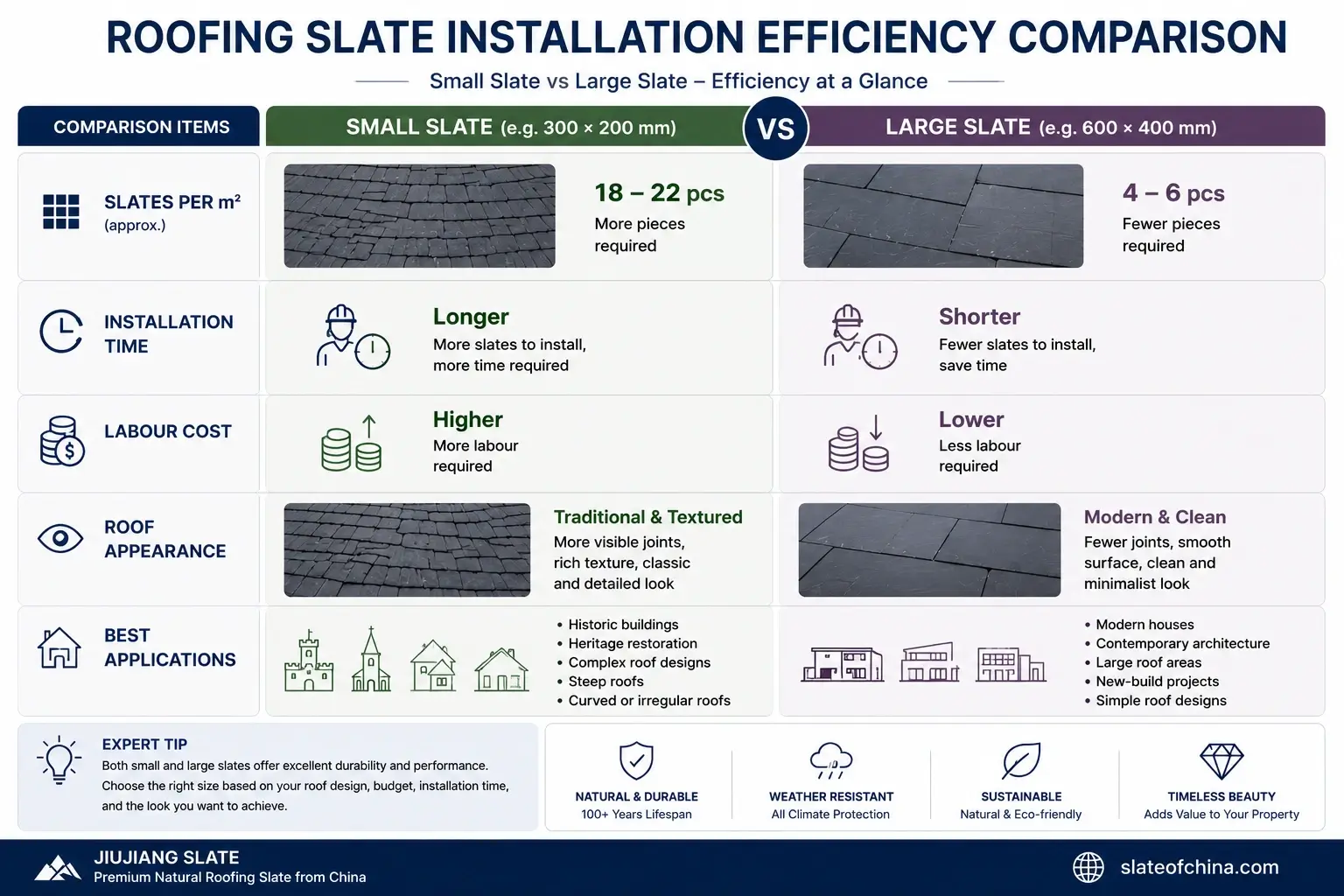
Installation efficiency comparison between small roofing slate and large roofing slate, showing slates per square metre, installation time, labour cost, roof appearance and best applications.

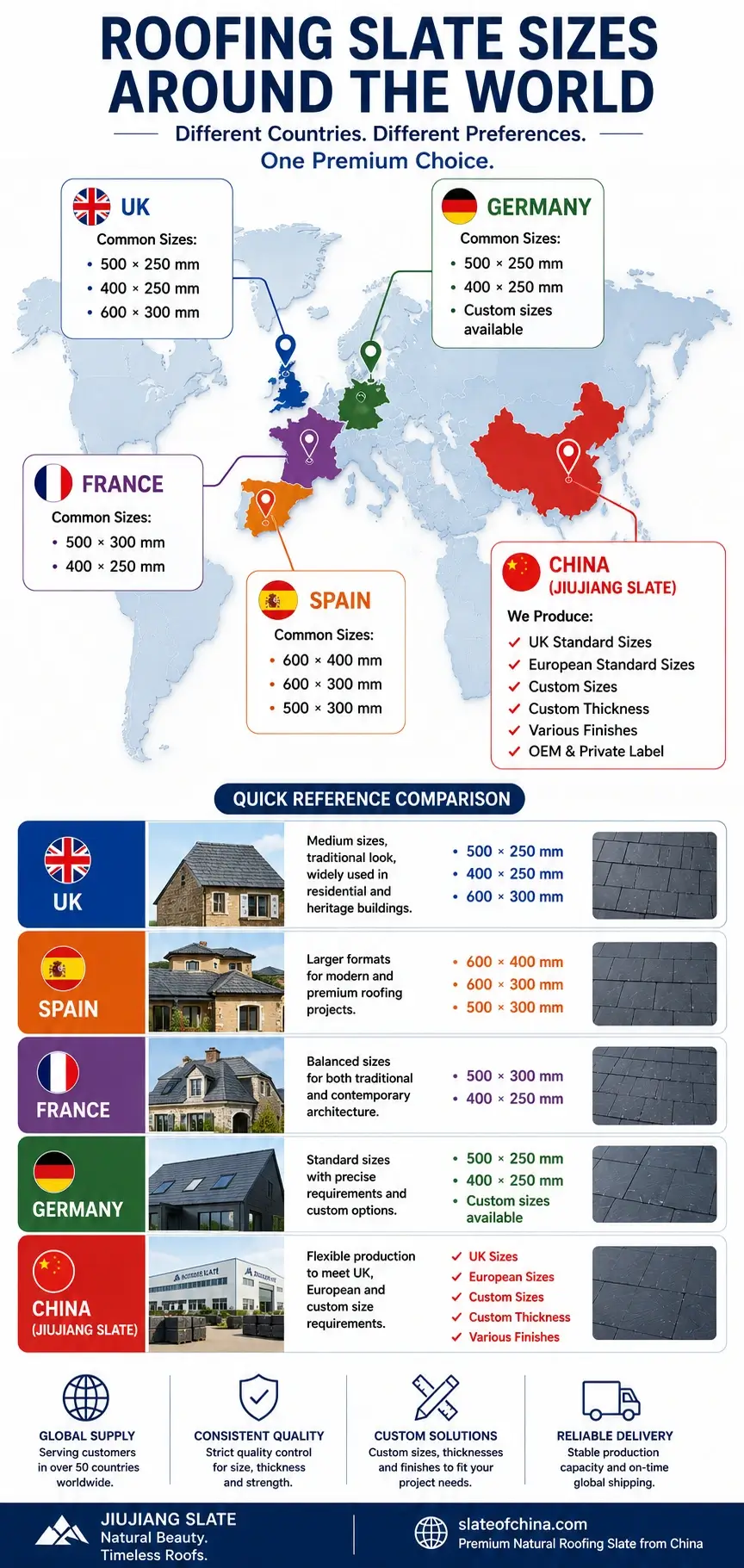
Roofing Slate Sizes by Country

Although natural roofing slate is used around the world, there is no single international standard for roofing slate sizes. Each country has developed its own preferred slate dimensions based on local architectural styles, roofing traditions, climate, and installation standards.

Understanding these regional preferences is essential for importers, distributors, architects, and contractors when selecting the right roofing slate for a project or sourcing products from overseas manufacturers.

Below is an overview of the most common roofing slate sizes used in major markets.

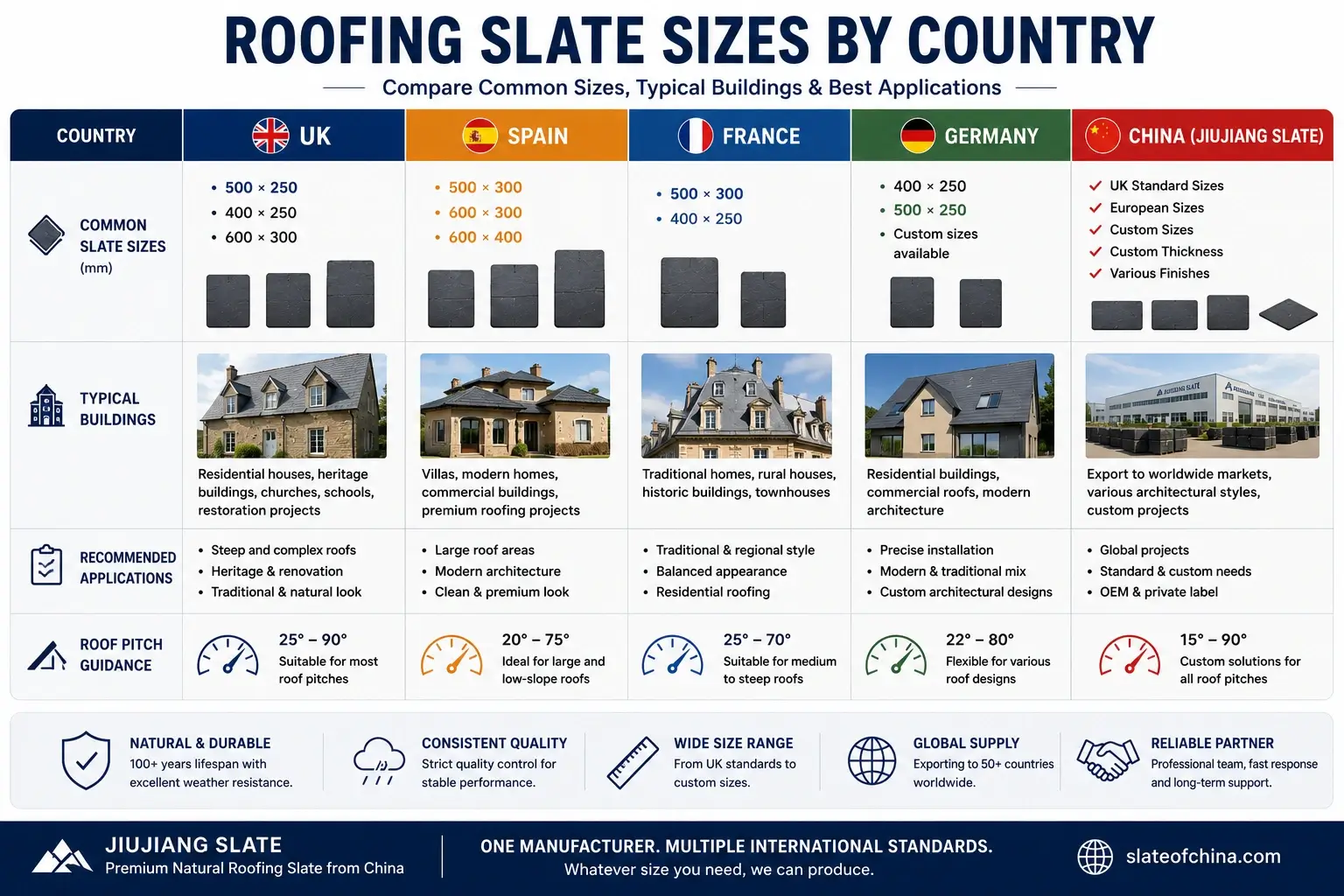
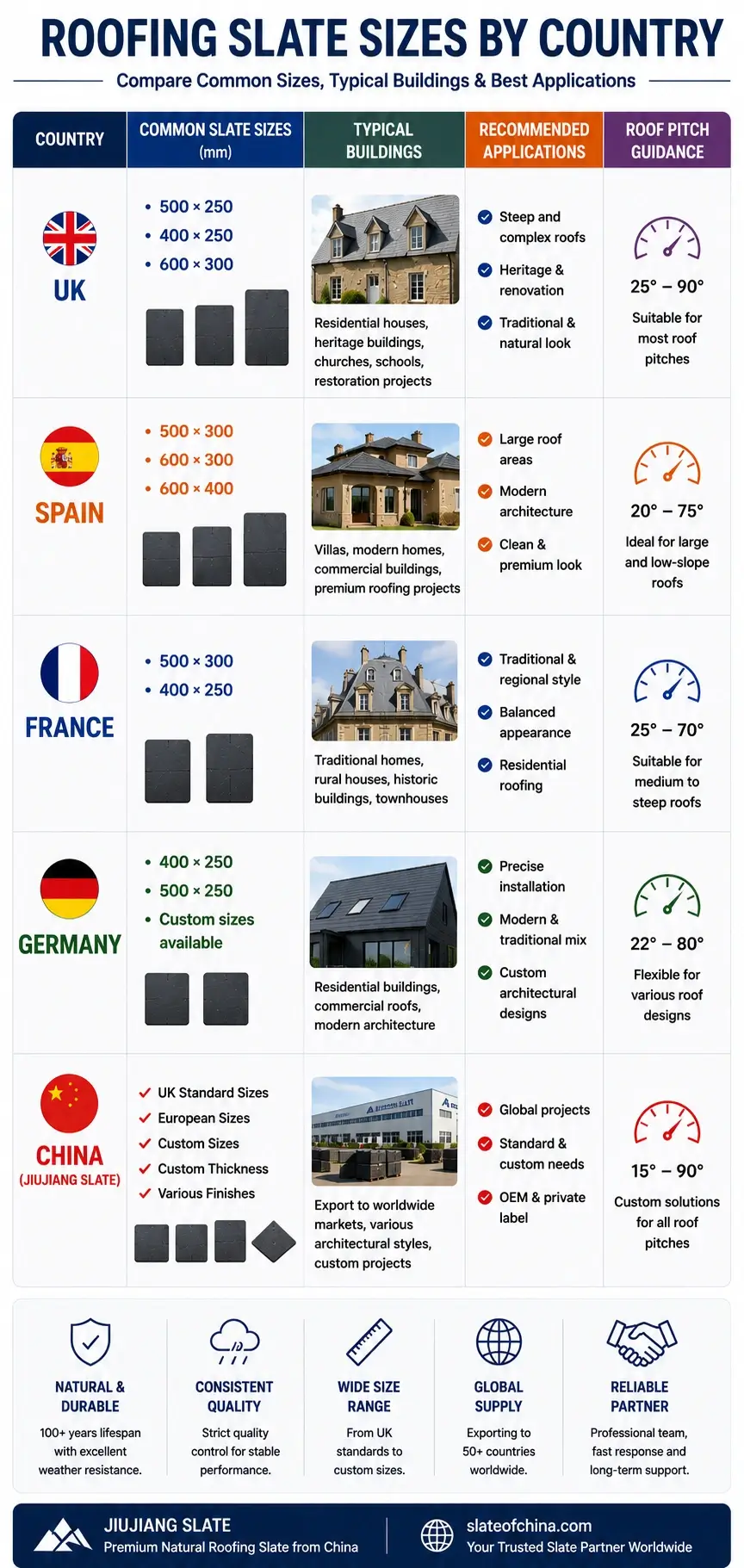
Roofing Slate Sizes by Country Comparison

Country / MarketCommon Roofing Slate SizesTypical Applications
UK400 × 250 mm, 500 × 250 mm, 600 × 300 mmResidential houses, heritage buildings
Spain500 × 300 mm, 600 × 300 mm, 600 × 400 mmVillas, commercial buildings, premium roofing
France400 × 250 mm, 500 × 300 mmTraditional and contemporary homes
Germany400 × 250 mm, 500 × 250 mm, custom formatsResidential and commercial roofing
China (Jiujiang Slate)UK sizes, European sizes, custom sizesGlobal export markets

Note: Available sizes may vary depending on roofing systems, local building regulations, and customer specifications.

UK Roofing Slate Sizes

The UK has one of the world’s longest traditions of natural slate roofing. British roofs typically use medium-sized slates, offering an excellent balance between appearance, durability, and installation efficiency.

The most popular UK roofing slate sizes include:

  • 400 × 250 mm
  • 500 × 250 mm (20 × 10 in) — the most widely used residential size
  • 600 × 300 mm

These sizes are commonly specified for residential housing, listed buildings, churches, schools, and renovation projects.

Spain Roofing Slate Sizes

The Spanish market generally favours larger-format roofing slates, particularly for modern architecture and premium residential developments.

Common Spanish slate sizes include:

  • 500 × 300 mm
  • 600 × 300 mm
  • 600 × 400 mm

Larger slates reduce the number of pieces required per square metre and create a cleaner, more contemporary roof appearance.

France Roofing Slate Sizes

In France, roofing slate sizes are selected according to regional architectural traditions and roof design.

The most common formats include:

  • 400 × 250 mm
  • 500 × 300 mm

French slate roofs often combine elegant proportions with precise installation, making medium-sized slates the preferred choice for many residential and heritage projects.

Germany Roofing Slate Sizes

The German market uses both standard and project-specific slate dimensions.

Common sizes include:

  • 400 × 250 mm
  • 500 × 250 mm
  • Custom-cut roofing slates for architectural applications

Many German roofing projects place strong emphasis on precision cutting, consistent thickness, and strict compliance with installation standards.

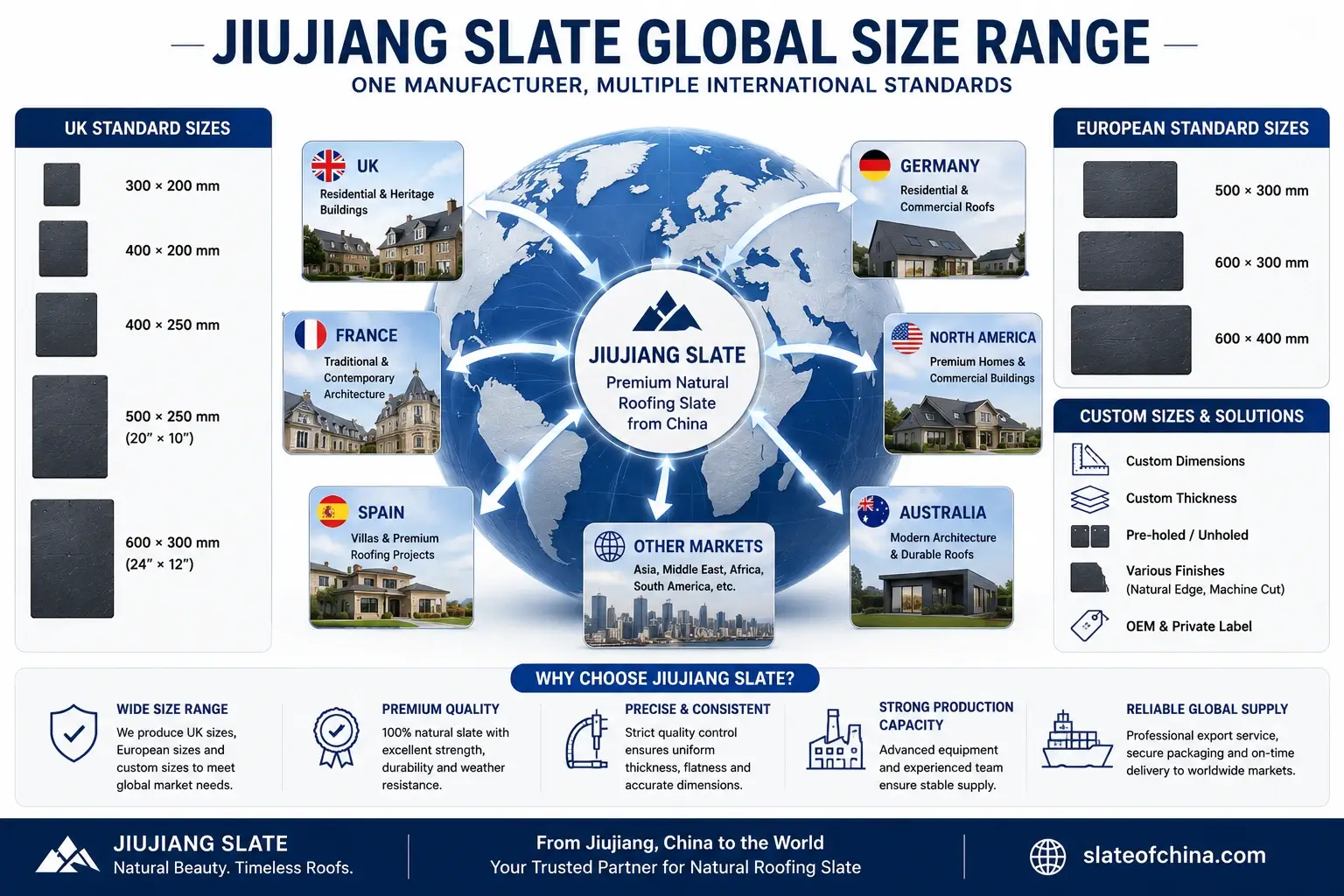
China (Jiujiang Slate) – Flexible Production for Global Markets

Unlike many manufacturers that offer only a limited range of standard products, Jiujiang Slate manufactures natural roofing slates in virtually all internationally recognised sizes.

We regularly produce:

UK Roofing Slate Sizes

  • 300 × 200 mm
  • 400 × 200 mm
  • 400 × 250 mm
  • 500 × 250 mm
  • 600 × 300 mm

European Roofing Slate Sizes

  • 500 × 300 mm
  • 600 × 300 mm
  • 600 × 400 mm

Custom Roofing Slate Sizes

For architects, roofing contractors, and distributors with project-specific requirements, we also offer:

  • Custom slate dimensions
  • Custom thicknesses
  • Pre-holed or unholed slates
  • Machine-cut or natural-edge finishes
  • OEM and private-label production

Whether you need traditional British roofing slates, large-format European slates, or bespoke dimensions for architectural projects, Jiujiang Slate can manufacture to your exact specifications.

Why Different Countries Use Different Slate Sizes

Regional preferences are influenced by several factors:

  • Traditional roofing practices
  • Architectural style
  • Roof pitch
  • Local climate and rainfall
  • Building regulations
  • Installation methods
  • Material availability

For example, steep roofs with complex detailing often use smaller slates for greater flexibility, while modern buildings with large roof areas benefit from larger slates that reduce installation time and create a cleaner appearance.

Expert Recommendation

If you are sourcing roofing slates for international projects, avoid assuming that one standard size suits every market.

Instead, consider:

  • The destination country
  • Local roofing standards
  • Roof pitch
  • Architectural style
  • Installation method
  • Customer preferences

Selecting the correct roofing slate size helps ensure compliance with local practices while improving installation efficiency and the overall appearance of the finished roof.

Why Choose Jiujiang Slate for International Projects?

As one of China’s leading natural roofing slate manufacturers, Jiujiang Slate supplies customers in Europe, North America, and other international markets with high-quality slate products tailored to regional requirements.

Our advantages include:

  • Manufacturing almost all international roofing slate sizes
  • Consistent dimensions and thickness tolerances
  • Custom production for architectural projects
  • Experienced export team
  • Reliable global shipping
  • OEM and private-label services

Whether you require UK roofing slate sizes, European slate dimensions, or custom-made roofing slates, our team can recommend the most suitable specifications for your market and project requirements.

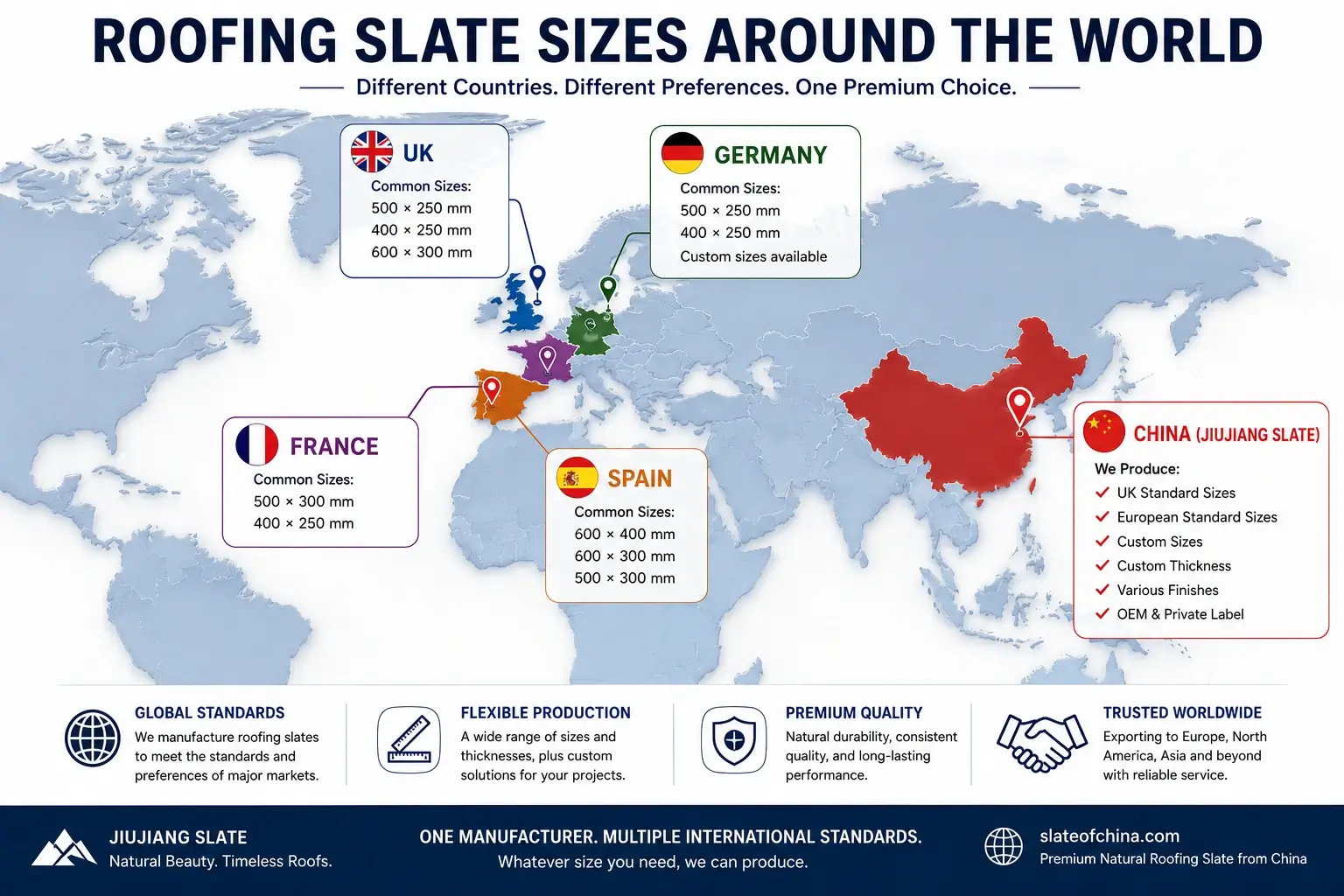
World map infographic showing common roofing slate sizes in the UK, Spain, France, Germany and China, including Jiujiang Slate production capabilities.
Comparison chart of roofing slate sizes by country, showing common slate dimensions, typical buildings and recommended applications in the UK, Spain, France, Germany and China.
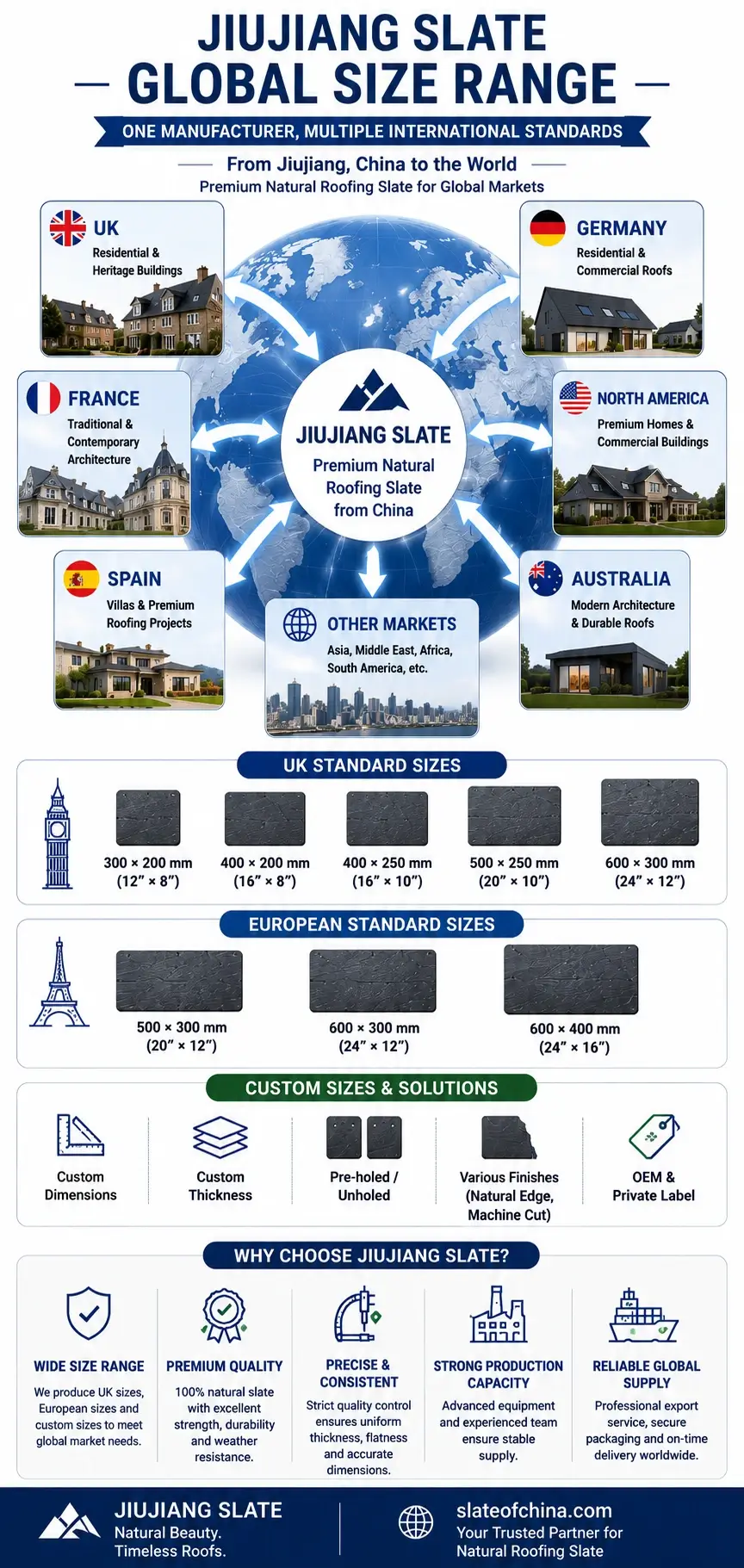
Jiujiang Slate global size range infographic showing UK standard roofing slate sizes, European standard sizes, custom slate sizes and worldwide export markets.

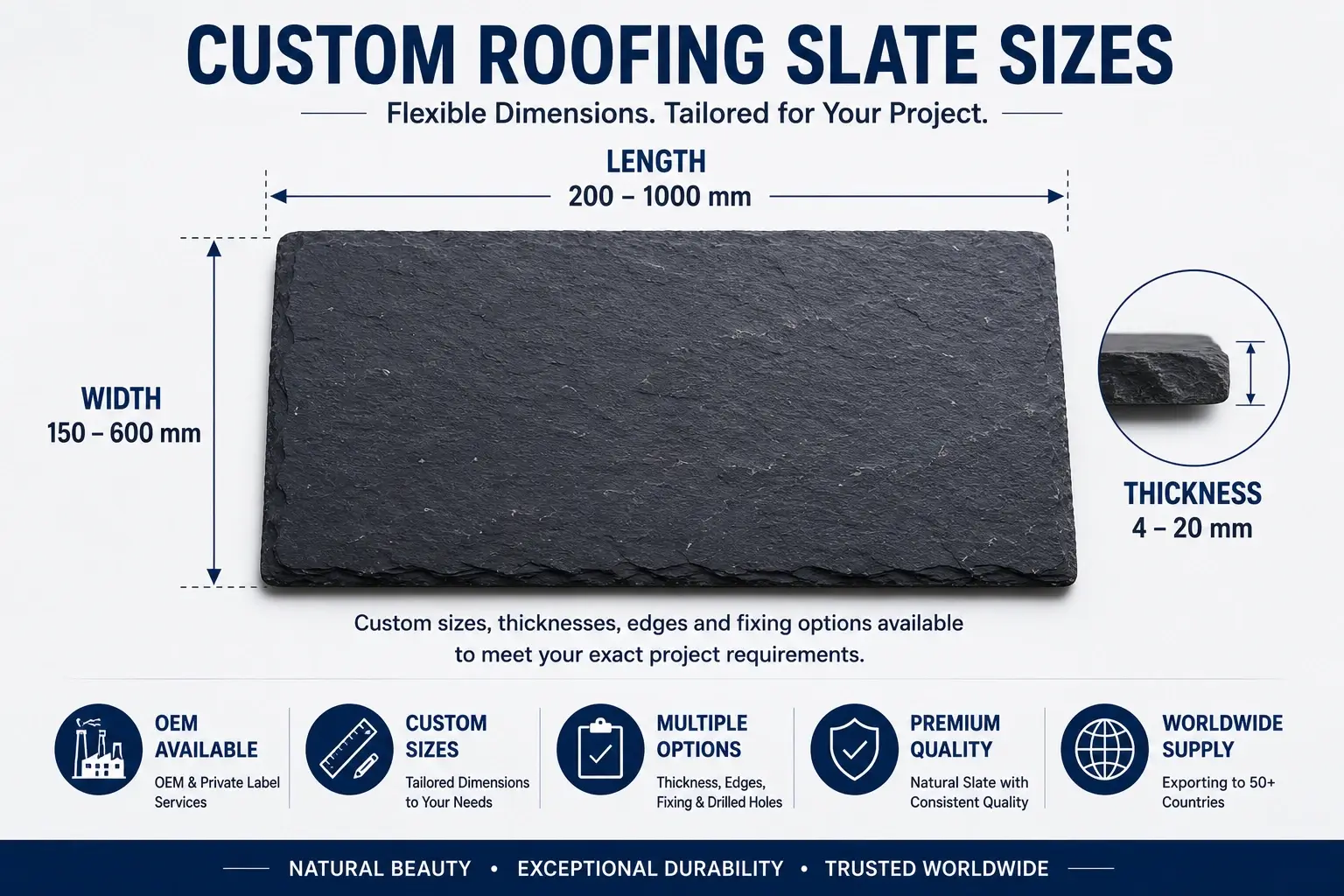
Custom Roofing Slate Sizes

Not every roofing project can be completed using standard slate sizes. Architects, roofing contractors, distributors, and importers often require custom roofing slate sizes to meet specific building designs, local installation standards, or restoration requirements.

As an experienced natural roofing slate manufacturer, Jiujiang Slate offers flexible production capabilities that go far beyond standard dimensions. Whether you need a unique slate size, a specific thickness, or a custom fixing method, we can manufacture roofing slates to your exact project specifications.

Our custom manufacturing service helps customers reduce on-site cutting, improve installation efficiency, and achieve the desired architectural appearance.


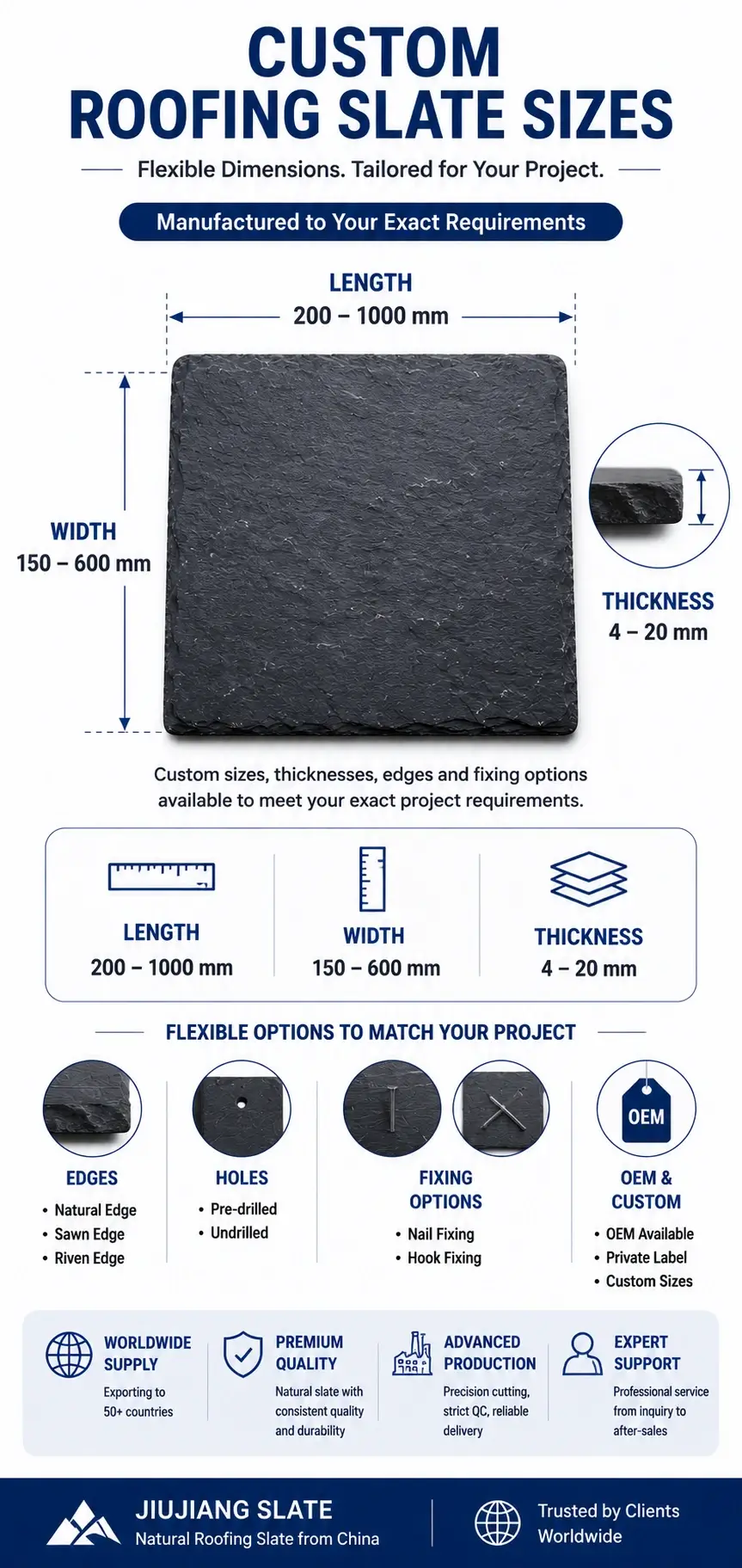
Jiujiang Slate Custom Manufacturing Capabilities

SpecificationAvailable Options
Length200–1000 mm
Width150–600 mm
Thickness4–20 mm
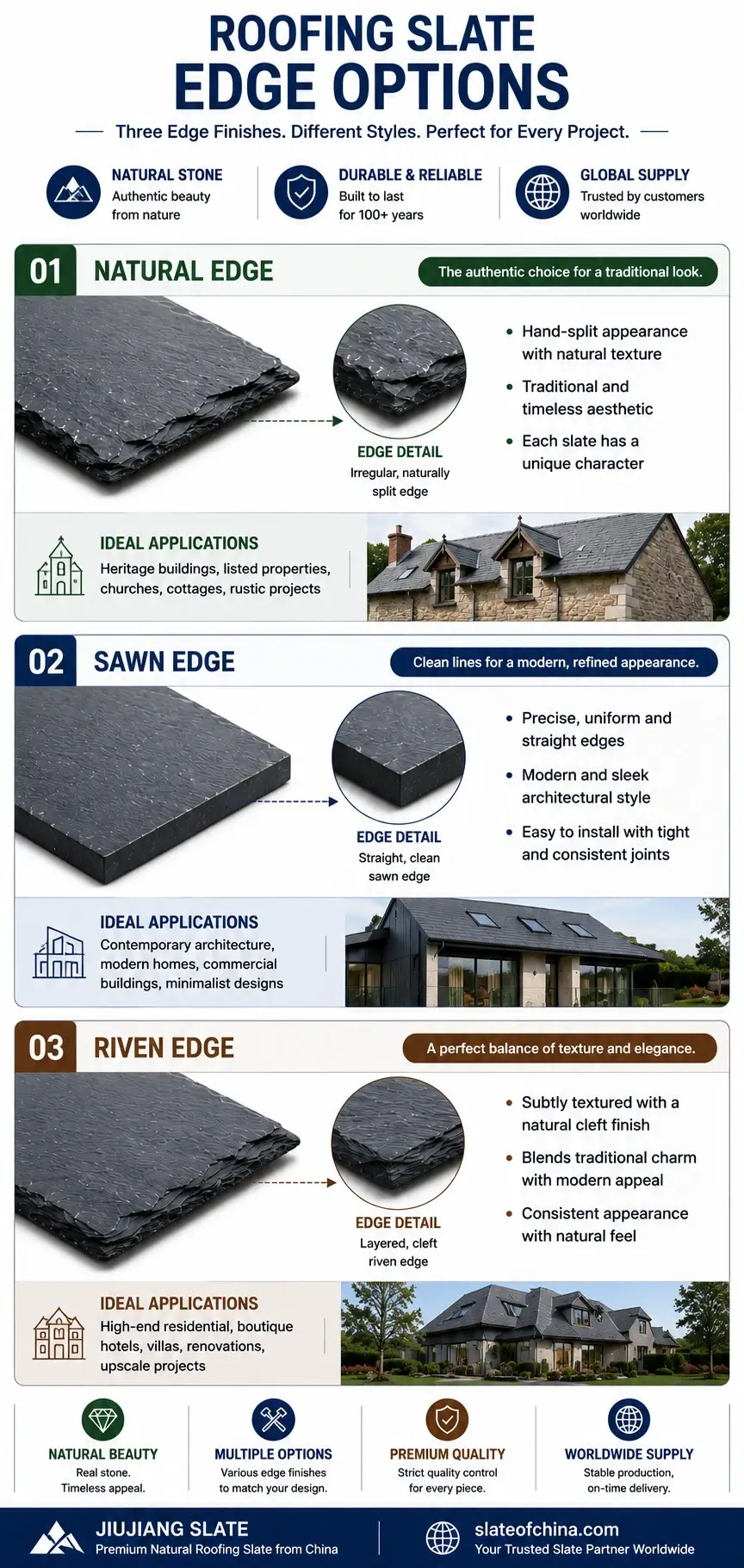
Edge FinishNatural Edge, Sawn Edge, Riven Edge
Hole OptionsPre-drilled, Undrilled
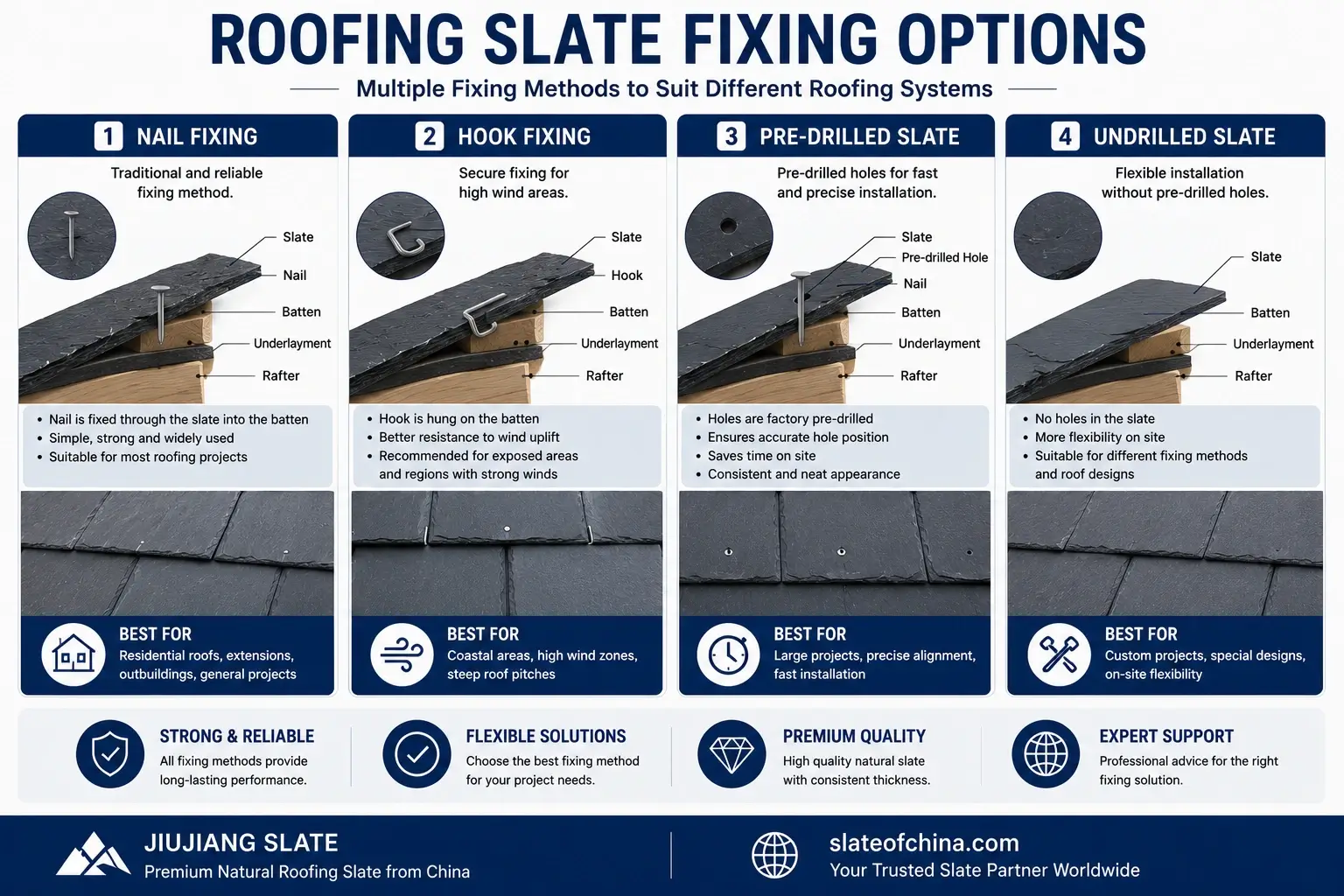
Fixing MethodNail Fixing, Hook Fixing
Surface FinishNatural Split, Honed (on request)
ShapeRectangle, Square, Custom Shapes
OEM ProductionAvailable
Private LabelAvailable

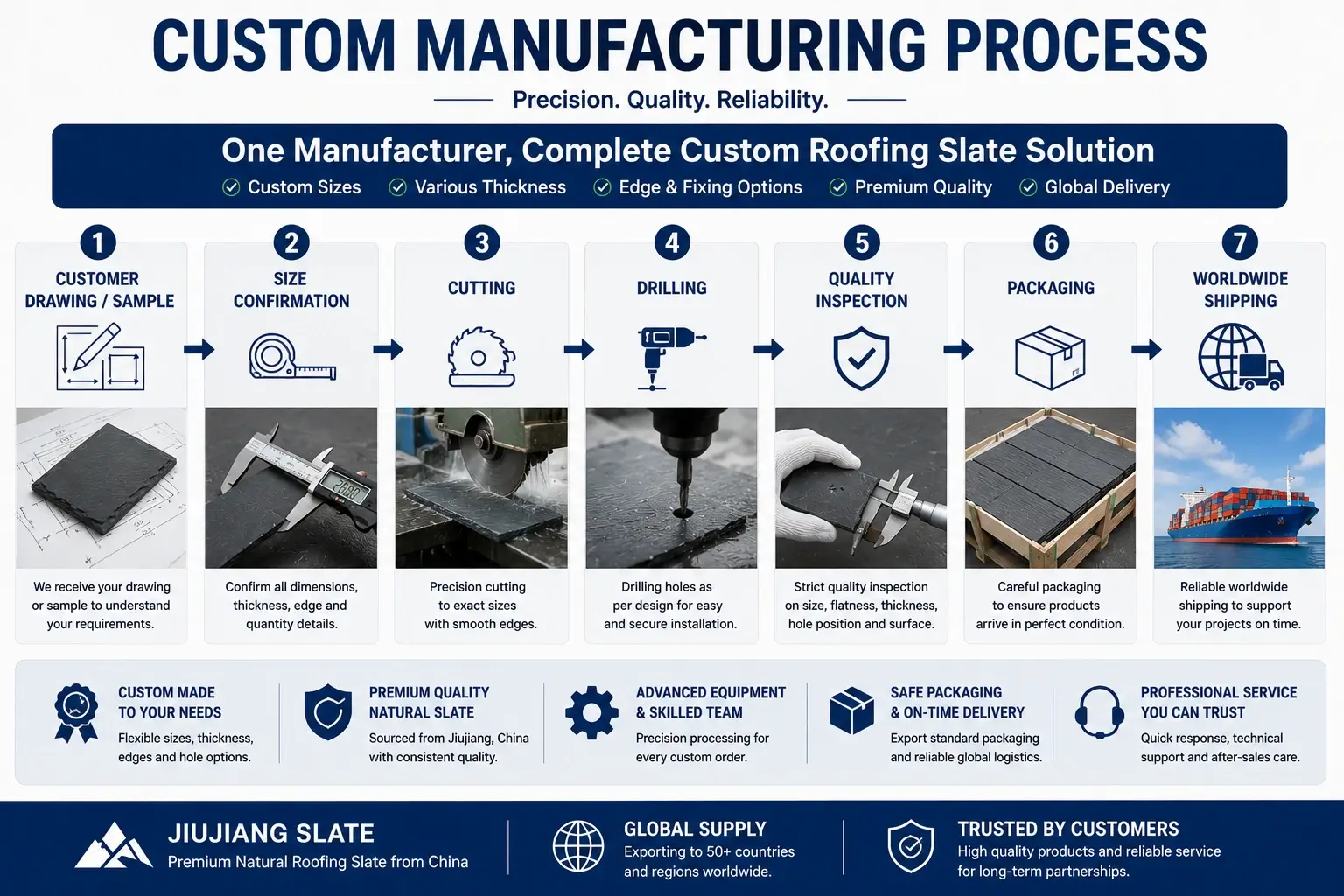
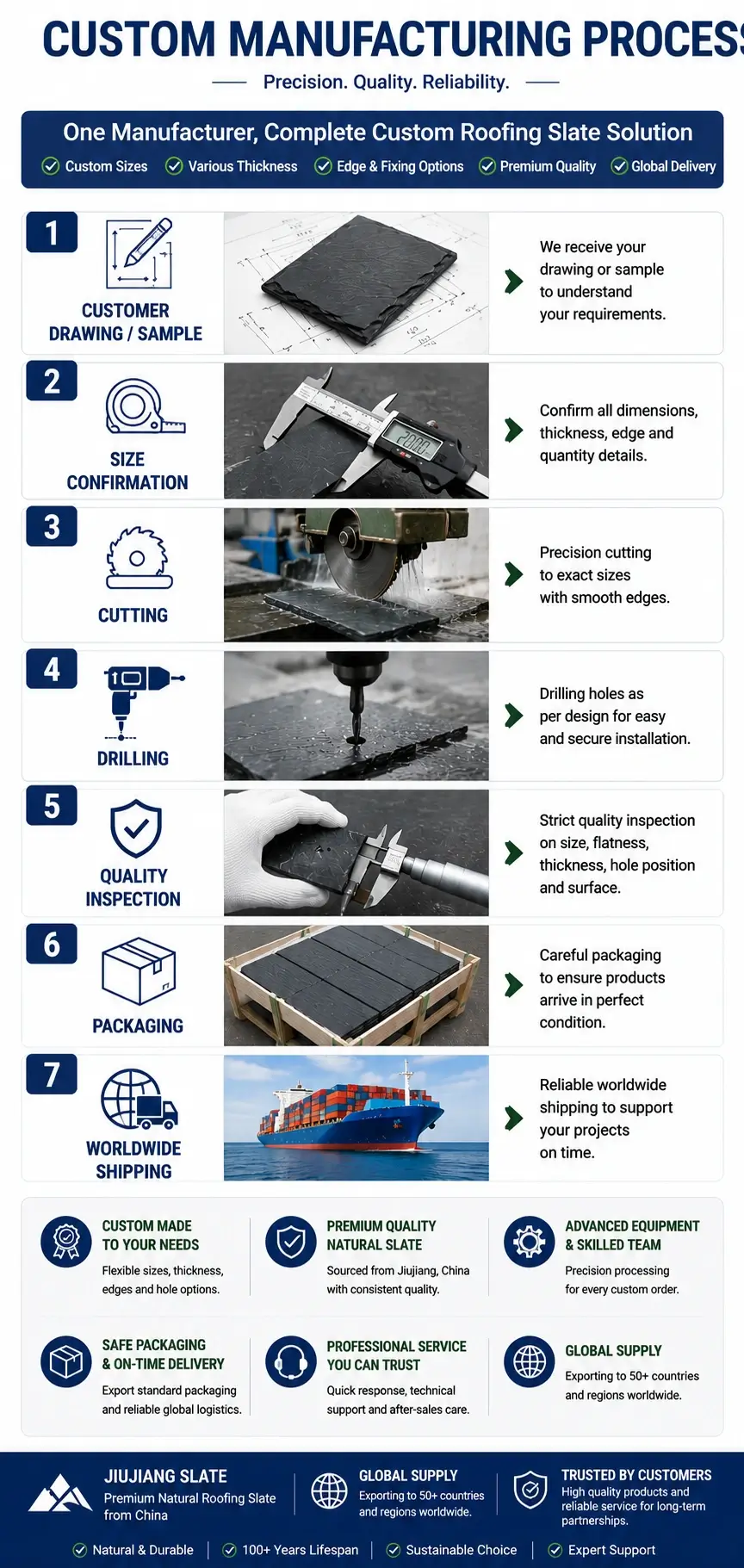
Custom sizes are manufactured according to customer drawings, samples, or technical specifications.

Available Custom Roofing Slate Options

Custom Slate Dimensions

Whether you require smaller slates for heritage restoration or oversized slates for contemporary architecture, we can manufacture a wide range of custom roofing slate sizes.

Typical production range:

  • Length: 200–1000 mm
  • Width: 150–600 mm
  • Custom dimensions available upon request

This flexibility allows architects and contractors to optimise roof appearance, installation efficiency, and material utilisation.

Custom Slate Thickness

Slate thickness affects both roof performance and appearance.

We manufacture roofing slates in thicknesses from:

  • 4–6 mm – Lightweight residential roofing
  • 5–7 mm – Standard roofing applications
  • 6–8 mm – Premium roofing projects
  • 7–9 mm – Heavy-duty roofing
  • Up to 20 mm – Architectural and special applications

Custom thickness tolerances are available for large projects.


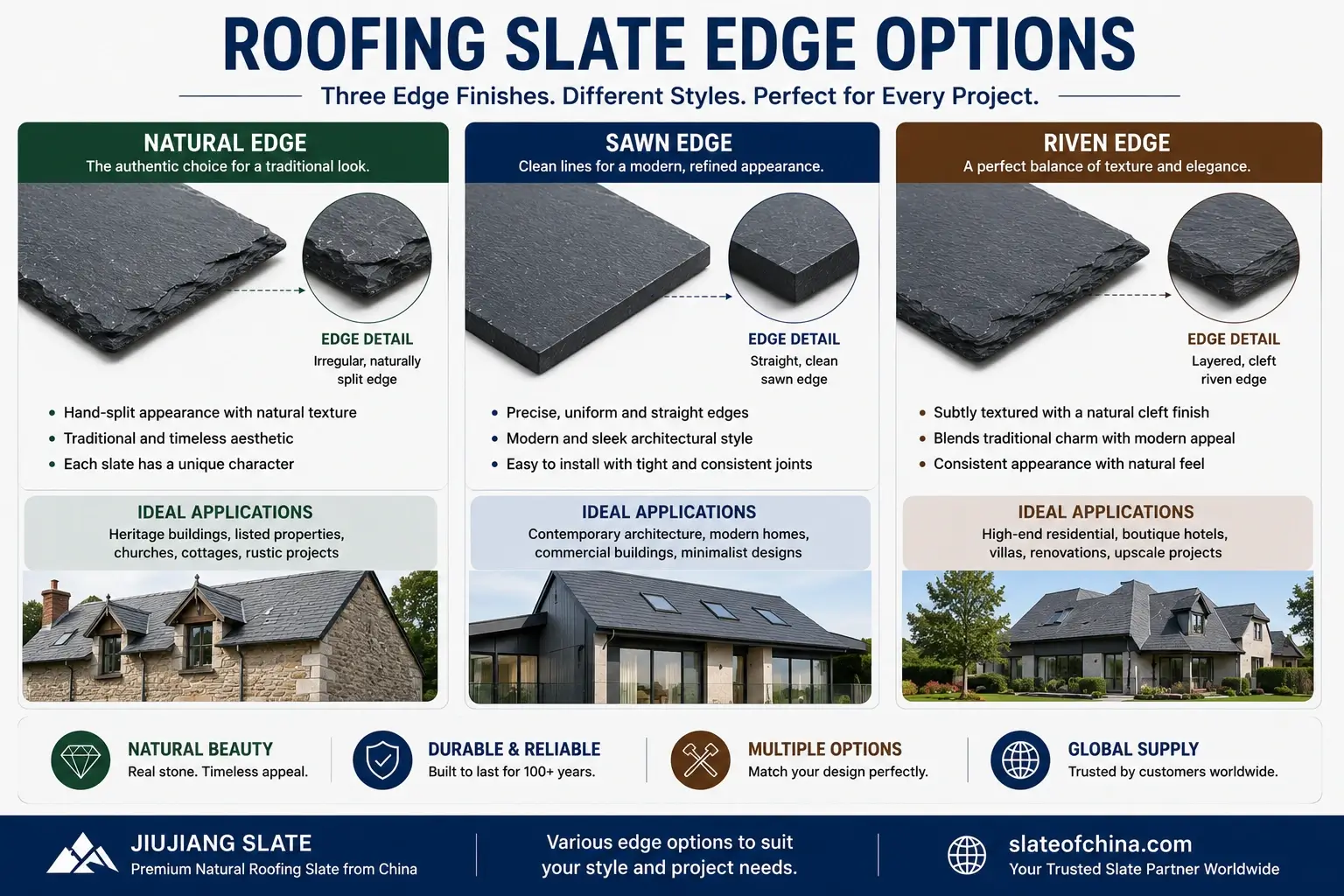
Edge Finishes

Different roofing styles require different edge finishes.

Available options include:

  • Natural Edge – Traditional handcrafted appearance
  • Sawn Edge – Clean, modern architectural finish
  • Riven Edge – Authentic natural slate texture

These options allow designers to achieve both traditional and contemporary roofing aesthetics.


Fixing Options

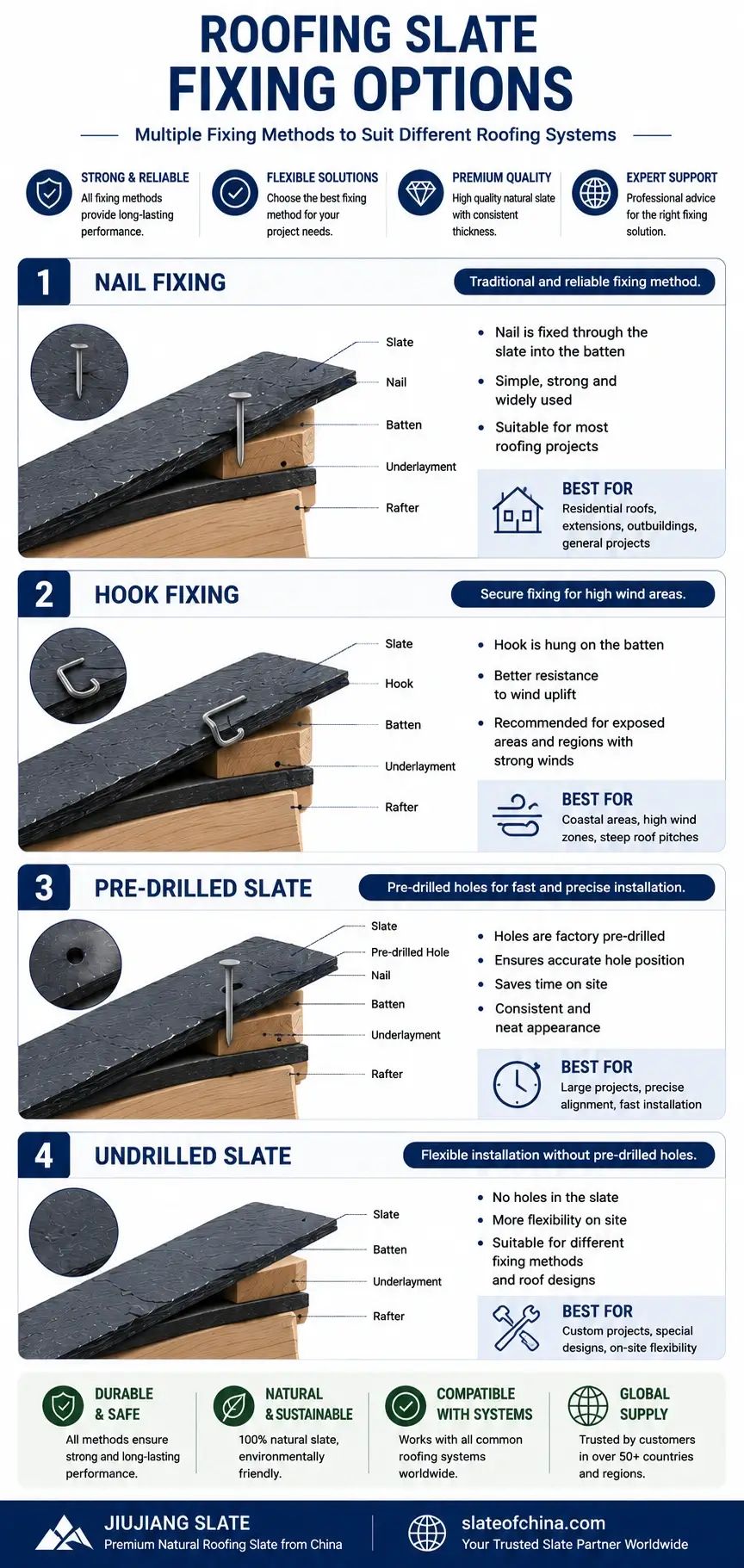
To match different roofing systems, Jiujiang Slate provides multiple fixing solutions.

Available options include:

  • Nail Fixing
  • Hook Fixing
  • Pre-drilled Slates
  • Undrilled Slates

Products can be manufactured to comply with UK, European, and project-specific installation methods.

OEM & Project-Specific Production

Many international distributors and roofing brands require products manufactured to their own specifications.

We support:

  • OEM manufacturing
  • Private-label production
  • Custom packaging
  • Customer logos
  • Project-specific dimensions
  • Architectural drawings and samples

Whether your project requires a single custom size or a complete product range, our production team can manufacture according to your exact requirements.

Typical Applications for Custom Roofing Slates

Custom roofing slate sizes are widely used in:

  • Heritage restoration projects
  • Listed buildings
  • Churches and historical monuments
  • Luxury villas
  • Contemporary architecture
  • Hotels and resorts
  • Commercial buildings
  • Government projects
  • Architectural landmark buildings

By selecting the right slate size and finish, architects can create unique roof designs while improving installation efficiency and reducing material waste.

Why Choose Custom Roofing Slates from Jiujiang Slate?

Choosing a manufacturer with flexible production capabilities can significantly simplify international sourcing.

With decades of experience in natural roofing slate manufacturing, Jiujiang Slate offers:

  • Wide range of standard and custom slate sizes
  • Precision cutting and consistent dimensions
  • Multiple thickness options
  • Various edge finishes
  • Flexible fixing solutions
  • OEM and private-label services
  • Stable quality control
  • Export experience for global markets

Whether you need UK standard roofing slate sizes, European slate dimensions, or a completely bespoke specification, our team can manufacture roofing slates that meet your exact project requirements.

Expert Recommendation

If your project involves unusual roof geometry, heritage restoration, or architectural design requirements, choosing custom roofing slate sizes can reduce installation time, minimise waste, and achieve a superior finished appearance.

Before placing an order, prepare the following information:

  • Required slate dimensions (length × width)
  • Thickness
  • Edge finish
  • Hole position or fixing method
  • Quantity
  • Project drawings or samples (if available)

Providing complete specifications allows the manufacturer to recommend the most suitable production solution and ensure consistent quality throughout your project.

Custom roofing slate sizes infographic showing available length (200–1000 mm), width (150–600 mm), thickness (4–20 mm), OEM manufacturing and worldwide supply.
Roofing slate edge options comparison showing natural edge, sawn edge and riven edge with close-up details and recommended applications.
Roofing slate fixing options infographic comparing nail fixing, hook fixing, pre-drilled slate and undrilled slate with cross-sectional installation diagrams.
Custom roofing slate manufacturing process infographic showing customer drawing, size confirmation, cutting, drilling, quality inspection, packaging and worldwide shipping.

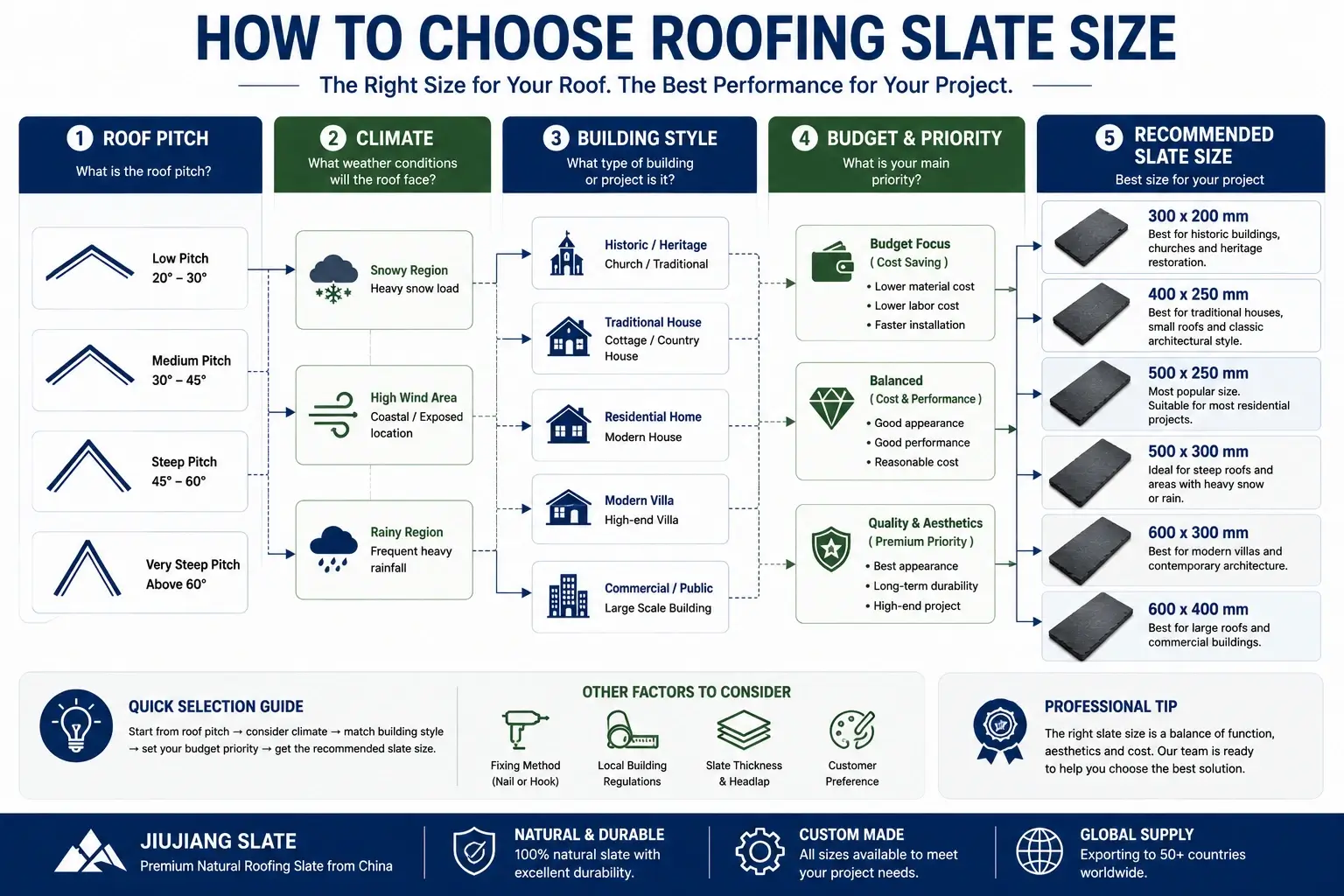
How to Choose the Right Roofing Slate Size

Choosing the right roofing slate size is about much more than appearance. The ideal slate dimensions should match your roof design, local climate, building style, and installation requirements.

A slate that performs perfectly on a modern villa may not be suitable for a historic church or a steep mountain roof. Selecting the correct size helps improve weather resistance, installation efficiency, roof aesthetics, and long-term durability.

The following guide will help you choose the most suitable natural roofing slate size for your project.


Step 1 — Consider Your Roof Pitch

Roof pitch is one of the most important factors when selecting roofing slate sizes.

Roof PitchRecommended Slate SizeWhy
20°–30°400 × 250 mmProvides greater overlap for improved water protection
30°–45°500 × 250 mmBalanced appearance and excellent coverage
45°–60°500 × 300 mmIdeal for steep residential roofs
Above 60°600 × 300 mmCreates a striking appearance while reducing the number of slates

Lower roof pitches generally require greater headlap and careful detailing, while steeper roofs allow greater flexibility in slate selection.


Step 2 — Consider Local Climate

Weather conditions directly influence the best roofing slate size.

Snowy Regions

In areas with heavy snowfall, medium to large slates provide strong weather protection and reduce the number of joints where moisture can penetrate.

Recommended sizes:

  • 500 × 250 mm
  • 500 × 300 mm
  • 600 × 300 mm

High-Wind Areas

Coastal and exposed locations benefit from smaller or medium-sized slates because each piece is secured with more fixing points, improving resistance to wind uplift.

Recommended sizes:

  • 400 × 250 mm
  • 500 × 250 mm

Hook fixing is also commonly recommended for high-wind applications.

Heavy Rainfall

Where rainfall is frequent, selecting the correct combination of slate size, thickness, and headlap is more important than simply choosing the largest slate.

Professional roof design should always follow local roofing standards.

Step 3 — Match the Building Style

Different architectural styles call for different slate sizes.

Building TypeRecommended Slate Size
Historic Buildings300 × 200 mm / 400 × 250 mm
Churches300 × 200 mm
Traditional Houses400 × 250 mm
Residential Homes500 × 250 mm
Modern Villas600 × 300 mm
Contemporary Architecture600 × 400 mm
Commercial Buildings600 × 300 mm or larger

Smaller slates create a classic, richly textured roof, while larger slates deliver a cleaner and more contemporary appearance.

Step 4 — Consider Installation Budget

Roofing slate size has a direct impact on installation cost.

PriorityRecommended Size
Lower Labour CostLarge Slate
Faster InstallationLarge Slate
Traditional AppearanceSmall Slate
Heritage RestorationSmall Slate
Architectural DetailSmall Slate
Modern DesignLarge Slate

Because larger slates cover more roof area per piece, fewer slates need to be installed, reducing labour time and fixing points.

Step 5 — Consider Historic Restoration

Many restoration projects require roofing slates that closely match the original roof.

Typical restoration sizes include:

  • 300 × 200 mm
  • 400 × 200 mm
  • 400 × 250 mm

In these cases, maintaining historical authenticity is often more important than installation efficiency.

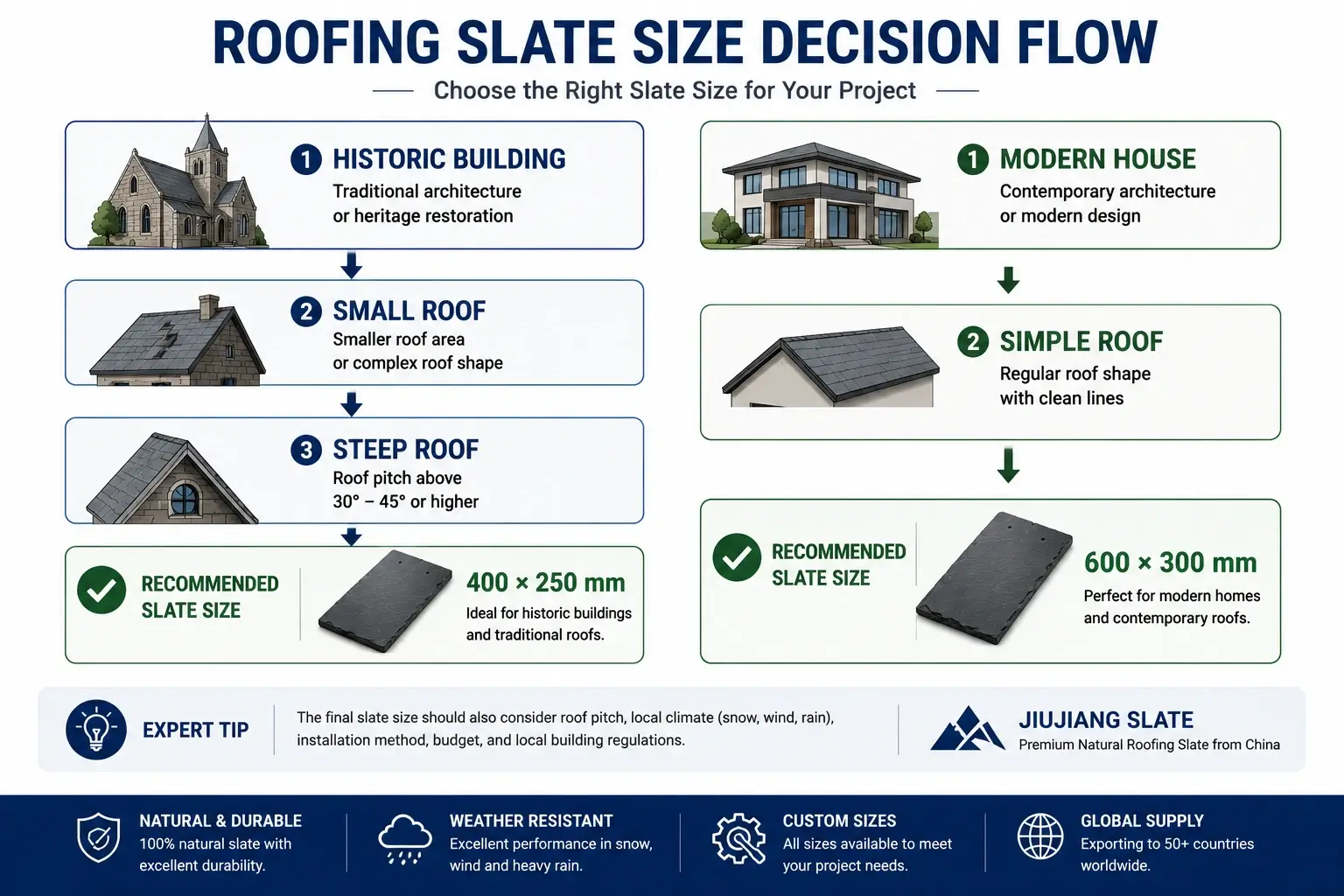
Roofing Slate Size Selection Guide

Follow this simple decision guide:

 
New Roofing Project


Is the building historic?

┌──────┴──────┐
│ │
Yes No
│ │
▼ ▼
Small Slate Modern Building?
300×200 │
400×250 │

Large Roof Area?

┌───────┴────────┐
│ │
Yes No
│ │
▼ ▼
600×300 mm 500×250 mm
600×400 mm
 

Tip: The final slate size should always be selected together with the required thickness, headlap, fixing method, and local roofing regulations.


Expert Recommendation

If you’re unsure which roofing slate size is right for your project, start by evaluating these five questions:

  1. What is the roof pitch?
  2. What weather conditions will the roof face?
  3. Is the building traditional or modern?
  4. What is your installation budget?
  5. Are there local building or heritage requirements?

Answering these questions will narrow the options quickly and help you select the most suitable slate dimensions.


Why Jiujiang Slate?

With the ability to manufacture virtually all international and custom roofing slate sizes, Jiujiang Slate can recommend the most appropriate dimensions for your specific market, project type, and roofing system.

Whether you need standard UK sizes, European formats, or bespoke architectural slates, our technical team can help you choose the right solution before production begins.

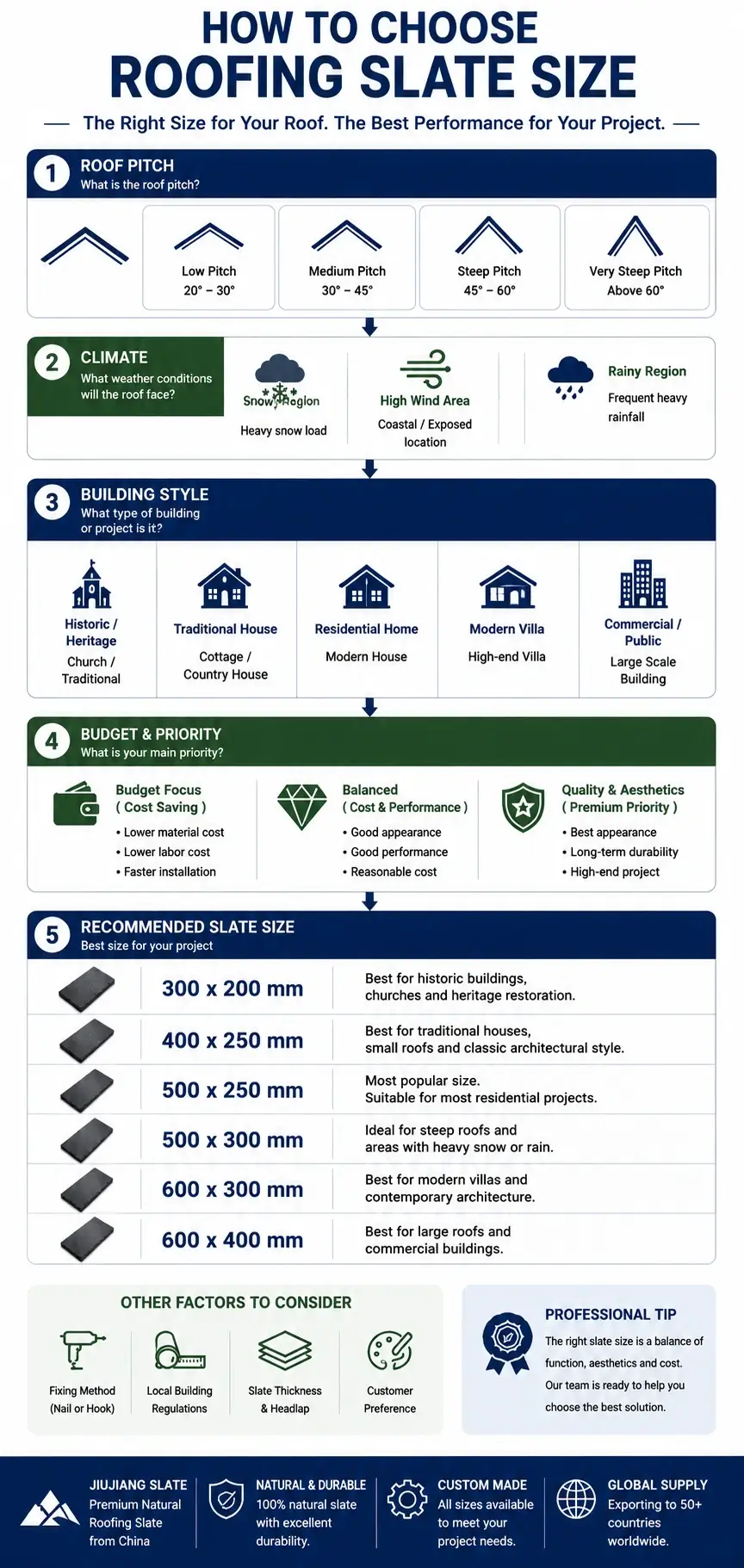
How to choose roofing slate size infographic showing a decision guide based on roof pitch, climate, building style, budget and recommended roofing slate sizes.
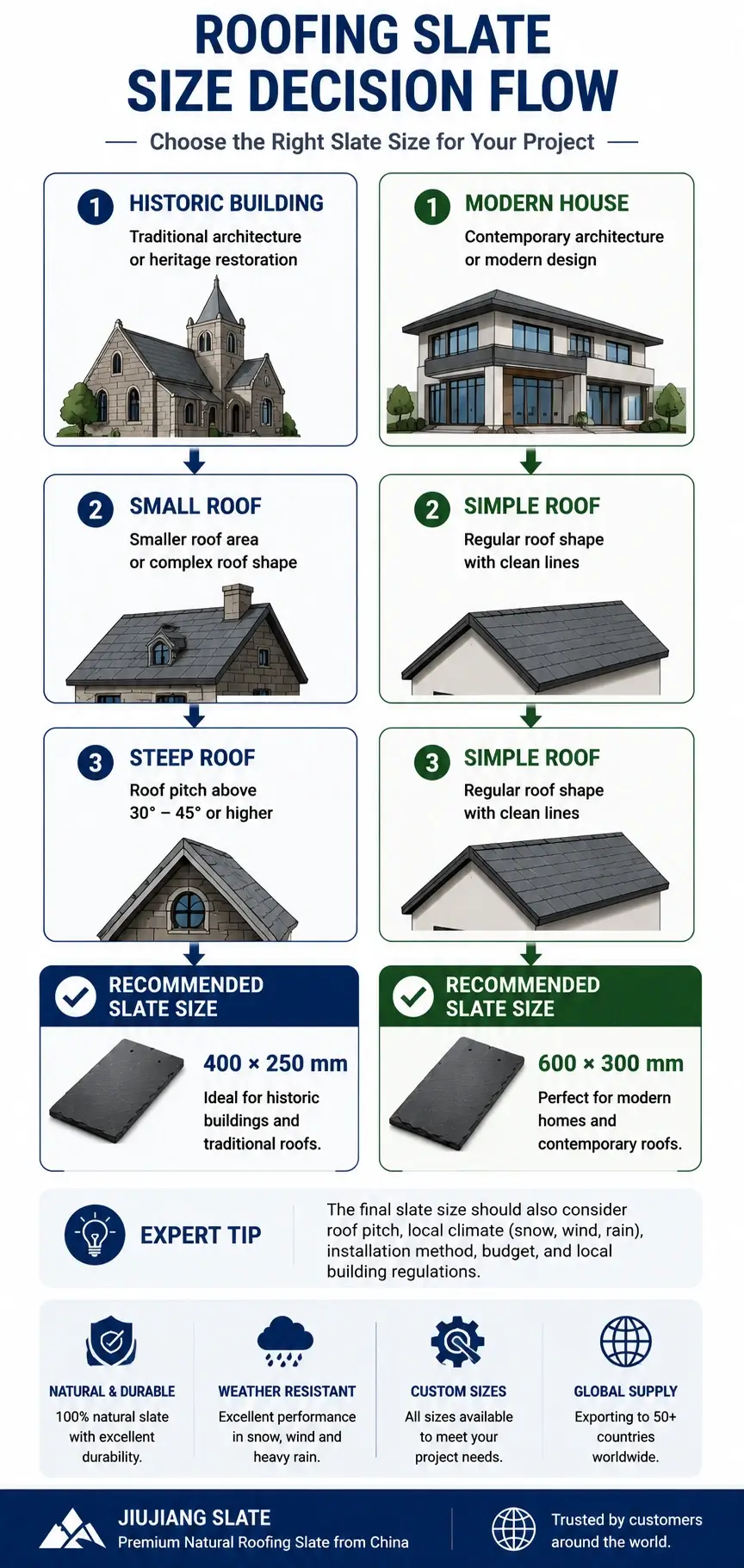
Roofing slate size decision flow infographic comparing historic buildings and modern houses to recommend the most suitable roofing slate sizes.
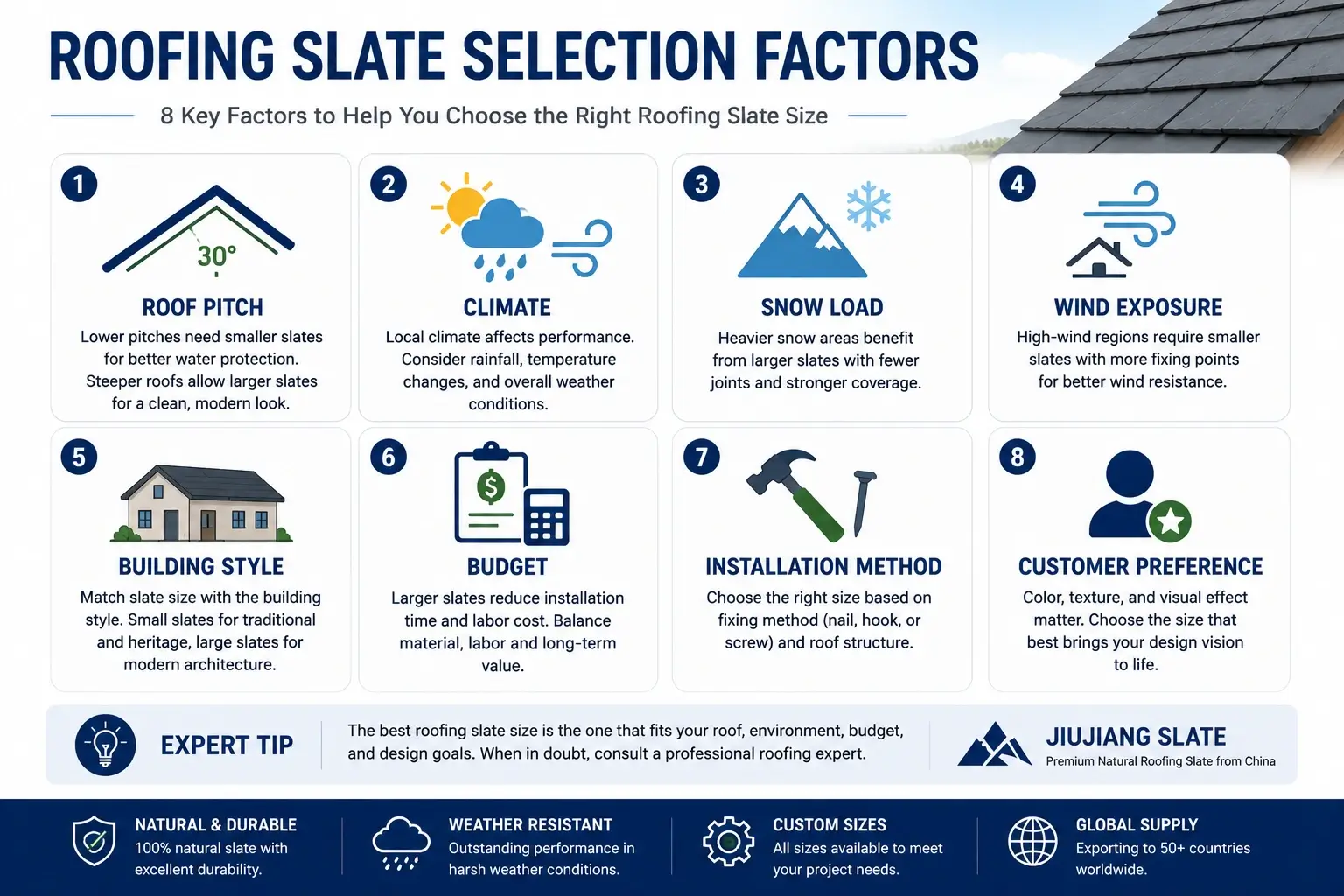
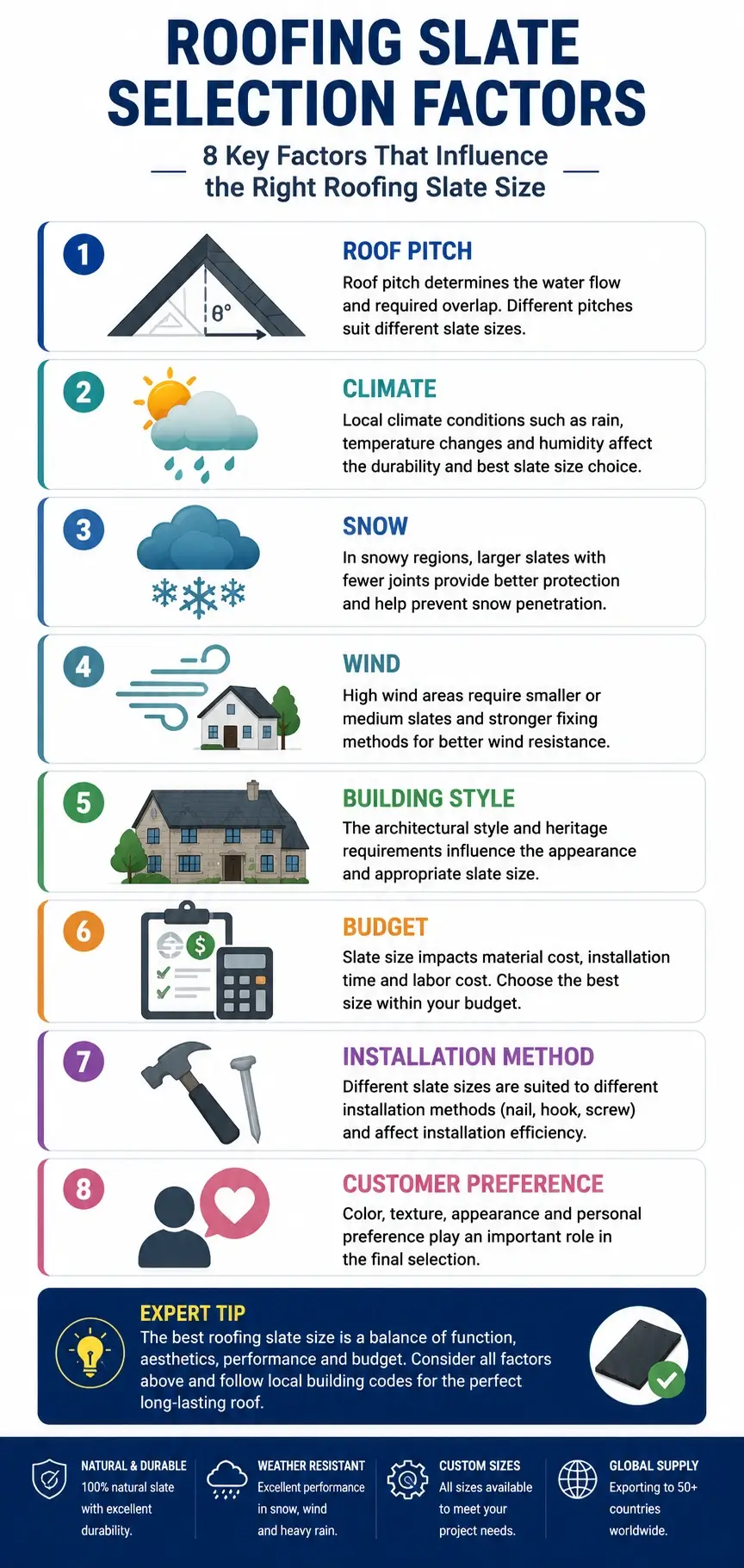
Roofing slate selection factors infographic showing the eight key considerations including roof pitch, climate, snow, wind, building style, budget, installation method and customer preference.
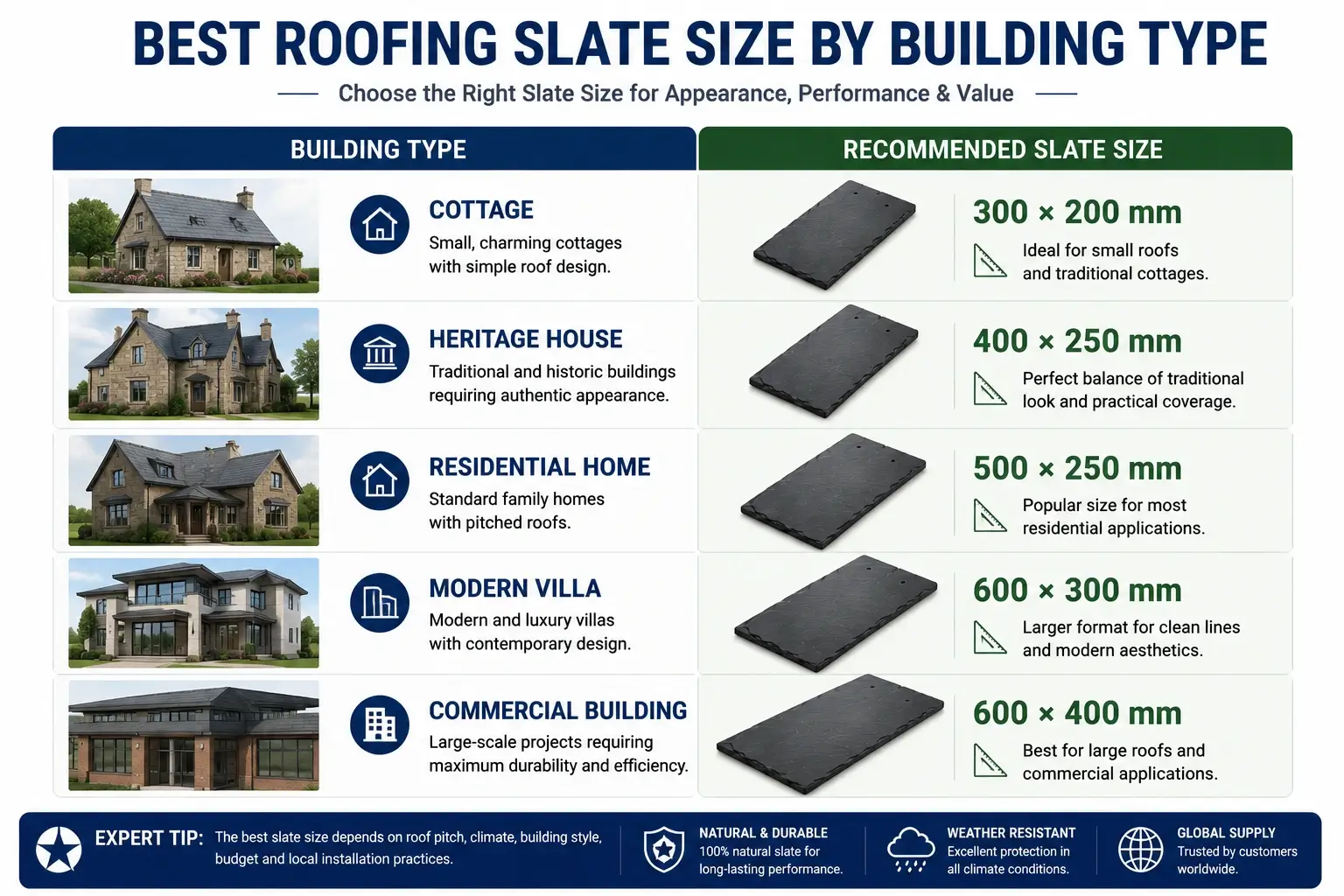
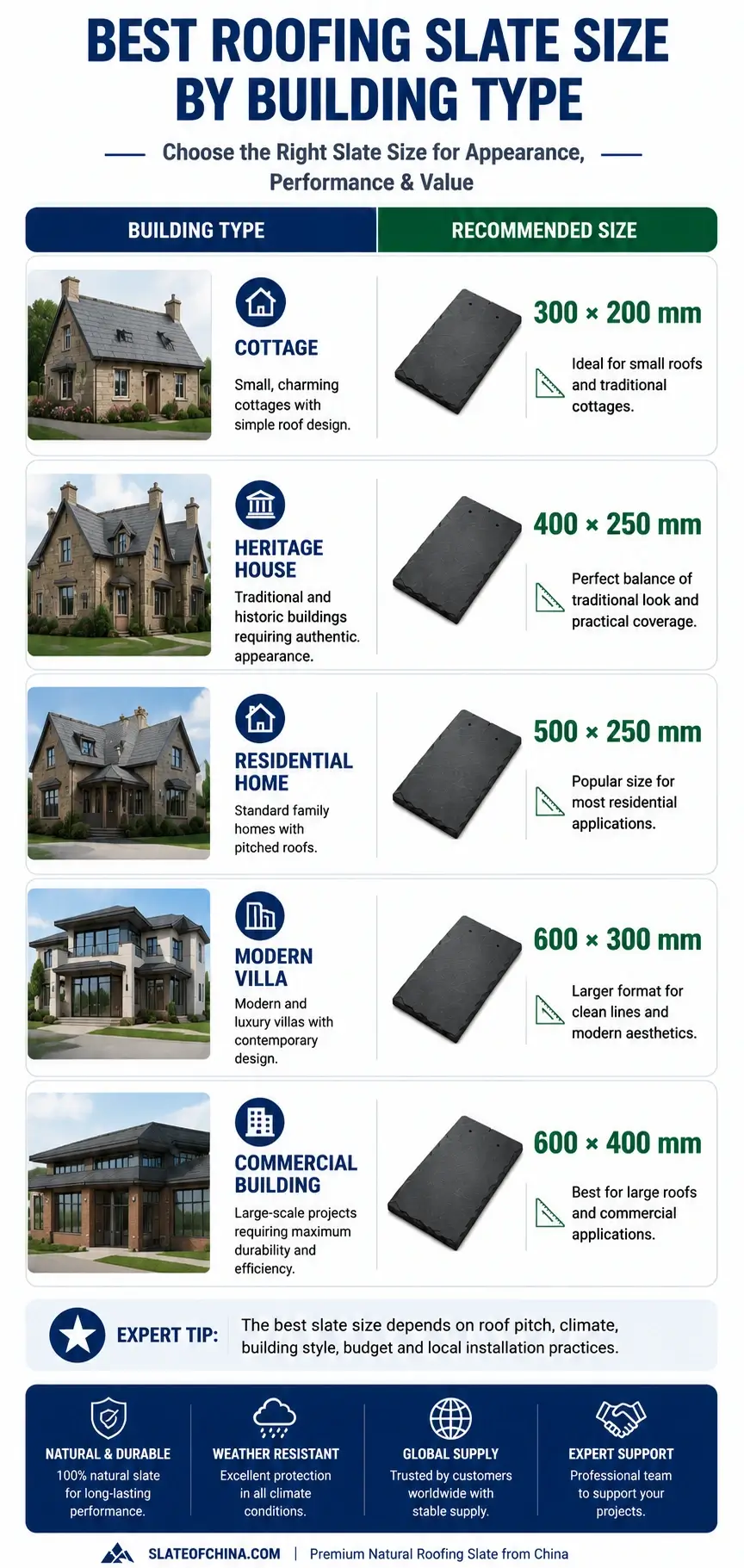
Infographic showing the best roofing slate size by building type, including cottage, heritage house, residential home, modern villa and commercial building with recommended slate dimensions.

Roofing Slate Size Tolerances

Natural roofing slate is a quarried stone product, not a factory-made ceramic tile. Because every slate is split from natural rock, slight dimensional variations are normal and are expected within recognised quality standards.

Professional roofing projects require more than selecting the correct slate size. They also depend on consistent roofing slate size tolerances, thickness accuracy, flatness, and edge quality to ensure smooth installation and a uniform roof appearance.

High-quality manufacturers control these tolerances throughout the production process to deliver reliable performance and consistent installation results.

Why Are Slate Size Tolerances Important?

Even when two roofing slates are labelled as 500 × 250 mm, they are not expected to be mathematically identical.

Small dimensional variations are acceptable for natural slate, provided they remain within the agreed manufacturing specification and applicable standards.

Consistent tolerances help to:

  • Improve installation accuracy
  • Maintain uniform headlap and sidelap
  • Reduce sorting on site
  • Improve roof appearance
  • Minimise installation waste
  • Increase overall roofing efficiency

For roofing contractors, consistent sizing means faster installation and fewer adjustments during laying.

Typical Roofing Slate Size Tolerances

The table below shows typical manufacturing control values commonly achieved by quality natural roofing slate producers. Actual acceptance criteria should follow the applicable product classification and project specification.

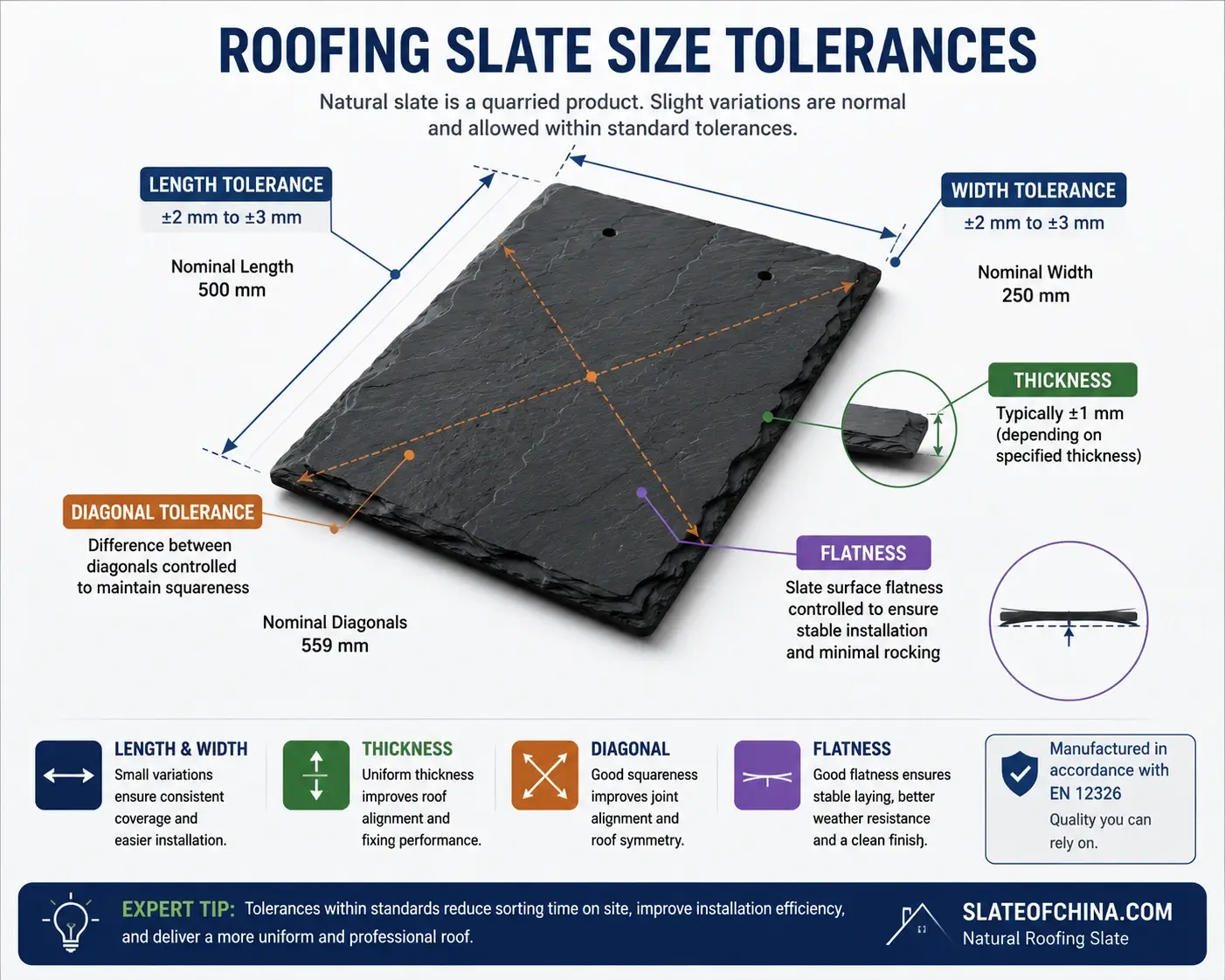
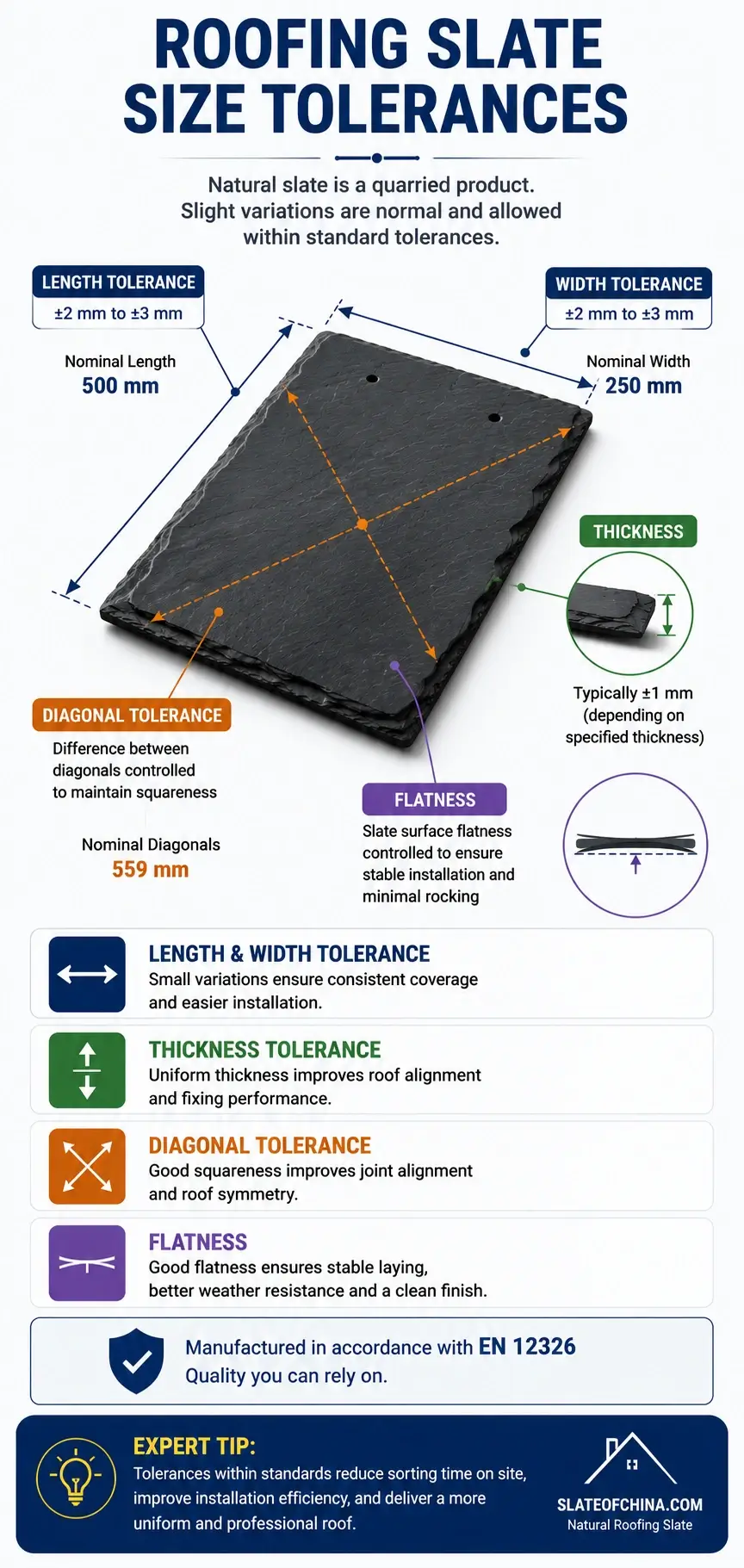
PropertyTypical Manufacturing Control*
Length Tolerance±2 mm to ±3 mm
Width Tolerance±2 mm to ±3 mm
Thickness ToleranceTypically within ±1 mm (depending on specified thickness range)
Diagonal DifferenceControlled to maintain squareness
FlatnessControlled to minimise rocking and uneven laying
Edge AccuracyConsistent straight or natural edges according to product type

*Typical values shown for guidance. Final requirements should comply with the agreed specification and the relevant classification of EN 12326 where applicable.

Key Dimensional Characteristics

Length & Width Tolerance

Small variations in length and width are normal for natural slate.

Well-controlled dimensional tolerances ensure:

  • Consistent roof courses
  • Easier alignment
  • Faster installation
  • Better finished appearance

Premium roofing slate manufacturers maintain tight production control throughout cutting and inspection.

Thickness Tolerance

Thickness consistency directly affects roof performance.

Uniform thickness helps achieve:

  • Better roof alignment
  • Stable headlap
  • Reliable fixing
  • Even visual appearance

Excessive thickness variation may increase installation time because roofers must sort slates before installation.

Diagonal Tolerance

Diagonal tolerance measures how square a roofing slate is.

Good squareness improves:

  • Joint alignment
  • Roof symmetry
  • Installation efficiency
  • Finished roof appearance

Professional quality control checks diagonal dimensions during production.

Flatness

Flatness refers to how evenly a slate lies against the roof battens.

Good flatness provides:

  • Stable installation
  • Better weather resistance
  • Reduced rocking
  • Cleaner roof lines

Although natural slate is never perfectly flat, premium products maintain excellent laying characteristics.

Roofing Slate Size Tolerances and EN 12326

Many roofing projects in Europe specify compliance with EN 12326.

This standard evaluates important characteristics including:

  • Dimensional accuracy
  • Thickness consistency
  • Water absorption
  • Flexural strength
  • Freeze-thaw resistance
  • Durability
  • Geometrical characteristics

Choosing roofing slate manufactured in accordance with recognised European standards provides greater confidence for architects, contractors, and importers.

How Jiujiang Slate Controls Manufacturing Accuracy

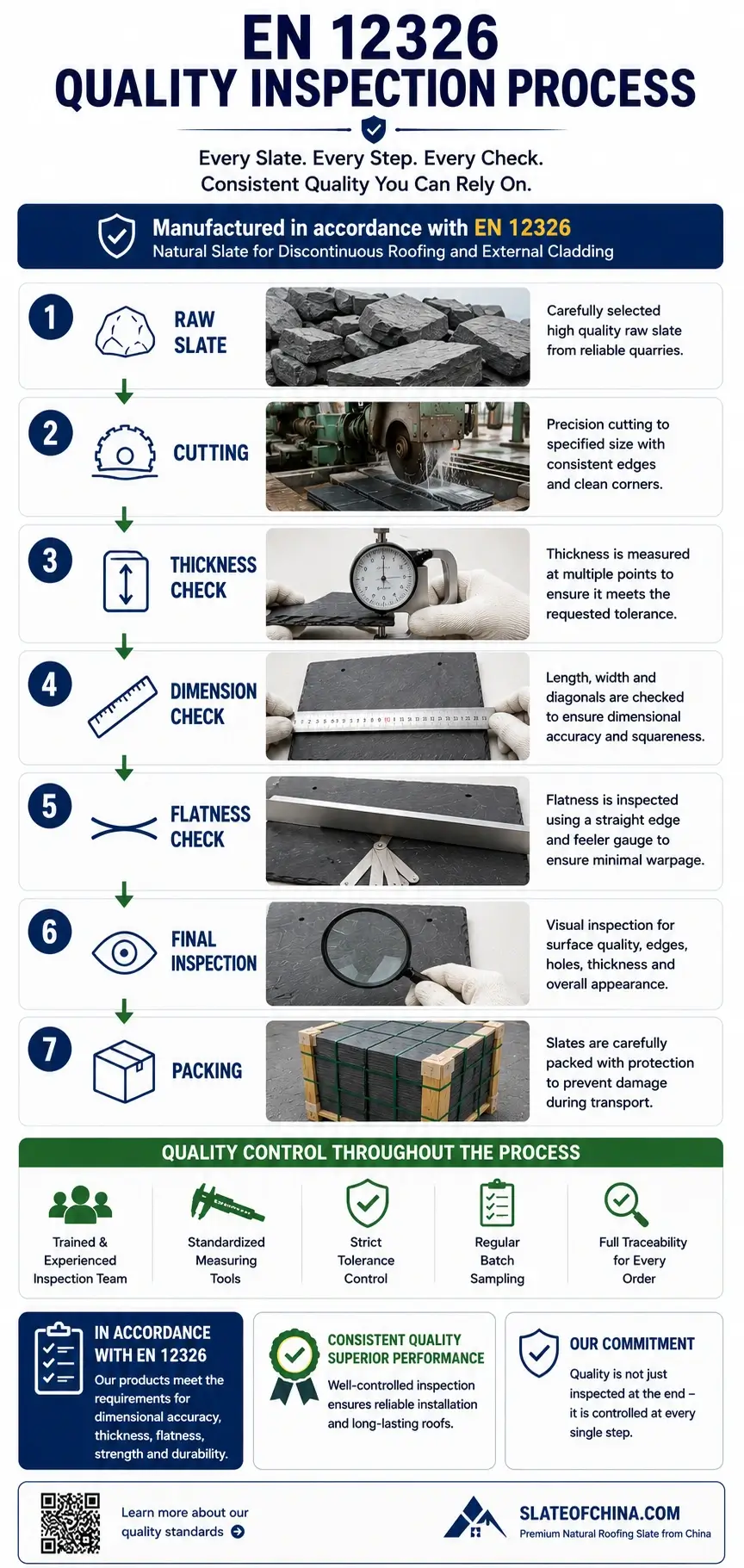
At Jiujiang Slate, dimensional consistency is controlled throughout every production stage.

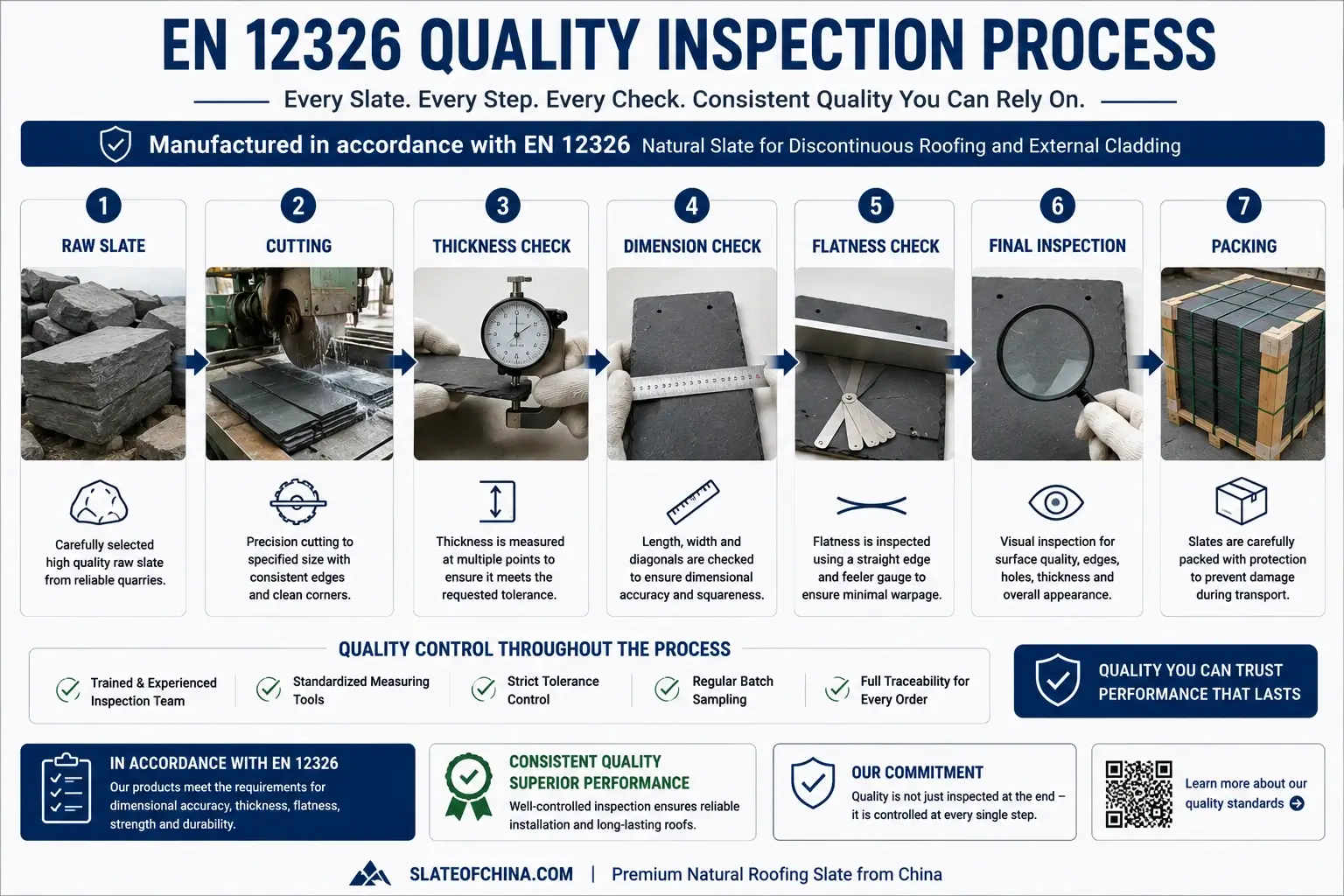
Our quality control process includes:

  • Precision cutting
  • Thickness grading
  • Diagonal inspection
  • Flatness inspection
  • Random batch measurement
  • Final visual inspection before packing

By combining experienced craftsmanship with modern production equipment, we deliver roofing slates with consistent dimensions that help reduce installation time and improve finished roof quality.

Expert Recommendation

When comparing roofing slate suppliers, don’t focus only on price or nominal size. Always ask for information about:

  • Size tolerances
  • Thickness consistency
  • Flatness
  • Squareness (diagonal accuracy)
  • Quality inspection procedures
  • Compliance with applicable project specifications or standards

A supplier with well-controlled manufacturing tolerances can significantly improve installation efficiency, reduce material waste, and deliver a more uniform and professional roofing finish.

Roofing slate size tolerances infographic showing length tolerance, width tolerance, thickness tolerance, diagonal tolerance and flatness in accordance with EN 12326 quality requirements.
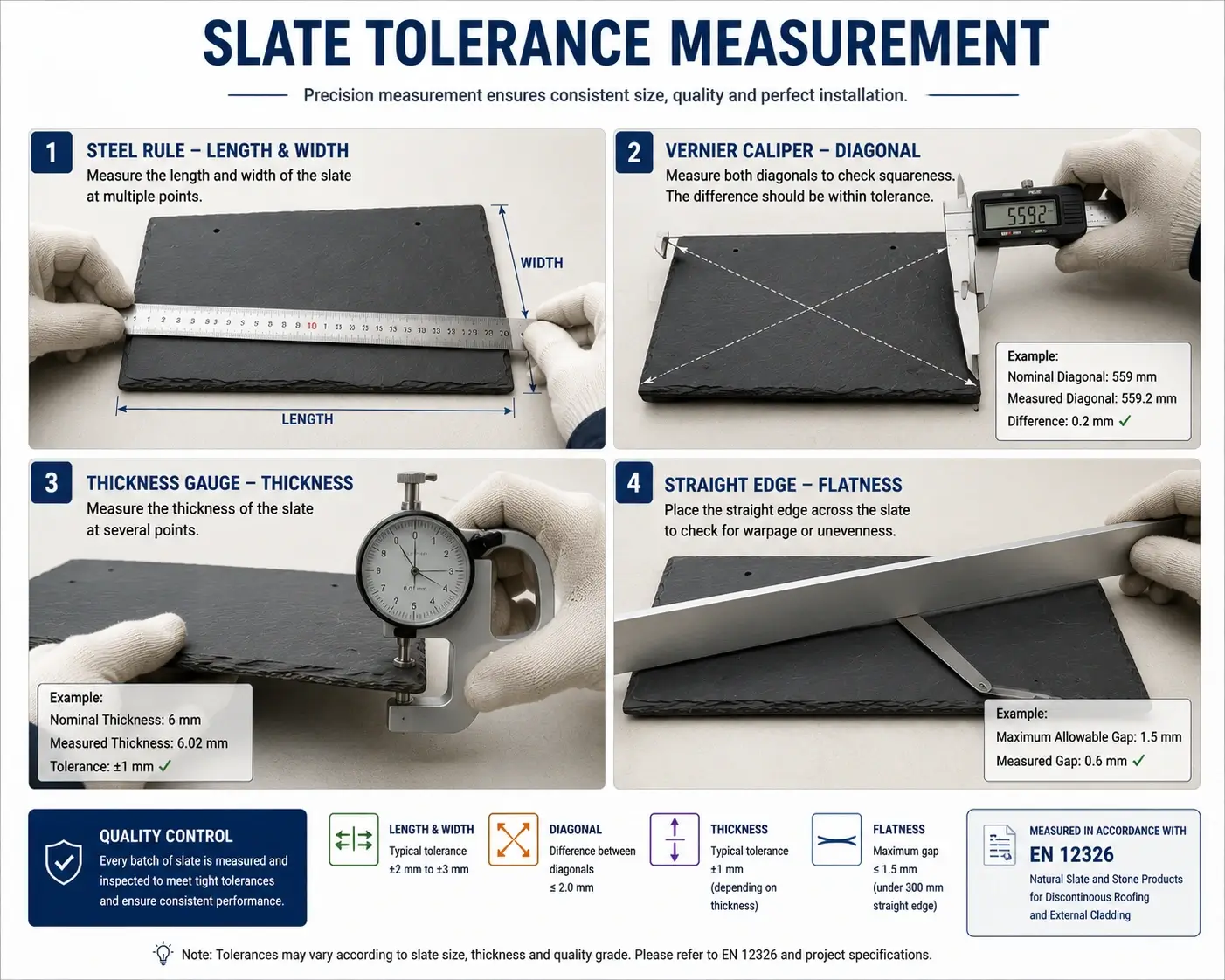
Slate tolerance measurement infographic showing how engineers inspect roofing slate using a steel rule, vernier caliper, thickness gauge and straight edge to verify dimensional accuracy.
EN 12326 quality inspection process infographic showing raw slate selection, cutting, thickness check, dimension check, flatness check, final inspection and packing for natural roofing slate.
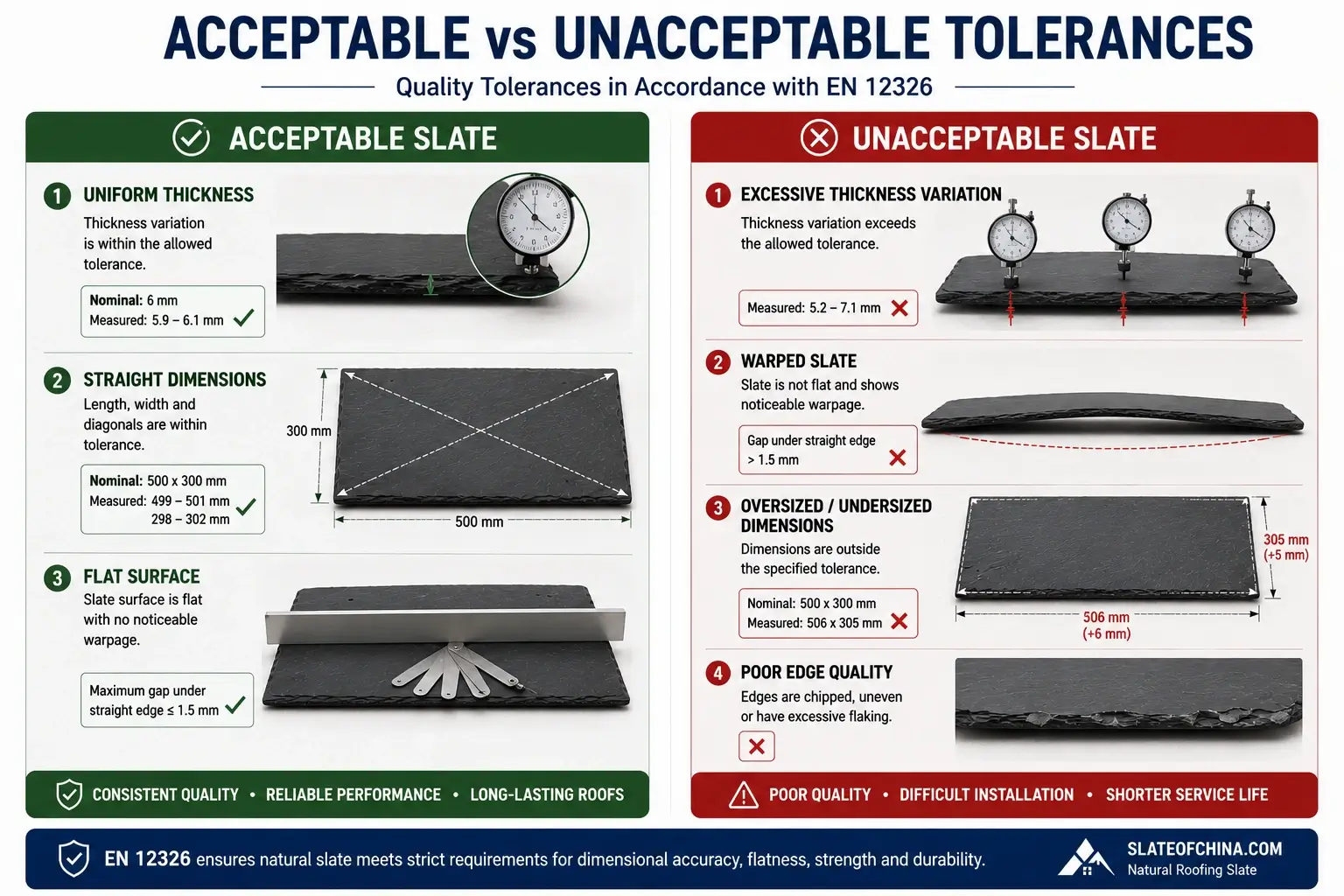
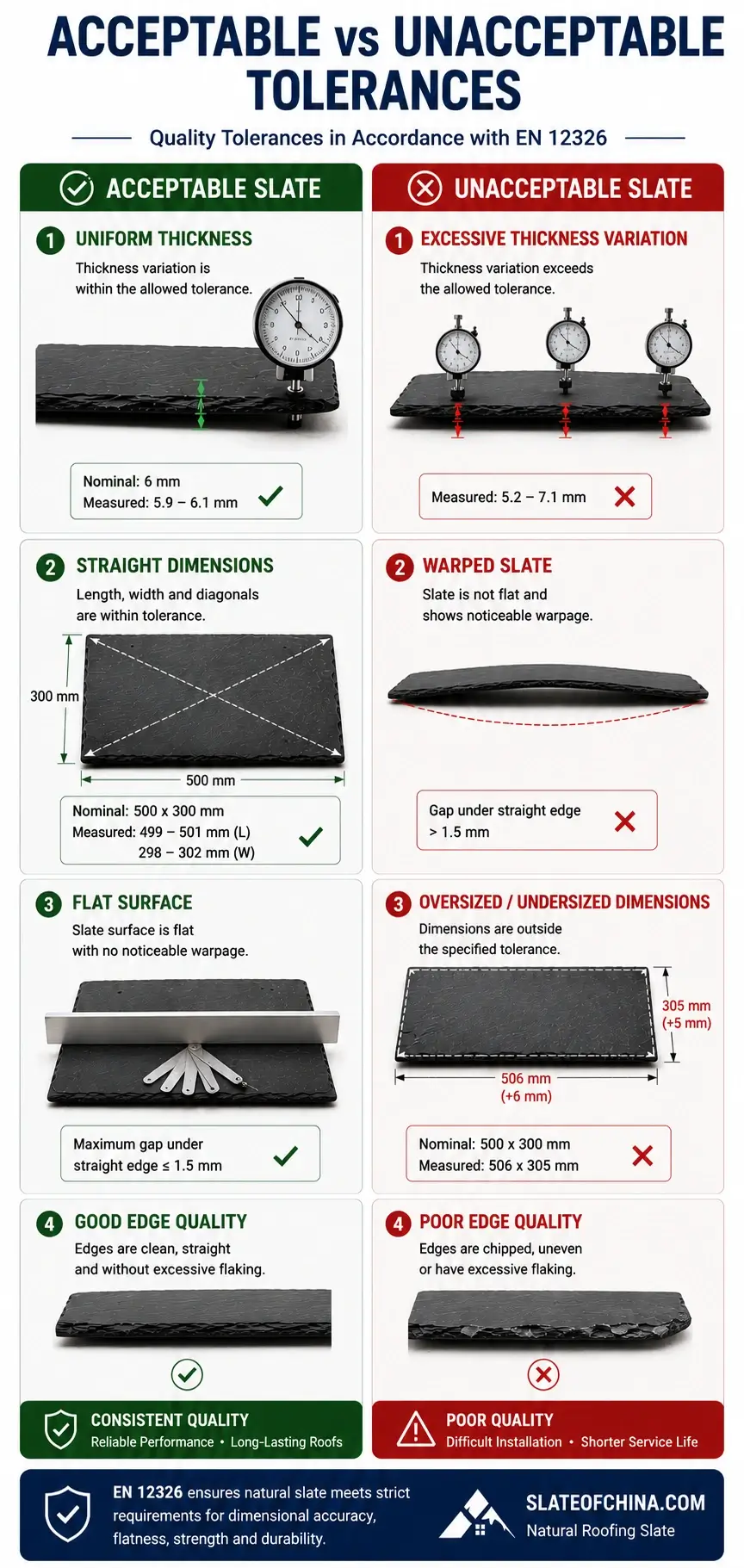
Comparison infographic showing acceptable vs unacceptable roofing slate tolerances, including thickness consistency, dimensional accuracy, flatness and edge quality according to EN 12326 quality standards.

Jiujiang Roofing Slate Size Advantages

Choosing the right roofing slate supplier is just as important as choosing the right slate size.

For importers, distributors, roofing contractors, and architects, a reliable manufacturer should provide more than standard dimensions. Consistent quality, flexible production, stable supply, and export experience all contribute to a successful roofing project.

As one of China’s leading natural roofing slate production regions, Jiujiang Slate has supplied roofing materials to customers across Europe, North America, Australia, and other international markets for many years. Our manufacturing capabilities allow us to produce both standard and custom roofing slate sizes while maintaining consistent quality throughout every order.

Why Many International Buyers Choose Jiujiang Slate

✔ Complete Roofing Slate Size Range

Different countries use different roofing slate standards.

Jiujiang Slate manufactures virtually all commonly used international sizes, including:

  • UK roofing slate sizes
  • European roofing slate sizes
  • Spanish roofing slate sizes
  • French roofing slate sizes
  • German roofing slate sizes
  • Custom project dimensions

Whether you require small slates for historic restoration or large-format slates for contemporary architecture, we can manufacture to your specifications.

✔ Stable Thickness & Dimensional Accuracy

Consistent dimensions are essential for efficient installation and a professional roof finish.

Our production process focuses on:

  • Stable thickness control
  • Accurate cutting
  • Consistent dimensions
  • Controlled flatness
  • Reliable edge quality

This helps roofing contractors reduce sorting time on site and achieve faster, more consistent installation.
✔ Flexible Custom Manufacturing

Every roofing project is different.

We offer custom production for:

  • Slate length
  • Slate width
  • Slate thickness
  • Edge finishes
  • Pre-drilled holes
  • Hook fixing
  • Nail fixing
  • OEM specifications
  • Private-label production

From restoration projects to large commercial developments, our production team can manufacture roofing slates that match your project requirements.

✔ Experienced Export Supplier

International roofing projects require more than quality products.

They also require:

  • Reliable packaging
  • Stable production schedules
  • Export documentation
  • Container loading experience
  • International logistics coordination

With extensive export experience, we understand the requirements of distributors, importers, and roofing suppliers worldwide.

✔ Quality Control Throughout Production

Every production stage is carefully monitored to maintain product consistency.

Our quality control process includes:

  • Raw material selection
  • Precision cutting
  • Thickness inspection
  • Size verification
  • Flatness inspection
  • Final visual inspection
  • Secure export packaging

This systematic approach helps ensure that every shipment meets the agreed project specifications.

✔ Large Production Capacity

For large roofing projects, consistent supply is just as important as consistent quality.

Our manufacturing facilities are capable of producing both standard and custom roofing slates in large volumes, helping customers maintain stable supply for residential, commercial, and restoration projects.

✔ Fast Delivery for Global Markets

Efficient production planning and well-organised export logistics enable us to deliver roofing slate to customers worldwide within agreed production schedules.

Whether shipping full container loads or mixed-size orders, we work to minimise lead times while maintaining product quality.

✔ Products Manufactured to International Standards

Our roofing slates are manufactured under strict quality management procedures and can be supplied to meet applicable project specifications and market requirements, including projects that require compliance with European product standards such as EN 12326 where specified.

At a Glance

AdvantageCustomer Benefit
Complete Size RangeSuitable for UK, European and custom projects
Stable ThicknessFaster installation and better roof appearance
Accurate CuttingConsistent dimensions with reduced on-site sorting
Custom ManufacturingFlexible production for project-specific requirements
Export ExperienceReliable documentation, packaging and logistics
Quality ControlConsistent products across every shipment
Large Production CapacityStable supply for small and large projects
Fast DeliveryEfficient production and worldwide shipping

Why It Matters for Your Project

Selecting a supplier with strong manufacturing capabilities can reduce installation delays, minimise material waste, and improve the overall quality of your roofing project.

Whether you need standard roofing slate sizes, custom dimensions, or technical support for a specific market, Jiujiang Slate provides the production flexibility and quality consistency required by professional roofing contractors and international distributors.

Expert Recommendation

When choosing a roofing slate manufacturer, look beyond the quoted price. Consider whether the supplier can consistently deliver the correct sizes, maintain dimensional accuracy, support custom specifications, and provide dependable export service.

For long-term roofing projects, these factors often have a greater impact on project success than the initial purchase cost.

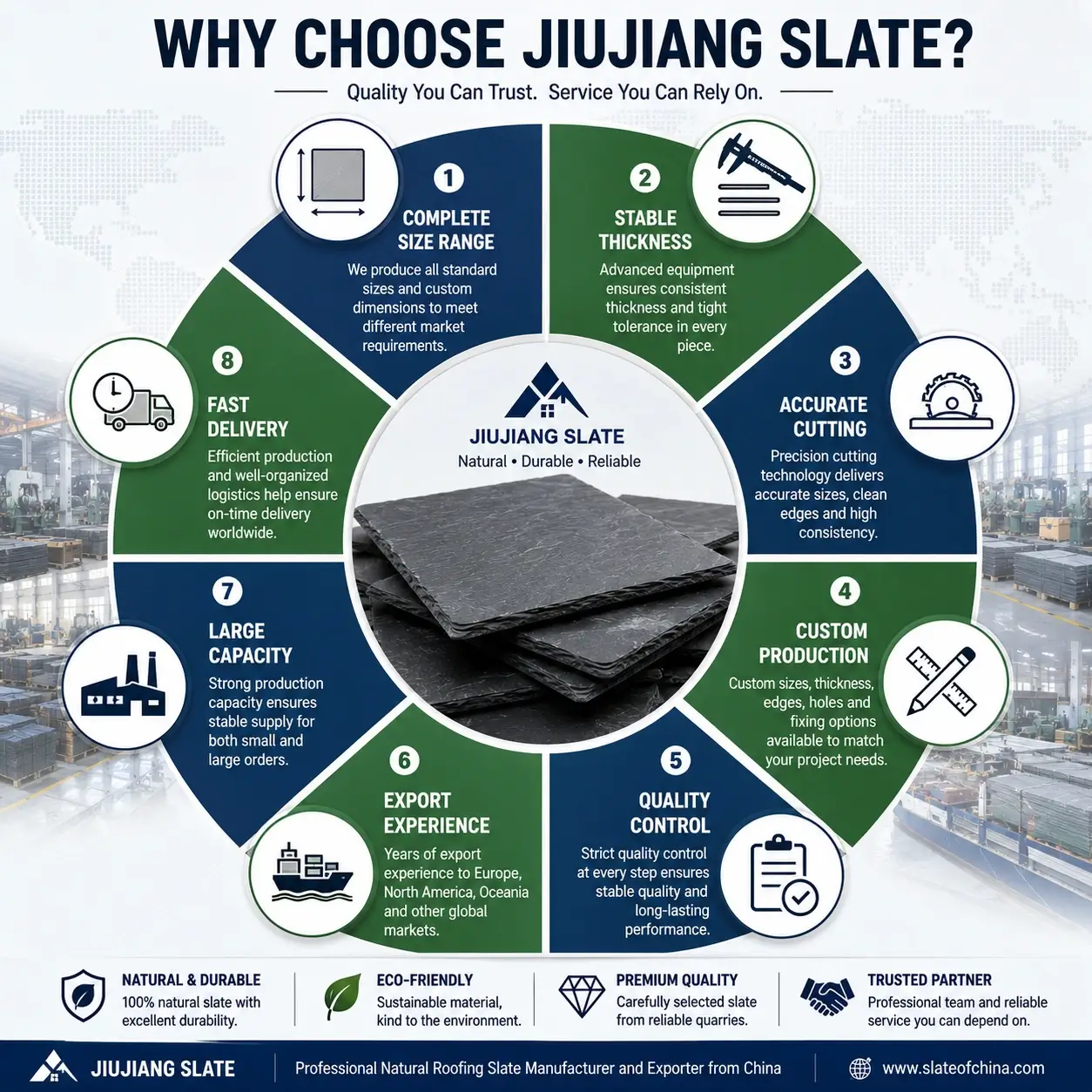
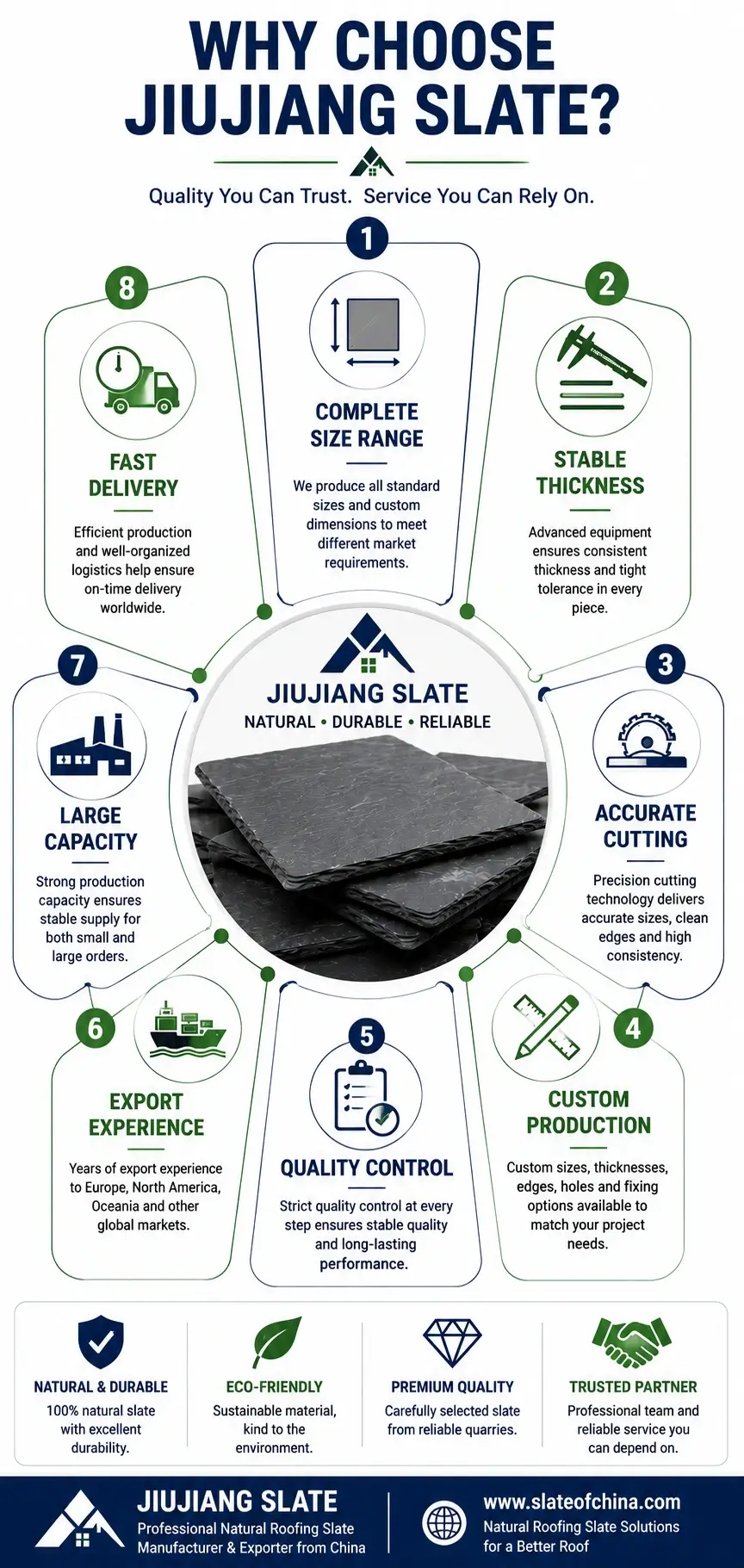
Why choose Jiujiang Slate infographic highlighting complete roofing slate size range, stable thickness, accurate cutting, custom production, quality control, export experience, large production capacity and fast worldwide delivery.
Roofing slate production capacity infographic showing the complete manufacturing process from quarry and factory to cutting lines, quality control, warehouse and container loading for worldwide export.
Worldwide roofing slate supply map showing Jiujiang, China exporting natural roofing slate to the UK, France, Spain, Germany, USA, Canada and Australia.
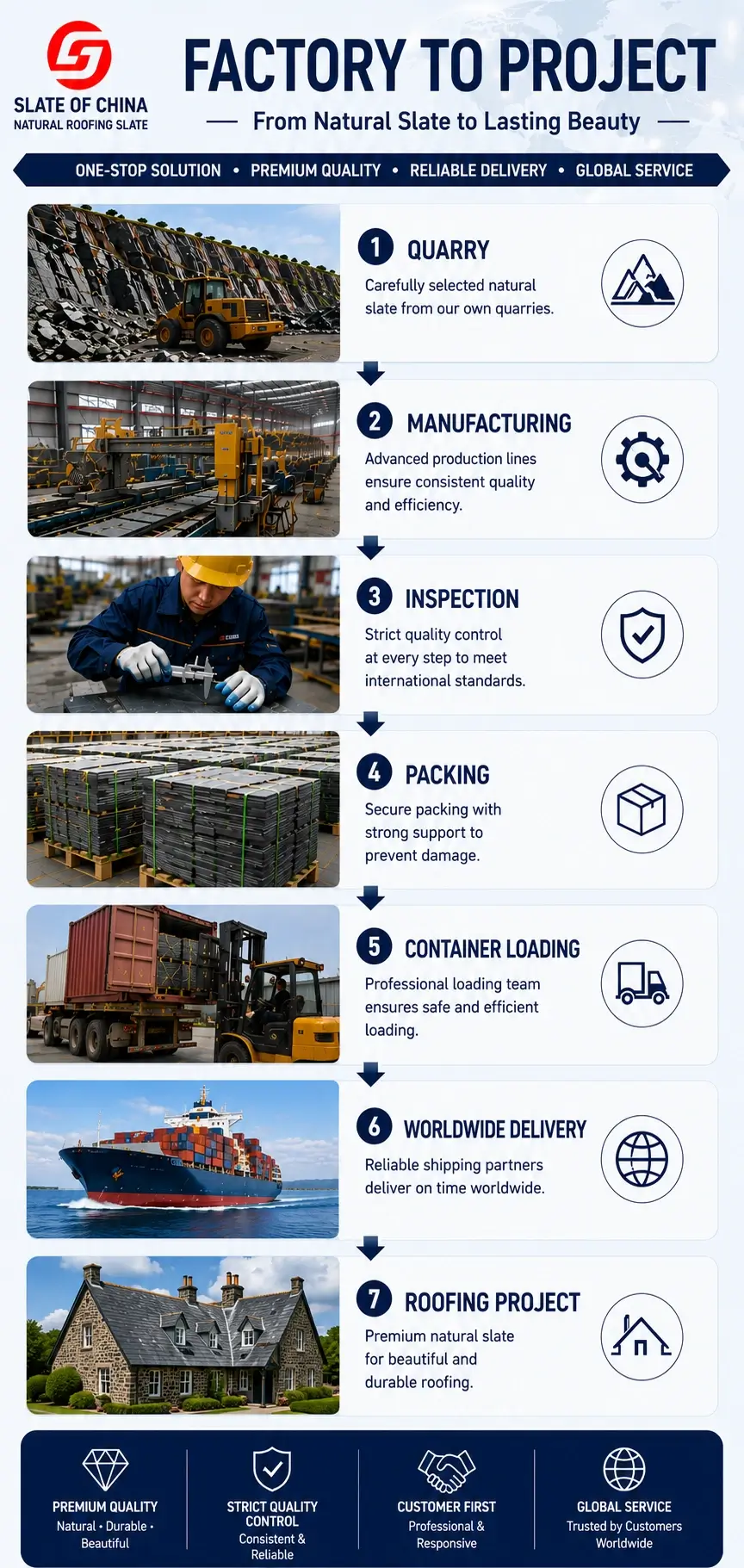
Factory to roofing project infographic showing the complete natural roofing slate manufacturing process from quarry, manufacturing, inspection and packing to container loading, worldwide delivery and final roof installation.
Frequently Asked Questions About Roofing Slate Sizes

Choosing the correct roofing slate size involves more than simply selecting a length and width. Roof pitch, slate thickness, installation method, regional standards, and project requirements all affect the final choice.

Below are answers to the questions most frequently asked by roofing contractors, architects, distributors, and international buyers.

1. What is the most common roofing slate size?

The most commonly used roofing slate size depends on the country and roofing style.

Some of the most popular sizes include:

CountryCommon Roofing Slate Sizes
UK500 × 250 mm, 400 × 250 mm, 600 × 300 mm
France400 × 250 mm, 500 × 300 mm
SpainLarger format slates
GermanyVarious regional sizes

For international projects, 500 × 250 mm remains one of the most widely specified roofing slate sizes.

2. What thickness should roofing slate be?

Natural roofing slate is commonly supplied in thicknesses between 4 mm and 8 mm for residential roofing.

Heavier architectural projects may require thicker slates depending on structural design and local building requirements.

Choosing consistent thickness is just as important as choosing the correct dimensions because it improves installation quality and roof appearance.

3. Which roofing slate size is best for steep roofs?

Smaller roofing slates generally perform well on:

  • Steep roofs
  • Complex roof shapes
  • Historic buildings
  • Roofs with valleys and dormers

Typical choices include:

  • 300 × 200 mm
  • 400 × 250 mm

Smaller slates provide greater flexibility when covering complicated roof geometries.

4. Are larger roofing slates better?

Large-format roofing slates offer several advantages:

  • Faster installation
  • Fewer slates per square metre
  • Reduced labour costs
  • Modern architectural appearance

However, they may require stronger roof structures because of their increased weight.

The best size depends on the project rather than simply choosing the largest slate available.

5. How many roofing slates are needed per square metre?

The number depends on:

  • Slate size
  • Headlap
  • Sidelap
  • Roof pitch

For example:

  • 500 × 250 mm slates typically require approximately 20–22 pieces per m², depending on the specified headlap and installation method.

Always calculate coverage using the effective exposed area rather than the nominal slate dimensions.

6. Can roofing slates be custom made?

Yes.

Professional manufacturers such as Jiujiang Slate can produce custom roofing slate sizes according to customer drawings or project specifications.

Typical custom options include:

  • Length
  • Width
  • Thickness
  • Edge finish
  • Drilled holes
  • Hook fixing
  • Nail fixing
  • OEM branding

Custom production is widely used for restoration projects and architectural designs.

7. Are Chinese roofing slate sizes the same as UK sizes?

Yes.

Chinese manufacturers can produce roofing slates in:

  • UK standard sizes
  • European standard sizes
  • French sizes
  • Spanish sizes
  • German sizes
  • Custom dimensions

Many international roofing slate suppliers manufacture according to customer specifications rather than domestic size standards.

8. Does larger slate reduce installation costs?

Generally, yes.

Because larger slates cover more roof area, installers need fewer pieces per square metre.

This can reduce:

  • Installation time
  • Labour costs
  • Number of fixings

However, roof complexity and installation method also influence the overall project cost.

9. What is the largest roofing slate size available?

Large-format roofing slates are commonly supplied up to:

  • 600 × 400 mm

Many manufacturers can also produce larger custom sizes for architectural projects upon request.

10. Can different roofing slate sizes be mixed on one roof?

Yes.

Mixed slate sizes are frequently used for:

  • Historic restoration
  • Decorative roofing
  • Random slate roofing
  • Heritage buildings

Professional roof design is recommended to maintain proper weatherproofing and visual balance.

11. Are natural roofing slates exactly the same size?

No.

Natural slate is a quarried stone product, so small dimensional variations are normal.

Professional manufacturers maintain controlled roofing slate size tolerances and quality inspections to ensure consistent installation performance.

12. What roofing slate size is best for modern homes?

For contemporary residential projects, popular choices include:

  • 500 × 250 mm
  • 600 × 300 mm
  • 600 × 400 mm

These larger sizes create cleaner roof lines, reduce installation time, and complement modern architectural styles.

13. What roofing slate size is best for heritage buildings?

Historic buildings often require smaller roofing slates to match the original roof design.

Common sizes include:

  • 300 × 200 mm
  • 400 × 250 mm

These formats are especially suitable for steep roofs, irregular layouts, and conservation projects.

14. What standards apply to roofing slate sizes?

Many international roofing projects specify compliance with EN 12326, which covers important characteristics such as dimensions, thickness consistency, water absorption, flexural strength, and durability.

Always confirm the applicable standards and project specifications before ordering roofing slate.

15. How do I choose the right roofing slate size?

The ideal roofing slate size depends on several factors, including:

  • Roof pitch
  • Climate
  • Building style
  • Installation method
  • Budget
  • Local regulations
  • Visual preference

If you are unsure which size is best, consult your roofing contractor or contact an experienced manufacturer who can recommend the most suitable option based on your project requirements.

Expert Buying Tip

When selecting roofing slate, avoid choosing a size based only on appearance or price. Consider the complete roofing system—including roof pitch, slate thickness, coverage, installation method, and project location—to achieve the best long-term performance and value.

Looking for Roofing Slate in Standard or Custom Sizes?

Whether you’re sourcing roofing slate for a residential project, historic restoration, commercial building, or wholesale distribution, choosing the right manufacturer is just as important as selecting the right slate size.

At Jiujiang Slate (Slate of China), we supply high-quality natural roofing slate to customers in more than 100 countries and regions. With decades of manufacturing and export experience, we provide reliable products, consistent quality, and flexible production solutions for projects of every scale.

Why Choose Jiujiang Slate?

✔ Complete range of standard roofing slate sizes

✔ UK, European, and custom dimensions available

✔ Stable thickness and accurate cutting

✔ Natural, sawn, and riven edge options

✔ Nail fixing and hook fixing solutions

✔ OEM & private label manufacturing

✔ Strict quality control throughout production

✔ Fast worldwide delivery and export support

Whether you need a full container of standard roofing slates or a custom-made specification for a unique roofing project, our experienced team is ready to help.

Roofing Slate Sizes Available

We manufacture and export a complete range of natural roofing slate, including:

  • UK Roofing Slate Sizes
  • European Roofing Slate Sizes
  • Spanish Roofing Slate Sizes
  • French Roofing Slate Sizes
  • German Roofing Slate Sizes
  • Custom Roofing Slate Sizes
  • OEM Roofing Slate Production

From 300 × 200 mm to 600 × 400 mm, as well as bespoke dimensions, we can produce roofing slate to meet your exact project requirements.

Request a Free Roofing Slate Quotation

Tell us your project requirements, and our team will recommend the most suitable roofing slate size, thickness, edge finish, and fixing option.
Simply send us:

  • Required slate size
  • Thickness
  • Quantity
  • Edge type
  • Destination country
  • Custom drawings (if applicable)

We will provide:

  • A free quotation
  • Product recommendations
  • Technical advice
  • Packing details
  • Shipping solutions
  • Fast response from our export team

Your Trusted Roofing Slate Manufacturer from China

From raw quarry stone to finished roofing projects, Jiujiang Slate provides a complete manufacturing solution for professional importers, distributors, roofing contractors, and architects around the world.
Whether you require standard roofing slate sizes or fully customised production, we are committed to delivering consistent quality, competitive pricing, and dependable global supply.

Contact us today for a free quotation and expert advice on your next roofing slate project.

Inquiry
Scroll to Top