
Slate Paving vs Concrete vs Porcelain Paving: An Honest Comparison
The day the paving goes down, every material looks good. The difference shows up five, ten or twenty years later. This guide compares slate paving vs concrete vs porcelain paving on the four things that decide how an outdoor surface actually ages: material behaviour, jointing, repairability and whole-life cost. It is written for homeowners, landscape designers and contractors who want a straight answer instead of a sales pitch.
A patio is not bought the way a tile sample is chosen. It is chosen the way a building is built — and the mistakes are usually the same ones. Cheap material alone does not make a cheap patio; the bedding, the joints and the drainage decide most of the cost over time. So before we put slate, concrete and porcelain side by side, it is worth being clear about the difference between a good slab and a good pavement.
1. The Honest Starting Point: A Slab Is Not a Pavement
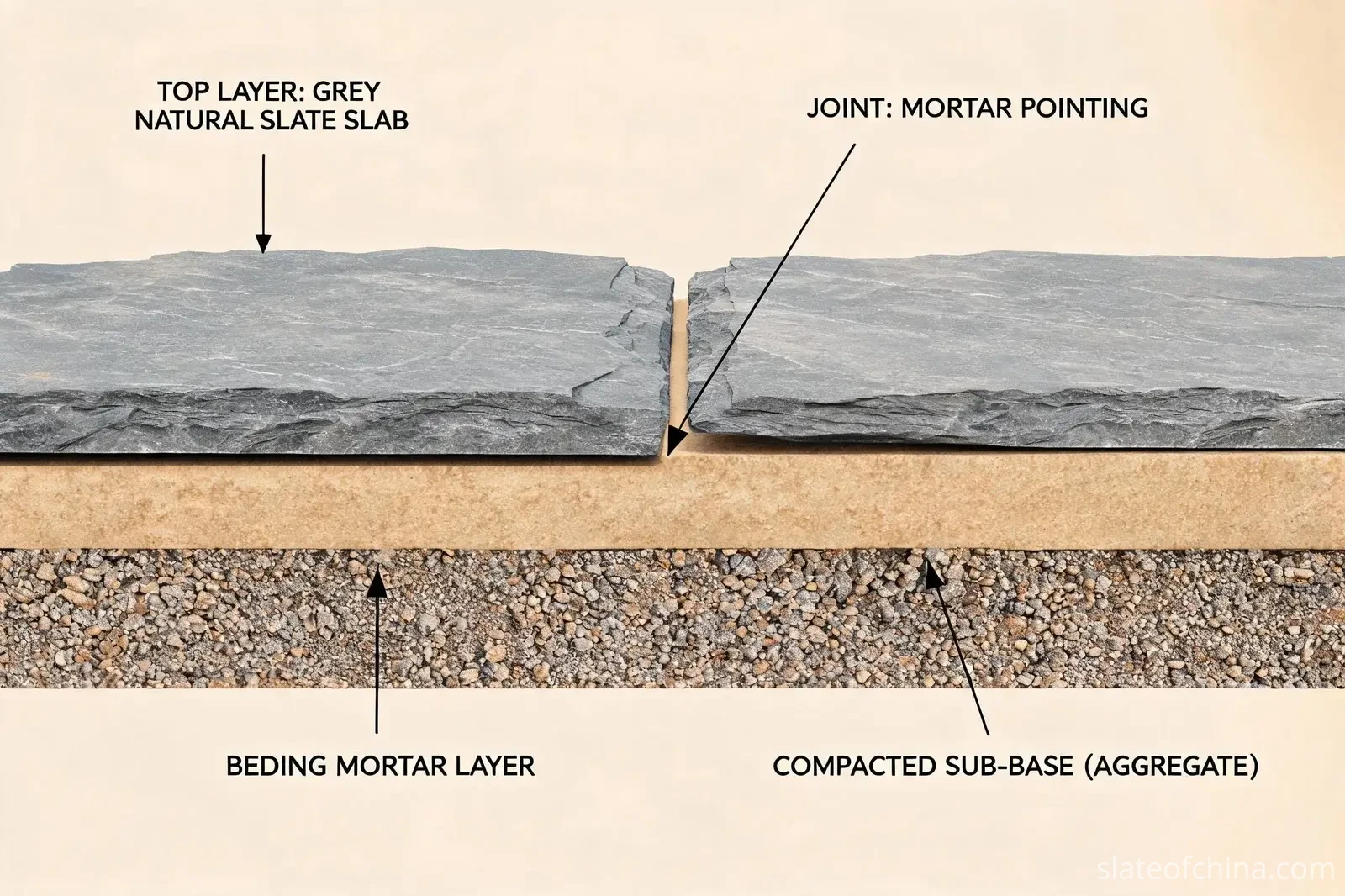
The single biggest mistake in paving is comparing the price of the stone or tile and forgetting everything underneath it. The slab you see is the top of a stack: sub-base, bedding, joints, drainage and sometimes a movement detail. Each layer carries a cost, and each layer has a job.
When people ask "is slate better than concrete or porcelain?", the honest answer begins with what sits beneath the surface — because that is where most failures start, regardless of material. A slate patio that rocks, a porcelain terrace that cracks a slab, a concrete path that settles: in nearly every case the cause is under the slab, not the slab itself.
That is why this guide compares the three materials as paving systems, not as pretty surfaces. And it is also why the same material can be a triumph on one site and a failure on another.
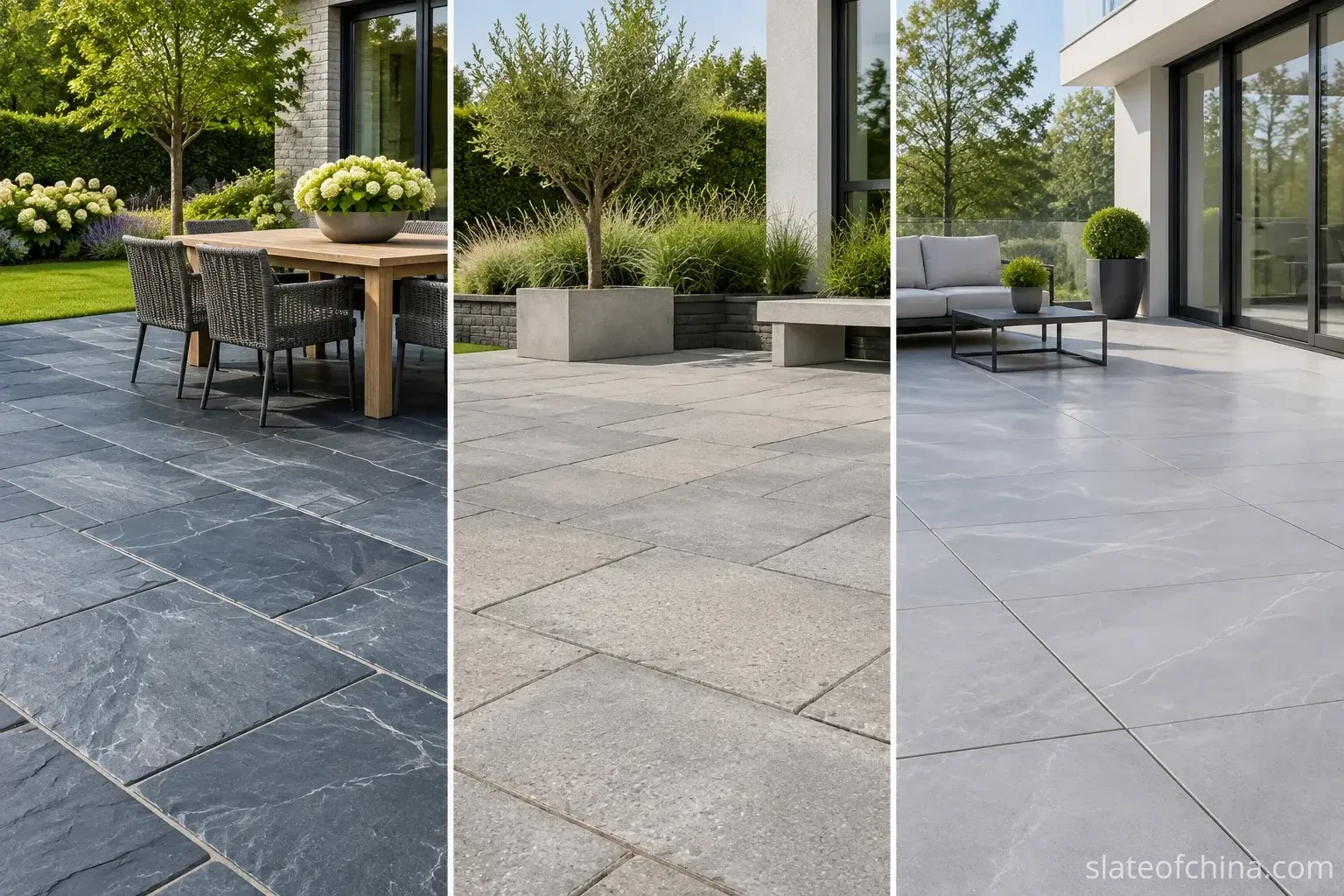
2. The Three Materials in Three Paragraphs
Before comparing behaviour, it helps to know where each material comes from, because that decides what it will and will not forgive.
2.1 Natural Slate Paving
Natural slate is a metamorphic rock that splits cleanly along its bedding planes. That natural character is both its strength and its responsibility. No two riven pieces are identical — colour, texture and even thickness vary within a batch, and a good supplier will sort and grade them before packing. Outdoor paving slate is usually supplied in a riven (natural cleft) finish or a sawn/gauged finish with more regular dimensions.
For paving, the quality of the slate matters more than the name. Different quarries have different water absorption, strength and weathering resistance. The right question to ask is not "is it slate?" but "is this particular slate, tested for this climate, thick enough for this load?"
2.2 Concrete Paving
Concrete paving is cast, not split. That gives it two real advantages: the slab is uniform in dimension and colour, and it is cheap to make in bulk. Concrete slabs and blocks come in a huge range of sizes, finishes and tones, and most contractors have laid them a hundred times.
Its weakness is the concrete itself. It is porous, it can absorb water, and its surface wears and fades with traffic and weather. A good mix and a sealed finish last far longer than a cheap wet-cast slab left to soak. Concrete is a system you buy, not a rock you choose.
2.3 Porcelain Paving
Outdoor porcelain is fired ceramic: very low water absorption, consistent colour, dense and hard. In cleanability and frost behaviour it is the strongest of the three on paper. Modern porcelain also prints surfaces that imitate slate, stone and wood convincingly.
But porcelain is rigid and brittle under point load, and it needs full bedding support — an unsupported corner can crack cleanly. And once a collection is discontinued, matching a replacement panel is the hardest of the three. Porcelain pays back only if the installation quality is high enough to use its strengths.
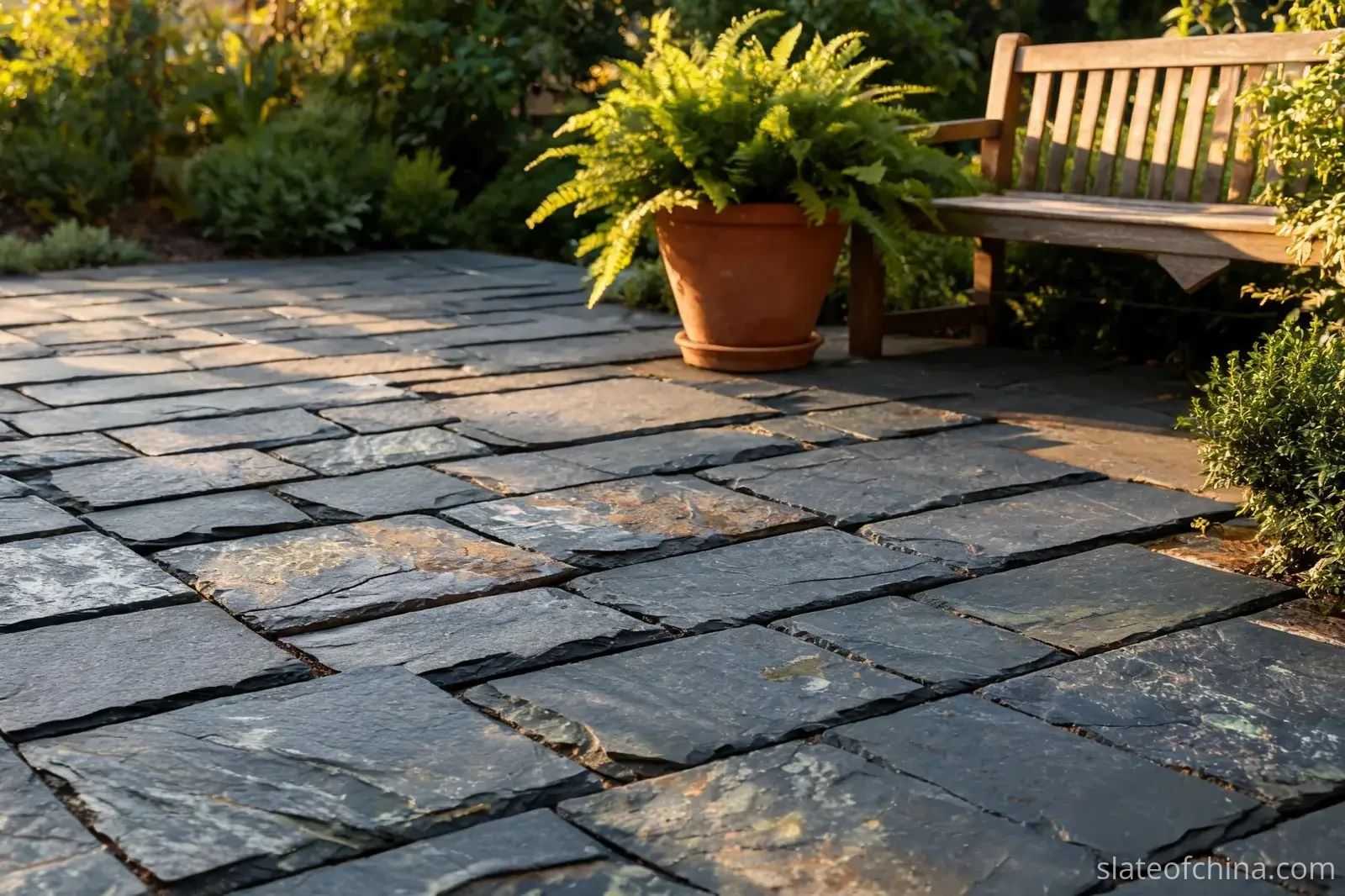
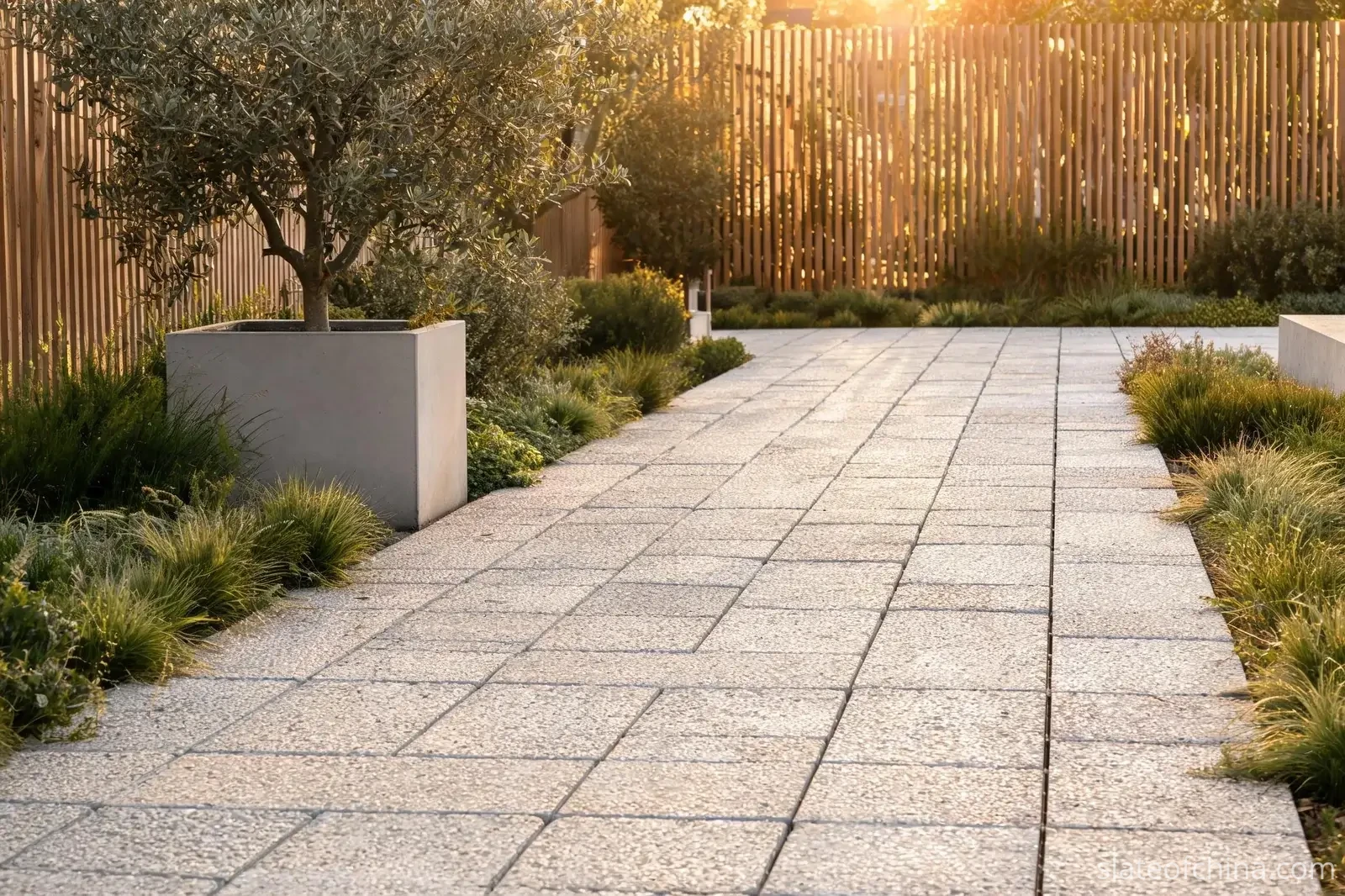
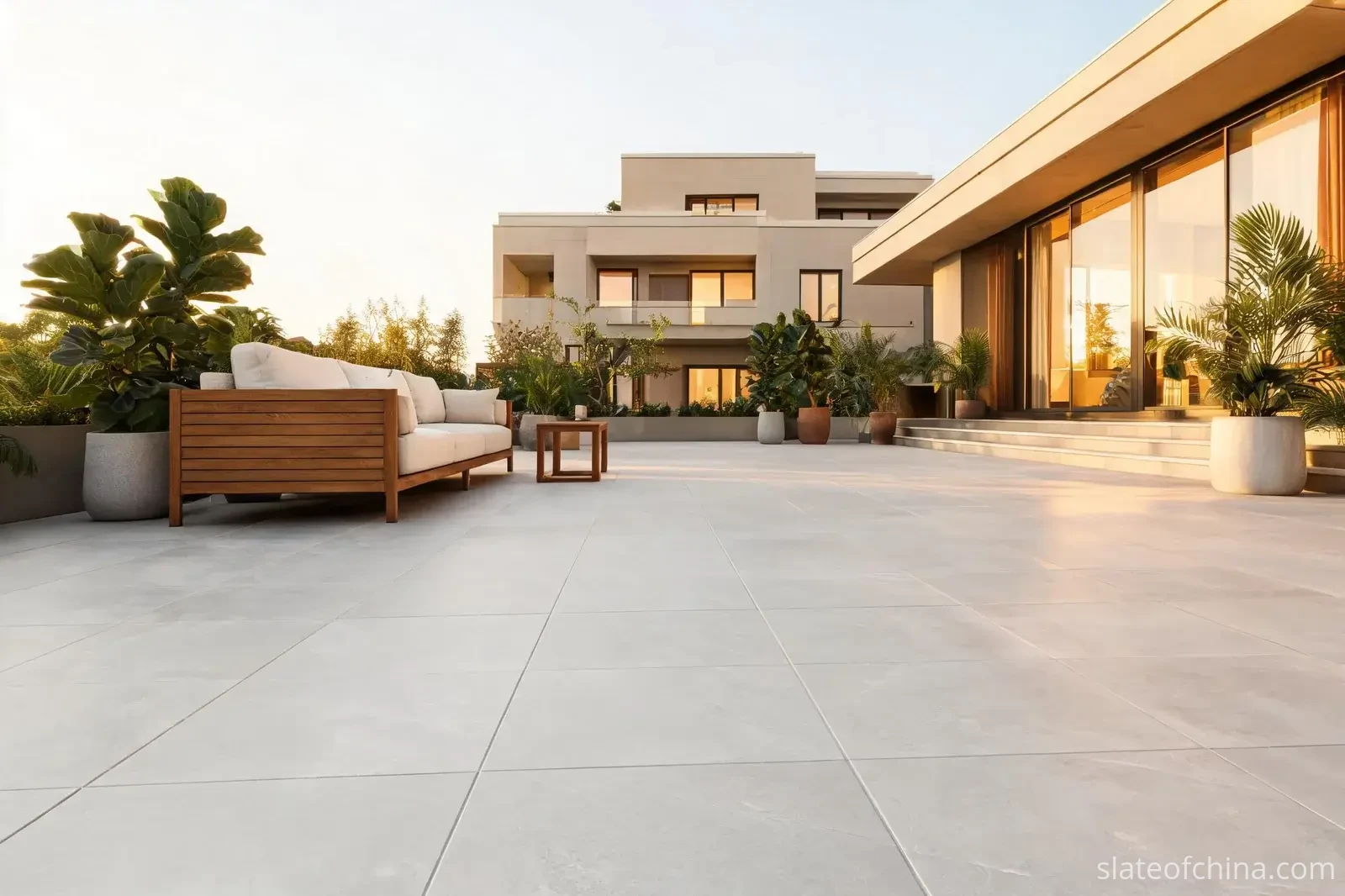
3. Material Behaviour: What Actually Wears, Moves and Holds Water
Behaviour is not appearance. It is how the material responds to water, frost, temperature change and foot traffic over years. For slate, the format and finish basics are set out in our Slate Paving buyer's overview.
3.1 Water and frost
The single most climate-critical property is water absorption. Water that gets in and freezes expands, and repeated freeze-thaw can crack a slab or spall its surface.
- Slate: absorption varies by deposit. A good paving slate has low absorption and resists frost; a poor one soaks water and suffers in a cold winter. The only honest check is a test report for the actual stone — ask for it.
- Concrete: it is porous. Saturation and freeze-thaw can damage a lower-grade slab. A dense, well-cured, sealed finish performs better.
- Porcelain: very low absorption means excellent frost resistance — on paper, the best of the three.
But low absorption is not the same as a watertight surface. Porcelain, too, can crack where water trapped beneath a rigid bed freezes. The material's porosity is one half of the story; the drainage of the whole construction is the other.
Relevant tests for natural slate paving
For professional projects, ask for test documentation rather than accepting general descriptions such as "frost-resistant" or "low-absorption" slate. Depending on the intended application, useful references for natural stone paving include:
- EN 13755 — determination of water absorption at atmospheric pressure.
- EN 12371 — determination of frost resistance.
- EN 12372 — determination of flexural strength under concentrated load.
The actual test requirements should be confirmed against the relevant product specification and intended application.
3.2 Surface wear and slip
A paving surface takes the weather and the shoes. Slate's riven face stays textured when wet — genuinely useful on patios and paths. Concrete can offer brushed or textured faces, and porcelain is available in textured exterior grades. The rule is simple and uncomfortable for a marketing department: a rough-looking surface is not automatically a slip-safe surface. For pool surrounds and public walkways, ask for slip-resistance test results for the actual product, tested wet.
3.3 Thermal movement
Everything expands and contracts with temperature. A pavement that cannot move will crack — and this is a systems question, not a material question. Porcelain's rigid large format needs movement joints and correct coverage. Slate is more tolerant but not immune. The jointing section below is where this actually gets solved.
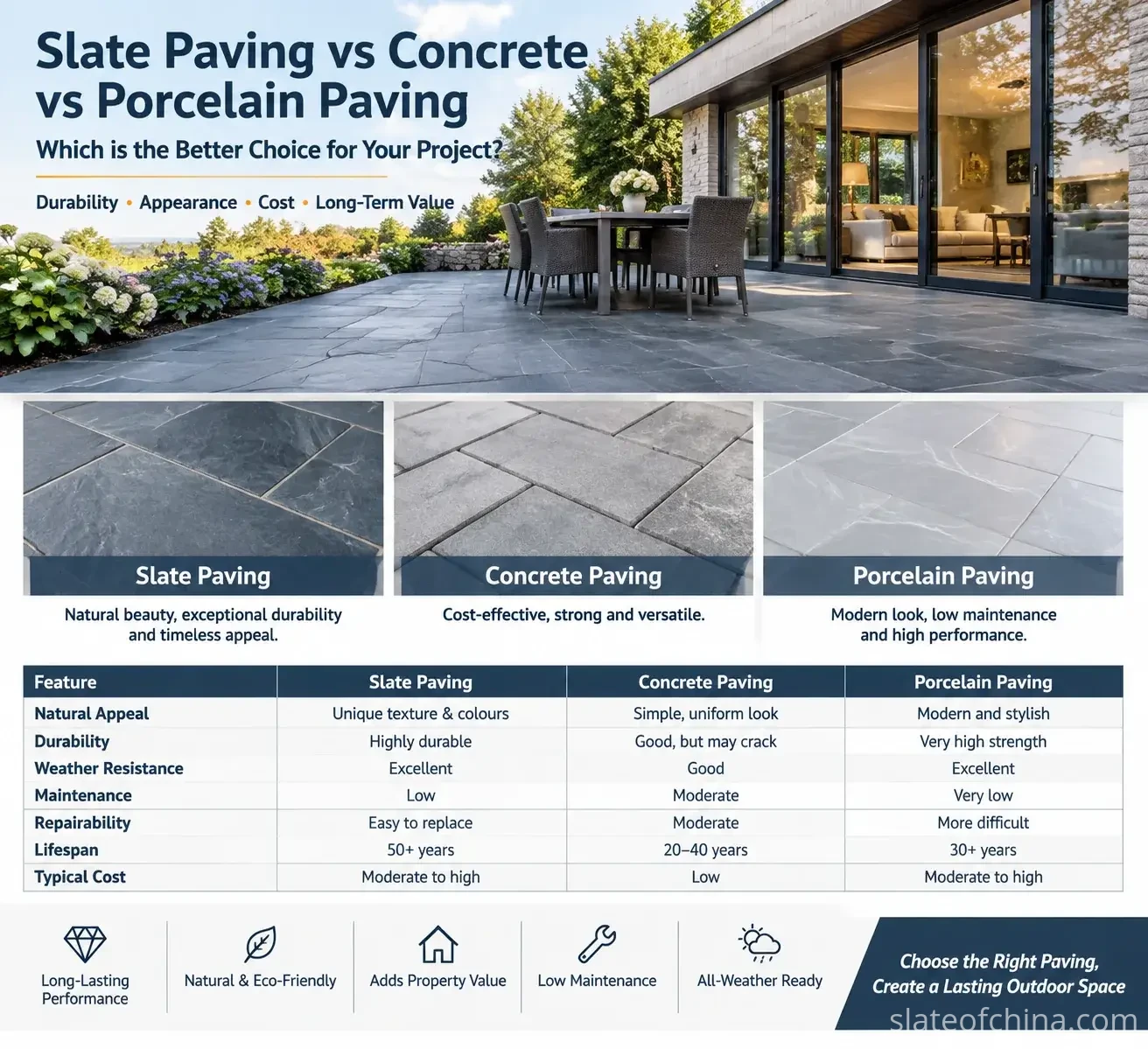
The table below is a first snapshot — actual performance depends on product quality, thickness, finish, installation and climate.
| Natural slate | Concrete paving | Porcelain paving | |
|---|---|---|---|
| Water absorption | Varies by grade and deposit | Generally higher than porcelain | Very low |
| Frost resistance | Product-dependent — see the test report | Product-dependent (mix and saturation) | Generally excellent when correctly specified |
| Appearance | Unique, geological variation | Manufactured, consistent | Manufactured, highly consistent |
| Routine surface care | Low to moderate | Low to moderate | Generally low |
| Individual slab replacement | Possible | Possible | Possible; matching can be harder |
| Initial material cost | Variable by grade and origin | Generally lower | Variable; often higher |
4. Jointing: The Silent Decider
The joint is where a pavement lives or dies. It takes the movement, handles the water, and holds the slabs together. Get the joints wrong and no material — slate, concrete or porcelain — will save you.
4.1 Jointing natural slate
Slate offers a wide range. A mortar pointing is traditional and durable, but must be compatible with the stone (a wrong mortar can stain or discolour it). Resin-based jointing compounds suit some slate. Open, sand or grit-filled joints suit permeable constructions designed to let water through. The choice is decided by the bedding and drainage, not by preference.
4.2 Jointing concrete
Concrete paving is jointed with mortar, with proprietary pointing, or with sand for block paving in a flexible construction. Concrete paving products are often manufactured to relatively consistent dimensions, although tolerances vary by production method and product specification. Natural slate may have greater dimensional variation, particularly in natural riven finishes. Joint widths should therefore be selected according to the actual product dimensions and installation requirements.
4.3 Jointing porcelain
Porcelain is the fussiest of the three. Because porcelain has a dense, low-absorption surface, the jointing compound must be specifically suitable for exterior porcelain paving — conventional products intended for other paving materials should not be assumed to be compatible. Exterior-grade cementitious, porcelain-specific slurry or two-component resin systems are the usual answers, and the panel size and bed need to move jointly. Butt-jointing porcelain is not recommended: a minimum joint is needed to let the surface work. Always follow the paving and jointing manufacturers' recommendations.
Why it matters: a poor joint lets water into a bedding it should not touch, grows weeds, cracks, and shifts the slabs. It is also the most expensive part to repair late. Jointing should be specified as part of the system, not left as an afterthought.
5. Repairability: When a Slab Breaks
Accidents, ground movement and bad luck happen. What matters is what you can do the day after.
5.1 Replacing slate
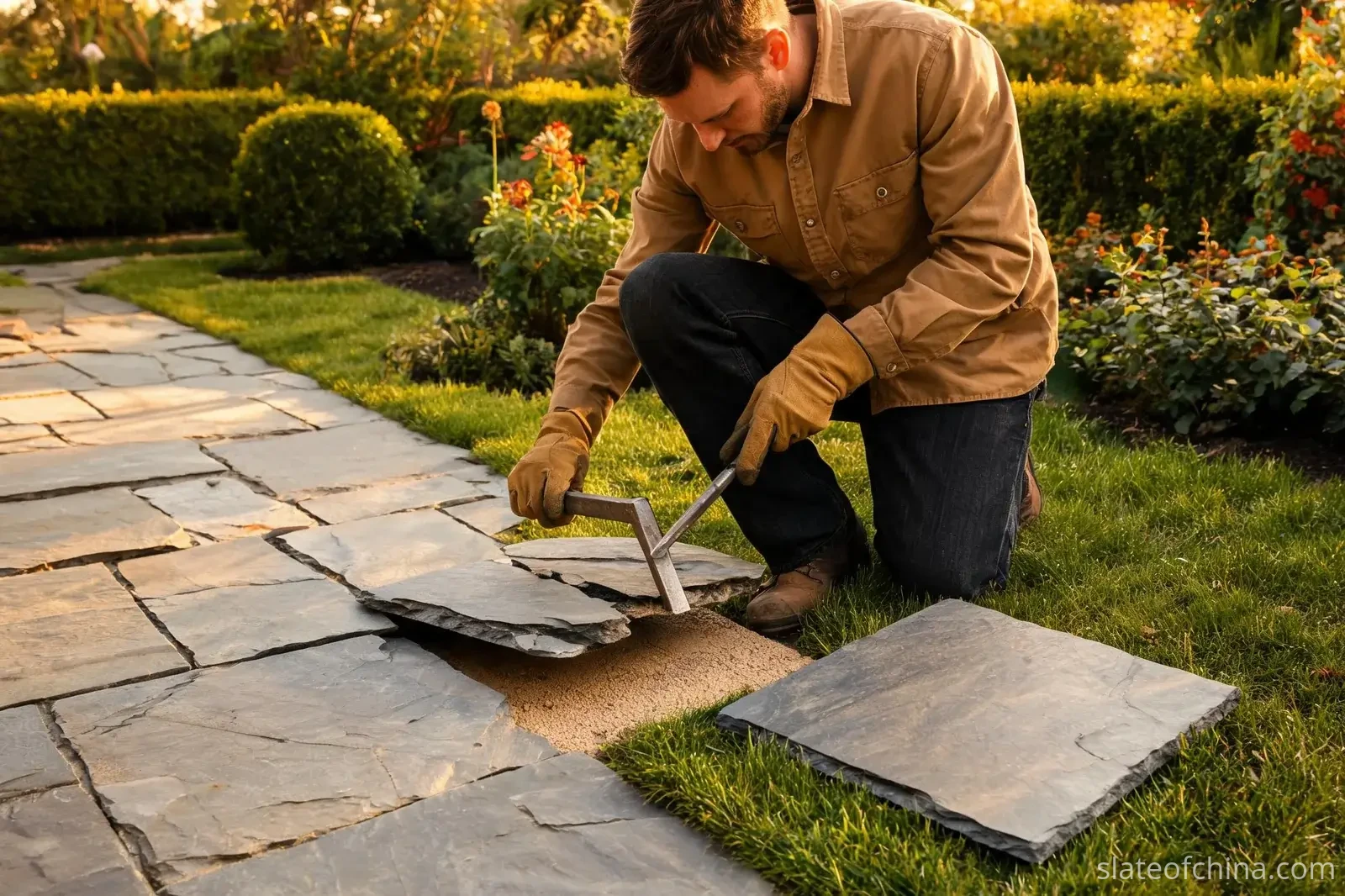
Individual slate slabs can often be replaced without reconstructing the entire paved area, provided the installation system allows access to the damaged unit — a broken slip is cut out, the bed repaired and a replacement laid. The ease of removal depends on the bedding method, the jointing material and the condition of the surrounding slabs. The honest catch: a replacement from a different batch will never match exactly, and a patio that has weathered for years will show a fresh piece. So the practical habit of good paving contracts is to order spare material in the original batch — usually a few percent over.
5.2 Replacing concrete
Concrete slabs and blocks are also replaceable individually. The catch is colour matching: cast concrete fades and weathers, so a new slab will look noticeably new. Standard long-running products help, but not always.
5.3 Replacing porcelain
Porcelain is the hardest to repair well. It is often bonded with strong adhesive on a rigid bed, so removing a broken panel risks your neighbours. And the day it is discontinued, your matching panel becomes an archaeology project. Keep spare stock if you can — and budget for a potentially bigger replacement job than the slab suggests.
6. Whole-Life Cost: The Honest Price
The cheapest slab in the yard is rarely the cheapest pavement. Real cost runs through supply, preparation, bedding, jointing, cleaning, repairs and eventual replacement.
A clear way to see it: whole-life cost = supply + installation + maintenance + repair + replacement, assessed over the same years and the same use. On that basis:
- A budget concrete patio can be genuinely low-cost for a path you want down for a few years.
- Slate rewards projects where character and repairability matter — it is a material that repays good support, and it can be replaced unit by unit.
- Porcelain wins where you want uniform looks and easy cleaning — if the installation is done right and you hold spares.
There is no universal cheapest material. There is only the cheapest one for your site, your climate and your willingness to maintain.
A practical example of whole-life paving cost
Imagine three patios with the same area, similar site conditions and equivalent intended use. The concrete option may have the lowest initial material cost, while slate and porcelain may require a higher initial investment.
However, the final cost depends on more than the purchase price. Installation labour, bedding materials, drainage, maintenance frequency (for slate, see the conditional plan in Sealing and Maintaining Slate Paving), the availability of replacement slabs and the cost of future repairs all influence the result.
A fair comparison calculates the total cost over an agreed period — say 20 or 30 years — using actual local quotations rather than assumed material lifespans.
7. Which Material for Which Job
Here is a rough guide, and it comes with the standing caveat: every recommendation depends on the specific product and the site.
- Garden patio: slate and porcelain both excellent; slate for character and warm natural tone, porcelain for a clean uniform patio. Concrete is the budget option.
- Garden path: slate for texture and soft natural look; concrete for tight budgets and crisp lines; porcelain if you want a precise finish.
- Commercial landscape: depends on loads and access. Concrete is the workhorse; slate suits select schemes where it is properly matched and thick enough; porcelain suits premium terraces with a real bed.
- Driveway: not every slab is for wheels. Use a product verified for vehicle loads — concrete block is a common answer; slate only if the specific stone and thickness are validated.
- Pool surround: the verdict comes from a slip test, wet, of the actual product. Texture is a clue, not a certificate.
8. The Honest Verdict
No material wins every row. Pick the one whose weaknesses you can live with.
- Choose slate if you want genuine natural stone — unique colour, texture and a repairable, characterful surface — and you will verify the stone's performance and install it on a proper bed.
- Choose concrete if budget and a predictable, standard-format surface matter most, and you accept the upkeep.
- Choose porcelain if you want a uniform, low-porosity, easy-clean finish and are ready to pay for a specialist install and spares.
For most outdoor projects the wise question is not "which is the strongest or the cheapest", but "which is the one I will still be happy with in ten years". When the answer is slate, the right step is to source a slate that is tested for your climate and thick enough for the job — and to lay it on a bed that lets it work. That is exactly the kind of information the right supplier will give you.
Frequently Asked Questions
Is slate paving better than concrete paving?
Not always. Slate offers natural colour and texture; concrete is usually cheaper and standardised. Which is better depends on your budget, the look you want, and how you plan to maintain it.
Is slate paving better than porcelain paving?
Neither wins outright. Slate gives genuine stone character and easy unit replacement; porcelain gives uniform colour and very low water absorption. Choose by your design and the site.
Does natural slate crack easily?
Not necessarily. A well-chosen, thick-enough slate on a proper bed performs well. The risk is a poor-grade or thin slab on a bad sub-base — that cracks in any material.
Does slate need sealing?
Not always. Some slate works fine unsealed; others can take an impregnating sealer to reduce staining and moisture. Test on a small area first, and only re-treat on a trigger, not a calendar.
Does porcelain crack in winter?
Porcelain itself is frost-resistant on paper. The failure risk is water trapped beneath a poorly supported rigid slab freezing. The substrate and drainage decide it, not the slab.
Which is the easiest to maintain?
Porcelain is usually easiest to clean because of its low porosity. Slate and concrete can also be easy with a suitable finish and a bit of periodic care.
Can slate be used on a driveway?
Some slate can, if its strength, thickness and the bedding are verified for vehicle loads. Not every patio slate is. Ask for the validation before you specify.
Is natural slate paving expensive?
It varies with the slate: origin, colour, thickness and finish. Compare the full installed and maintained cost, not just the slab price — a well-chosen slate can be economical over a long life.
Related reading
Looking for a slate that will actually last on your project?
Natural slate tested for outdoor use, graded for consistency, and delivered with the technical information you need to specify it properly. We will help you match the grade, thickness and finish to your site.